Can Google Detect AI-Generated Content? SEO Risks and Best Practices
Can Google Detect AI-Generated Content?
As generative AI becomes part of everyday content production, many businesses are asking the same question: can Google tell whether an article was written by a person or generated with AI?
The more useful question is not whether Google can identify the tool used to produce a page. The real issue is whether the final content is useful, original, accurate, trustworthy, and created to satisfy a genuine user need.
AI-assisted content is not automatically prohibited from appearing in Google Search. However, using automation to publish large volumes of unoriginal or low-value pages primarily to manipulate search rankings can violate search spam policies.
This guide explains how Google approaches AI-generated content, which practices create SEO risks, and how businesses can combine AI efficiency with human research, experience, judgment, and editorial control.
Does Google Ban AI-Generated Content?
No. Content is not automatically disqualified simply because AI was involved in its production.
AI tools may support legitimate activities such as:
- Organizing research
- Creating an initial outline
- Generating topic ideas
- Summarizing supplied material
- Improving grammar and readability
- Translating content
- Producing an early draft for human review
The method used to create a page is only one part of the process. What matters to users is whether the published result:
- Answers the question accurately
- Provides useful and relevant information
- Reflects real business knowledge
- Supports important claims
- Avoids misleading statements
- Offers a clear and usable experience
Can Google Identify AI-Written Text?
Search engines use automated systems to evaluate webpages, patterns, links, quality signals, relevance, and possible spam behavior.
However, website owners should not build their content strategy around trying to make AI text “undetectable.”
AI-detection tools and writing-pattern tests can produce inconsistent results. Human writing may be labeled as AI-generated, while heavily edited machine-generated text may appear human.
The safer approach is to concentrate on the quality of the final page rather than attempting to conceal the production method.
Google Does Not Need to Prove That a Page Was Written by AI
A page can perform poorly because it is repetitive, inaccurate, unoriginal, poorly structured, commercially misleading, or unable to satisfy search intent—regardless of whether a human or AI system created it.
Likewise, a useful AI-assisted article may perform well when it contains accurate information, genuine expertise, original value, and a strong user experience.
What Is Scaled Content Abuse?
Scaled content abuse generally involves creating many pages primarily to manipulate search rankings rather than help users.
The problem is not automation by itself. The problem is producing content at scale without meaningful value.
Examples may include:
- Generating thousands of near-identical location pages
- Rewriting other websites without adding original information
- Publishing articles for every minor keyword variation
- Creating pages containing generic answers and aggressive calls to action
- Using automation to fill an expired or repurposed domain with unrelated content
- Producing large quantities of pages that nobody reviews for accuracy
Changing a few words, headings, or examples does not necessarily make substantially similar pages useful or original.
Low-Quality AI Content vs. High-Quality AI-Assisted Content
| Area | Low-quality AI content | High-quality AI-assisted content |
|---|---|---|
| Purpose | Created mainly to target keywords or increase page count | Created to answer a real customer question or business need |
| Research | Relies on unverified generated statements | Uses verified sources, business data, and expert input |
| Original value | Repeats information already available elsewhere | Adds experience, examples, analysis, data, or useful tools |
| Editing | Published directly from the AI output | Reviewed and improved by a responsible human editor |
| Accuracy | Contains unsupported facts, invented details, or outdated information | Important claims are checked against reliable information |
| Brand voice | Generic and interchangeable with competitor content | Reflects the business’s actual products, expertise, and audience |
| Page strategy | One page created for every keyword variation | Related searches are grouped according to intent |
| Measurement | Success measured only by publication volume | Success measured through visibility, engagement, leads, and revenue |
Common Signs of Unedited AI Content
These characteristics do not prove that AI was used, but they often indicate that a draft needs stronger editorial review.
1. Repetitive Introductions and Conclusions
The article repeatedly states that a topic is “important in today’s digital landscape” without providing useful information.
2. Generic Explanations
The page describes concepts broadly but provides no original examples, data, procedures, limitations, or decision-making guidance.
3. Invented Facts or Sources
The content includes statistics, quotations, case studies, laws, product details, or research that cannot be verified.
4. Excessive Heading Fragmentation
The article contains many headings followed by only one or two generic sentences.
5. Formulaic Language
Every section follows the same pattern, tone, sentence length, and conclusion.
6. Unsupported Certainty
The article guarantees rankings, revenue, traffic, results, or outcomes that depend on many external factors.
7. Unnatural Keyword Repetition
The exact target phrase appears in nearly every heading and paragraph even when a synonym would be clearer.
8. Lack of a Defined Audience
The content attempts to speak to beginners, experts, consumers, and enterprise buyers at the same time.
Risks of Publishing Unedited AI Content
1. Factual Errors
Generative AI can produce statements that sound convincing but are incorrect, incomplete, or unsupported.
This risk is especially important for:
- Medical information
- Legal guidance
- Financial information
- Technical specifications
- Current prices
- Regulations and policies
- News and current events
2. Brand Reputation Damage
Publishing inaccurate information can make customers question the reliability of the company’s products, services, and professional advice.
3. Generic and Interchangeable Content
When many companies use similar prompts, they may publish articles with the same structure, examples, and conclusions.
This makes it harder for any page to provide a reason for users to choose it.
4. Copyright and Attribution Risks
Businesses should not assume that all generated output is automatically original or safe to publish.
Editors should review:
- Passages that resemble source material
- Images and media rights
- Quotations
- Data attribution
- Brand names and trademarks
5. Privacy and Confidentiality Risks
Employees should not submit confidential client, employee, financial, product, contract, or system information to an AI tool unless the company’s policies and data-processing terms permit it.
6. Content Overlap
AI-assisted production may create several pages answering substantially the same search intent.
This can make the website harder to manage and create internal competition between URLs.
7. Inconsistent Brand Voice
Generated content may use terminology, tone, promises, or positioning that conflicts with the company’s established communication.
Does AI Content Create Duplicate-Content Penalties?
AI-generated content does not automatically create a duplicate-content penalty.
However, substantially similar pages can still create problems, including:
- Unclear page targeting
- Several URLs competing for the same search intent
- Weak user experience
- Wasted crawling and editorial resources
- Difficulty choosing the preferred page
If several pages serve the same purpose, consider consolidating them, differentiating their intent, or redirecting obsolete versions.
How E-E-A-T Relates to AI-Assisted Content
E-E-A-T refers to Experience, Expertise, Authoritativeness, and Trustworthiness.
It is useful as a framework for reviewing whether content deserves user confidence.
Experience
Does the article demonstrate direct familiarity with the product, service, process, location, or problem?
Experience may be shown through:
- Original photographs
- Project examples
- Testing notes
- Customer scenarios
- Implementation lessons
Expertise
Is the content created or reviewed by someone who understands the subject?
For specialist topics, include appropriate technical or professional review.
Authoritativeness
Does the website or author have a credible relationship to the topic?
Relevant signals may include:
- Industry recognition
- Professional experience
- Original research
- Reliable references
- Useful contributions to the field
Trustworthiness
Can users understand who produced the content, why it exists, and how important claims were supported?
Trust may be improved through:
- Accurate author information
- Clear company contact details
- Sources and references
- Visible correction practices
- Transparent commercial relationships
- Secure website operation
Adding an author biography alone does not make weak information trustworthy. The page itself must demonstrate accuracy and responsibility.
How to Use AI Responsibly for SEO Content
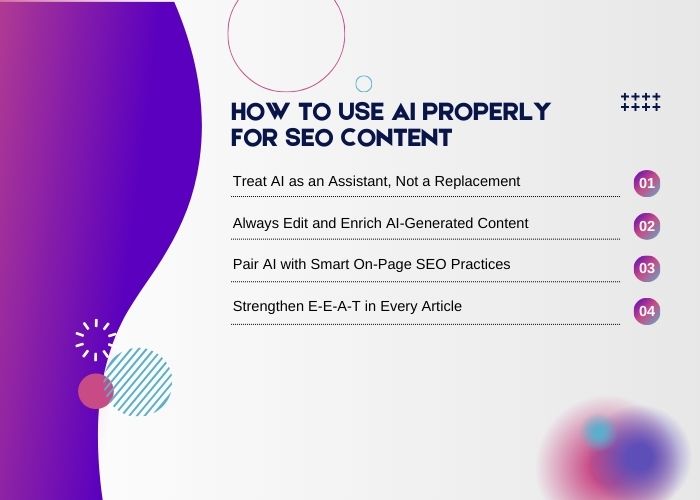
Step 1: Define the Content Purpose
Before generating anything, specify:
- The target audience
- The user’s problem
- The primary search intent
- The desired page type
- The business objective
- The action users should take next
Step 2: Collect Reliable Input Material
Provide the AI system with appropriate source material, such as:
- Product specifications
- Company policies
- Interview notes
- Existing research
- Customer questions
- Official documentation
- Approved brand guidelines
Do not expect an AI system to know confidential or highly specific business facts that were never supplied.
Step 3: Use AI for Appropriate Tasks
AI may be useful for:
- Topic ideation
- Content outlines
- Question grouping
- Drafting alternatives
- Summarizing supplied documents
- Reformatting information
- Grammar improvement
Step 4: Verify Every Important Claim
Check:
- Names
- Dates
- Statistics
- Quotations
- Prices
- Technical requirements
- Legal or medical statements
- Product specifications
- Source links
Step 5: Add Original Human Value
Improve the draft with information that generic AI output cannot provide easily:
- Firsthand observations
- Company data
- Customer examples
- Professional judgment
- Original images
- Implementation details
- Known limitations
- Lessons learned
Step 6: Edit for Clarity and Brand Voice
Remove:
- Repetitive introductions
- Empty promotional language
- Unsupported superlatives
- Unnecessary sections
- Robotic transitions
- Repeated conclusions
Step 7: Optimize the Entire Page
Review:
- Search intent
- Title tag
- Meta description
- H1–H3 structure
- Internal links
- Images and ALT text
- URL
- Mobile experience
- Indexing
- Conversion tracking
Step 8: Perform Final Human Approval
A responsible person should approve the final page before publication, particularly when it contains professional advice, business claims, customer information, or time-sensitive facts.
Do AI-Assisted Articles Need to Be Long?
No fixed word count guarantees quality or rankings.
An article should be long enough to satisfy the search intent and explain the relevant information clearly.
Some topics need a concise answer. Others require:
- Detailed procedures
- Examples
- Comparisons
- Evidence
- Technical limitations
- Frequently asked questions
Adding generic paragraphs solely to reach 1,500 or 3,000 words can reduce usefulness.
Should Businesses Disclose the Use of AI?
Not every use of spelling correction, translation, outlining, or drafting requires a prominent disclosure.
Disclosure may be appropriate when it helps users understand:
- How the content was produced
- Whether a person reviewed it
- Whether an image or voice is synthetic
- Whether the content could be mistaken for a real event or person
- Who is responsible for factual accuracy
The appropriate level of disclosure depends on the content type, audience, industry, legal requirements, and potential for misunderstanding.
How to Choose AI Tools for Content Production
AI platforms change frequently, so businesses should evaluate tools according to their requirements rather than relying on a permanent “best tools” list.
| Evaluation area | Questions to ask |
|---|---|
| Data privacy | How is submitted data stored, processed, and used? |
| Source support | Can the tool work from supplied documents or provide verifiable references? |
| Editorial control | Can teams review, revise, approve, and maintain version history? |
| Brand consistency | Can the tool follow approved terminology and style guidance? |
| Language quality | Does it produce reliable output in the required languages? |
| Integration | Can it work safely with the company’s CMS and editorial process? |
| Cost | Does the value justify subscriptions, training, and review time? |
| Human oversight | Does the workflow make final human review mandatory? |
Recommended AI and Human Content Workflow
- Define the audience, search intent, and business objective.
- Gather reliable internal and external source material.
- Create a content brief and assign the page to an appropriate URL.
- Use AI to propose an outline or organize supplied information.
- Create a first draft.
- Verify facts, data, quotations, and product information.
- Add original expertise, examples, images, and business context.
- Edit for clarity, tone, structure, and accuracy.
- Review title, metadata, headings, links, images, and indexing.
- Complete legal, technical, or professional review where required.
- Publish and monitor search and conversion performance.
- Update the page when information or user needs change.
How to Measure AI-Assisted Content Performance
Do not measure success only by the number of articles published.
Search Performance
- Organic impressions
- Organic clicks
- Relevant queries
- Priority landing-page visibility
- Indexed URLs
User Behavior
- Landing-page engagement
- Internal-link clicks
- Downloads
- Form interactions
- Return visits
Business Outcomes
- Qualified leads
- Bookings
- Orders
- Revenue
- Lead quality
- Assisted conversions
Content-Quality Indicators
- Correction requests
- Customer feedback
- Expert review outcomes
- Content overlap
- Unsupported-claim findings
- Time required for editorial correction
AI Content Quality Checklist
| Area | Question before publishing |
|---|---|
| Purpose | Does the page address a real user and business need? |
| Search intent | Is this the correct page type for the query? |
| Accuracy | Have important facts, dates, data, and claims been verified? |
| Original value | Does the page add experience, examples, data, or analysis? |
| Sources | Are important claims supported by reliable references? |
| Brand voice | Does the content sound consistent with the company? |
| Privacy | Was confidential or personal information handled appropriately? |
| Copyright | Have quotations, images, and source material been reviewed? |
| Structure | Are headings and sections logical and easy to scan? |
| Duplication | Does another page already satisfy the same search intent? |
| Human review | Has a responsible editor approved the final page? |
| Indexing | Can search engines crawl and index the page? |
| Conversion | Does the page provide a relevant next step? |
Frequently Asked Questions
Does Google penalize AI-generated content?
Google does not automatically penalize content because AI was used. The risk arises when automation is used to create large amounts of unoriginal or low-value content primarily to manipulate search rankings.
Can Google tell if ChatGPT wrote an article?
Search engines can evaluate content quality and spam patterns, but businesses should not focus on making AI text undetectable. The final page should be accurate, useful, original, and reviewed by a responsible person.
Can AI-generated content rank on Google?
AI-assisted content can appear in search results when it satisfies user needs and meets relevant quality and technical requirements. The use of AI does not guarantee or prevent rankings.
Is AI content considered duplicate content?
Not automatically. Duplication becomes a concern when pages substantially repeat other content or when several URLs on the same website target the same search intent without providing distinct value.
Does every AI article need human editing?
Content representing a business should be reviewed for accuracy, relevance, tone, privacy, copyright, and brand consistency. The level of specialist review should reflect the subject and potential harm from errors.
Does AI-generated content need a disclosure?
Disclosure may be appropriate when users need to understand how the content was created, whether a human reviewed it, or whether synthetic media could be mistaken for a real person or event.
How long should an AI-assisted SEO article be?
There is no required word count. The page should be long enough to satisfy the search intent without adding repetitive content solely to reach a length target.
What is the biggest risk of AI content?
The largest risk is publishing confident-sounding but inaccurate, generic, unsupported, or commercially misleading information without proper human review.
Conclusion
Google does not need to classify every webpage as “human-written” or “AI-written” to evaluate whether it is useful.
The most important distinction is between content created responsibly to help users and content generated primarily to manipulate search visibility at scale.
AI can improve productivity by helping teams organize research, create outlines, produce drafts, translate information, and complete repetitive editorial work. It should not replace factual verification, professional judgment, original experience, privacy controls, or final human responsibility.
Businesses should use AI as one part of a documented content process. Every important page should have a clear purpose, reliable inputs, original value, appropriate expert review, and measurable business outcomes.
When AI efficiency is combined with human experience, research, editing, and accountability, it can support content that is useful to readers and suitable for long-term SEO development.



Questions & Comments
You can ask a question about this article. Viet SEO will review and reply after moderation.