Professional Website Maintenance Services
Professional Website Maintenance Services
Viet SEO provides website maintenance for businesses that need ongoing technical support, updates, backups and monitoring. We review the website and agree on a practical scope to help reduce operational risk and keep information current.
Services can be adapted for corporate, content, multilingual and e-commerce websites, including WordPress, WooCommerce, Laravel and custom PHP systems, subject to an initial review.
Website Maintenance Pricing and Packages
Website maintenance pricing depends on the website platform, size, complexity, update frequency, security requirements, support expectations, and included services.
Monthly reference prices: choose an initial scope below. The final proposal confirms the work limits and support terms after a technical review.
Basic Maintenance
From 1,500,000 VND per month
- Suitable For
- Small corporate or personal websites
- Typical Services
- Routine software updates, uptime checks, security review, and scheduled backups
Standard Maintenance
From 3,000,000 VND per month
- Suitable For
- Growing business and content websites
- Typical Services
- Software updates, daily backups, routine performance checks, basic SEO health checks, and monthly reporting
Premium Maintenance
From 5,000,000 VND per month
- Suitable For
- E-commerce, business-critical, or more complex websites
- Typical Services
- Expanded monitoring, security support, performance reviews, priority assistance, and agreed UX or SEO tasks
Custom Maintenance
Quotation required
- Suitable For
- Custom applications, enterprise systems, or multiple websites
- Typical Services
- Scope based on platform, support requirements, infrastructure, and business risk
Reference prices exclude VAT unless otherwise stated. Final pricing is confirmed after reviewing the website and required scope.
Confirm before starting: websites covered, included hours or requests, update schedule, backup storage and retention, restoration testing, support hours, response targets and reporting. A response target is distinct from a restoration deadline.
Separate recurring maintenance from hosting, domains, paid SSL, licenses, backup-storage charges and emergency work. The quotation should identify which costs are included and how extra work is approved and billed.
Factors Affecting Website Maintenance Cost
- Website platform
- Number of websites
- Website size and traffic
- E-commerce or payment functions
- Custom code and integrations
- Required backup frequency
- Security and monitoring requirements
- Included support hours
- Response-time requirements
- Content-update volume
- Hosting and server responsibilities
Work That May Require a Separate Quotation
- New features or modules
- Major design changes
- Website migration
- Malware cleanup on an already compromised website
- Emergency data recovery
- Server migration or reconfiguration
- Large content-entry projects
- Third-party software licenses
- Advanced SEO campaigns
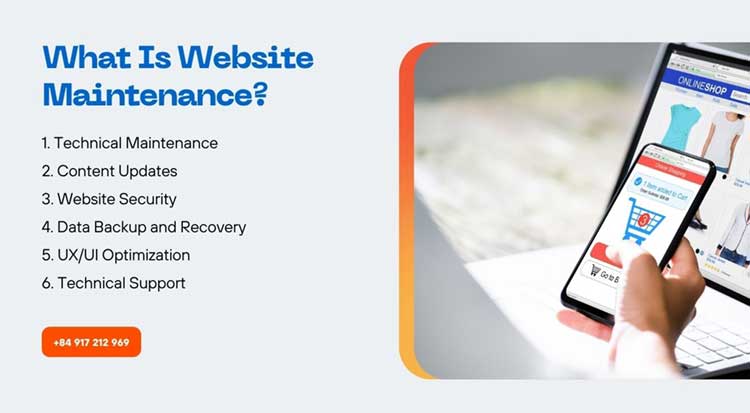
What Is Website Maintenance?
Website maintenance is the ongoing process of reviewing, updating, protecting, and improving a website after it has been launched.
Depending on the website and service agreement, maintenance may include:
- Software and plugin updates
- Bug fixes
- Website backups
- Security monitoring
- Performance optimization
- Content updates
- Uptime checks
- Technical support
- SEO health checks
- User-experience improvements
The purpose is not only to respond when something breaks. Effective maintenance also aims to reduce risk, identify emerging issues, and keep the website aligned with changing business and technical requirements.
What Does Website Maintenance Include?
1. Technical Maintenance
Websites depend on software, code, databases, servers, themes, plugins, APIs, and third-party services. These components can become outdated or incompatible over time.
Technical maintenance may include:
- Diagnosing website errors
- Fixing broken pages, forms, or functions
- Updating content management systems
- Updating plugins, themes, libraries, and frameworks
- Reviewing third-party integrations
- Resolving browser or device display issues
- Managing redirects and broken links
- Reviewing server and database behavior
Updates should be tested carefully because a new software version may occasionally create compatibility problems with existing code or extensions.
2. Website Performance Maintenance
Website performance can decline as content, plugins, scripts, products, and database records accumulate.
Performance maintenance may include:
- Image compression and resizing
- Cache configuration
- Database cleanup and optimization
- CSS and JavaScript review
- Plugin and extension review
- Server-response analysis
- Content delivery network configuration
- Core Web Vitals monitoring
Performance results depend on the website architecture, hosting environment, third-party services, content volume, and user devices.
3. Content Updates
Outdated or inaccurate information can create confusion and weaken customer confidence.
Content maintenance may include:
- Updating company information
- Adding or editing service pages
- Updating product details and prices
- Publishing articles or announcements
- Replacing banners and promotional materials
- Updating contact information
- Correcting formatting or content errors
- Removing outdated offers or unavailable products
The amount of included content work should be defined clearly in the maintenance agreement.
4. Website Security Maintenance
Website security is an ongoing risk-management process. No provider can guarantee that a website will never be attacked or compromised.
Security maintenance may include:
- Applying software and security patches
- Monitoring suspicious activity
- Scanning for malware
- Reviewing user accounts and access permissions
- Strengthening login security
- Configuring firewalls and security tools
- Reviewing SSL and HTTPS configuration
- Reducing spam and automated abuse
- Removing unused plugins, themes, or accounts
Security responsibilities may be shared between the website owner, maintenance provider, hosting provider, software vendors, and third-party services.
5. Backup and Recovery
Backups help reduce the impact of data loss, failed updates, server problems, accidental deletion, or security incidents.
A backup plan may include:
- Website-file backups
- Database backups
- Automated backup schedules
- Off-site or remote storage
- Retention policies
- Periodic restoration testing
- Documented recovery procedures
The backup schedule should reflect how frequently website data changes. Confirm files and database coverage, retention, storage location, access and restoration testing. Recovery depends on the condition and age of the available clean backup; recent changes after that backup may not be recoverable.
For example:
- A small corporate website may require less frequent backups.
- An e-commerce website processing daily orders may require more frequent database backups.
6. Uptime and Availability Monitoring
Monitoring tools can check whether the website is responding and alert the technical team when an outage is detected.
Monitoring may include:
- Homepage availability
- Important landing pages
- Checkout or login functions
- SSL-certificate expiry
- Domain expiry
- Server-resource usage
- Scheduled-job failures
Monitoring helps identify outages more quickly, but it does not guarantee uninterrupted availability. Hosting, networks, third-party services, and external incidents can still affect uptime.
7. UX and UI Improvements
User expectations and business requirements can change after a website launches.
Maintenance may therefore include minor user-experience improvements such as:
- Improving navigation
- Adjusting mobile layouts
- Improving form usability
- Clarifying calls to action
- Correcting spacing or typography issues
- Improving checkout or inquiry flows
- Updating accessibility elements
Major redesigns, new interfaces, or extensive conversion projects may require a separate quotation.
8. Technical Support
Technical support helps businesses resolve operational problems and use their websites more effectively.
Support may cover:
- Website errors
- Content management questions
- Plugin or extension issues
- Domain and DNS configuration
- Hosting and server coordination
- Email configuration
- Analytics and tracking issues
- Third-party integration problems
Support channels, working hours, response targets and emergency procedures should be stated in the service agreement. Automated monitoring does not imply continuous staffing or guaranteed recovery within a fixed time.
Why Do Businesses Need Website Maintenance?
Business continuity
Forms, checkout, bookings and account functions need routine checks to help identify problems affecting customers.
Data and recovery
Access controls, suitable backups and restoration checks support recovery planning when errors or incidents occur.
Performance and accuracy
Review growing media, scripts and data alongside prices, products, policies and contact information.
Search and future changes
Maintain working links, accessible pages and mobile usability. Broader SEO campaigns and new features require their own scope.
Benefits of Regular Website Maintenance
Software updates
- Potential Business Benefit
- Reduced compatibility and security risk
Backups
- Potential Business Benefit
- Improved recovery options after data loss or failed updates
Performance optimization
- Potential Business Benefit
- Faster and more stable user experiences
Content updates
- Potential Business Benefit
- More accurate information and stronger customer confidence
Security monitoring
- Potential Business Benefit
- Earlier detection of suspicious activity
Technical support
- Potential Business Benefit
- Faster access to help when operational issues occur
SEO health checks
- Potential Business Benefit
- Reduced risk of unnoticed indexing, link, or metadata problems
Website Maintenance by Platform
WordPress Maintenance
WordPress maintenance may include:
- WordPress core updates
- Plugin and theme updates
- Backup management
- Security review
- Database optimization
- WooCommerce updates
- Plugin-conflict troubleshooting
WooCommerce Maintenance
E-commerce maintenance may also cover:
- Checkout testing
- Payment-gateway checks
- Order-email testing
- Product and inventory issues
- Shipping configuration
- Customer-account functions
- Database and performance monitoring
Laravel and Custom PHP Maintenance
Custom application maintenance may include:
- PHP and framework compatibility
- Dependency updates
- Database queries
- API integrations
- Scheduled tasks
- Authentication and permissions
- Application logs
- Custom-feature troubleshooting
Server and Hosting Maintenance
Where included in the service agreement, server-related work may cover:
- Hosting configuration
- SSL renewal
- DNS records
- Server-resource monitoring
- Web server and PHP configuration
- Database services
- Backup automation
- Security and firewall configuration
Hosting and server administration may be quoted separately from website-level maintenance.
Preventive vs. Reactive Website Maintenance
Timing
- Preventive Maintenance
- Performed regularly before a major issue occurs
- Reactive Maintenance
- Performed after a problem becomes visible
Examples
- Preventive Maintenance
- Updates, backups, security reviews, monitoring
- Reactive Maintenance
- Malware cleanup, emergency restoration, broken checkout repair
Business disruption
- Preventive Maintenance
- Designed to reduce unexpected disruption
- Reactive Maintenance
- Often begins after disruption has already occurred
Cost predictability
- Preventive Maintenance
- Usually based on an agreed recurring plan
- Reactive Maintenance
- May involve unpredictable emergency costs
A complete maintenance strategy may include both preventive work and a defined process for responding to unexpected incidents.
Viet SEO’s Website Maintenance Process
- Review the system: inspect the platform, hosting, software, custom code, integrations, access and known issues.
- Agree on scope: define websites covered, hours or requests, update and backup schedules, support terms, exclusions and third-party responsibilities.
- Prepare changes: confirm suitable backups, record the baseline and plan recovery for significant updates.
- Maintain and validate: perform agreed tasks and test important pages, forms, login, checkout and integrations after changes.
- Report and respond: record completed work, backup status, incidents, used hours or requests, unresolved issues and recommendations. Assess additional work before proceeding.
Clients provide approved content, suitable licenses and necessary access while retaining control of accounts and data. Agree on access revocation, source-code documentation and backup handover when the service ends.
How to Choose a Reliable Website Maintenance Provider
1. Relevant Technical Experience
The provider should have experience with your website platform, hosting environment, and required integrations.
A WordPress site, Magento store, Laravel application, and custom PHP system may require different technical skills.
2. Clear Service Scope
The proposal should state exactly what is included.
Important questions include:
- How many support hours are included?
- Are software updates included?
- Are content updates included?
- Are backups managed and tested?
- Is malware cleanup included?
- Does the service cover hosting and email?
- What work requires a separate quotation?
3. Defined Response Times
Response targets should be based on issue severity.
For example:
- Website unavailable
- Checkout or payment failure
- Security incident
- Minor display issue
- Routine content request
A response target is not always the same as a resolution guarantee. Some issues depend on third-party providers, access, backups, or investigation complexity.
4. Backup and Recovery Practices
Ask where backups are stored, how long they are retained, and whether restoration is tested.
5. Security Practices
The provider should follow suitable access, password, update, backup, and monitoring procedures.
6. Transparent Pricing
The agreement should separate:
- Recurring maintenance fees
- Included support hours
- Emergency work
- Hosting or server fees
- Third-party software costs
- New-feature development
7. Reporting and Communication
A reliable provider should maintain clear communication about completed work, identified risks, and recommended actions.
8. Access and Ownership
The business should retain appropriate ownership and access to:
- Domain accounts
- Hosting accounts
- Website administration
- Backups
- Analytics platforms
- Relevant source code and credentials
Why Choose Viet SEO?
Viet SEO has provided website development, server administration, and search engine optimization services since 2007.
Our combined technical and marketing experience allows us to maintain websites as complete business systems rather than focusing only on software updates.
Clients choose Viet SEO for:
- Website and SEO experience since 2007
- Experience with WordPress, WooCommerce, Laravel, PHP, and custom systems
- Website, hosting, server, security, and SEO capabilities
- Support for Vietnamese and international businesses
- Flexible maintenance scopes
- Transparent pricing and responsibilities
- Optional performance, content, and SEO support
- Practical recommendations based on business priorities
We do not promise that a website will never experience downtime, security incidents, or software conflicts. Our objective is to reduce risk, respond professionally, and keep the website operating as reliably as reasonably possible under the agreed service scope.
Frequently Asked Questions About Website Maintenance
How often should a website be maintained?
The appropriate frequency depends on the website platform, update activity, business importance, traffic, and security risk. Business-critical and e-commerce websites generally require more frequent monitoring than small, rarely updated websites.
Does website maintenance include hosting?
Not always. Hosting, server administration, domain registration, email, and website maintenance may be separate services. The proposal should clarify what is included.
Does maintenance include content updates?
Content updates may be included up to an agreed number of hours or requests. Large content projects are usually quoted separately.
Does maintenance guarantee that the website will never be hacked?
No. Maintenance can reduce risk through updates, monitoring, backups, and security controls, but no provider can eliminate all cybersecurity risk.
What happens if an update breaks the website?
The maintenance team can investigate the conflict, restore a backup where appropriate, disable the affected component, or develop a suitable fix. The available solution depends on the software, backup condition, and service scope.
Are backups included?
Backups may be included depending on the package. The agreement should specify frequency, storage location, retention, and recovery responsibilities.
Does website maintenance improve SEO?
Maintenance can support SEO by preserving website accessibility, performance, working links, security, and accurate content. It does not guarantee ranking improvements without a broader SEO strategy.
Can Viet SEO maintain a website built by another company?
Yes, subject to an initial technical review. Some websites may require preliminary repairs, access recovery, software upgrades, or code cleanup before ongoing maintenance can begin.
Is emergency support available?
Emergency support may be available under specific packages or separate terms. Support hours, response targets, and additional fees should be confirmed in advance.
Can I cancel the maintenance service?
Cancellation terms depend on the service agreement. The agreement should explain notice periods, outstanding payments, access handover, and backup delivery where applicable.
Request a Website Maintenance Quotation
Whether you manage a small company website, an online store, a multilingual platform, or a custom web application, regular maintenance can reduce technical risk and help keep the website aligned with your business needs.
Viet SEO can review your website, hosting environment, platform, known issues, required response times, and ongoing support needs before recommending a suitable maintenance plan.
Contact Viet SEO:
- Phone and Zalo: +84 917 212 969
- Contact person: Mr. Viet
- Service area: Vietnam and international markets
Keep your website secure, current, supported, and ready to serve your customers.




Questions & Comments
You can ask a question about this article. Viet SEO will review and reply after moderation.
James Wilson
20/09/2026Before taking over maintenance, Viet SEO normally reviews the current website, including the WordPress version, plugins, theme, custom code, hosting environment, backups, security condition, and any known compatibility issues.
For important updates, we generally recommend creating a suitable backup first and checking whether the new WordPress, plugin, or theme version may affect existing functions.
Depending on the maintenance scope, our work may include:
• WordPress core, plugin, and theme updates
• Backup management before important changes
• Plugin conflict troubleshooting
• Fixing layout or functional errors after updates
• Security monitoring and malware checks
• Database and performance optimization
• Uptime and SSL monitoring
• Testing important functions such as forms, login, checkout, and payment
• Technical support when unexpected issues occur
If an update causes a problem, we can investigate the conflict and, where appropriate, restore a backup, disable the affected component, or apply a suitable technical fix.
A complete rebuild is normally only considered when the existing website has serious structural problems, outdated technology, difficult-to-maintain custom code, or limitations that make ongoing maintenance impractical.
We can first review the current website and recommend a suitable maintenance scope before any changes are made.