Professional SEO Audit Services
Professional SEO Audit Services
Viet SEO reviews your website’s technical access, content, structure, authority, and user experience. The audit connects evidence to business priorities and provides a practical roadmap, with affected pages, recommended actions, and implementation responsibilities.
SEO Audit Pricing and Scope
Reference options are listed below. Final cost depends on pages and templates, platform complexity, content and backlink analysis, languages, competitor research, documentation, and consultation.
Reference SEO Audit Pricing
The following ranges are provided for initial reference only. Final pricing is confirmed after reviewing the website and project requirements.
Focused SEO Review
From 2,000,000 VND
- Typical Scope
- Selected technical, metadata, performance, or indexation checks for a small website
Comprehensive SEO Audit
Quoted according to scope
- Typical Scope
- Technical SEO, content, internal linking, UX, backlinks, and competitor analysis
Enterprise or E-Commerce Audit
Quoted according to scope
- Typical Scope
- Large-scale crawling, templates, categories, filters, JavaScript, international SEO, and data analysis
Ongoing SEO Monitoring
Monthly quotation
- Typical Scope
- Recurring technical checks, reporting, and issue monitoring
Complex projects may require a significantly larger budget than a focused review. The proposal should clearly define the audit coverage, deliverables, exclusions, and whether implementation is included.
Audit versus implementation: confirm which services cover analysis only and which include fixes, rewriting, development, or retesting. Also agree on delivery time, data access, consultation, taxes, payment, and exclusions before work starts.
Provide the website URL, known issues, priority services, recent changes, and Search Console/Analytics access where available. Without internal data, the report will state the limits of the assessment.
What Does a Professional SEO Audit Deliver?
The exact deliverables depend on the size and complexity of the website. A comprehensive audit may include:
- A review of website crawlability and indexation
- Technical SEO and website architecture analysis
- Page performance and mobile-usability review
- On-page SEO and metadata evaluation
- Content quality and search-intent analysis
- Internal-linking and navigation review
- Backlink and external authority assessment
- Competitor and search-results comparison
- A prioritized list of issues and recommendations
- Implementation guidance for developers, writers, and marketing teams
A useful audit should explain:
- What the issue is
- Why it matters
- Which pages are affected
- How serious the impact may be
- How the issue can be resolved
- Who should be responsible for implementation
Why Is an SEO Audit Important?
- Find barriers: investigate inaccessible or excluded pages, redirects, duplicate content, weak internal links, mobile layouts, and performance.
- Prioritize: distinguish urgent problems from improvements with limited impact or dependencies.
- Guide investment: assess the foundation before new content, promotion, redesign, or a recurring SEO campaign.
- Establish a baseline: record current search, technical, and measured conversion performance.
An audit diagnoses and plans. Search and business results depend on appropriate implementation and follow-up, alongside competition and other conditions.
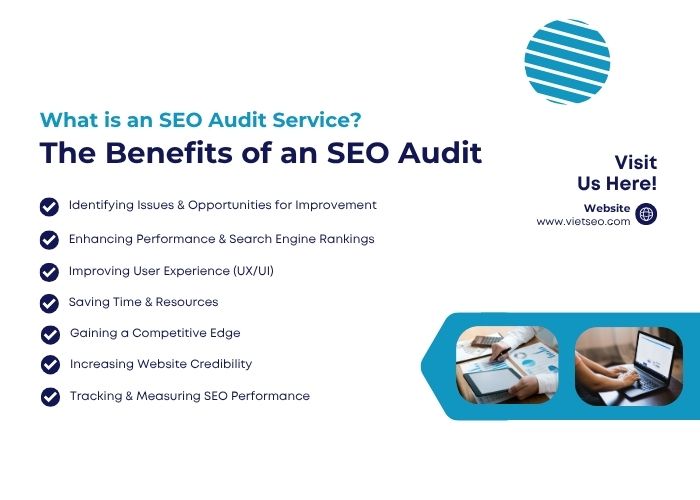
Core Components of an SEO Audit

- Technical access: robots, sitemaps, indexation, orphan pages, HTTP responses, redirects, canonicals, duplicate URLs, parameters, and rendering.
- Architecture: navigation, categories, click depth, breadcrumbs, internal links, and relationships between page types.
- Performance and mobile: server response, images, fonts, scripts, caching, layout stability, interactions, and content parity across devices.
- On-page and content: titles, descriptions, headings, introductions, intent, topic relevance, accuracy, freshness, overlapping pages, and calls to action.
- Structured data: validity, visible-content consistency, conflicting entities, and properties appropriate to page types.
- Authority: relevant referring domains, anchor patterns, link changes, editorial mentions, and business-profile consistency.
- UX and tracking: contact paths, forms, ordering, analytics configuration, events, conversions, cross-domain settings, and data gaps within scope.
- Competition and international SEO: page types, content gaps, language URLs, hreflang, canonicals, and localized content where included.
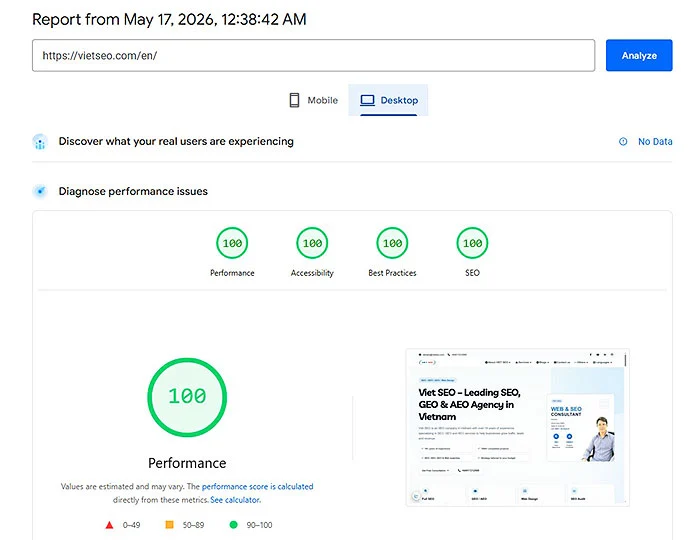
Interpret tool warnings in context. A single performance score does not represent all visitors; use laboratory and real-user data where available. Backlink actions require evidence, rather than an automated toxicity score alone.
Viet SEO’s SEO Audit Process
- Scope: review the business, goals, website, history, recent changes, and data available.
- Collect: configure crawling appropriately and gather search, analytics, performance, and backlink data within scope.
- Analyze: assess technical, content, authority, and UX findings against affected pages and business priorities.
- Compare: review relevant search competitors and realistic content opportunities.
- Prioritize: consider impact, urgency, effort, dependencies, and responsible teams.
- Deliver: provide the report and consultation where included; agree separately on implementation and retesting.
SEO Audit vs. Holistic SEO
An SEO audit and holistic SEO are closely related, but they are not the same service.
Purpose
- SEO Audit
- Identify issues, risks, and opportunities
- Holistic SEO
- Implement and manage a coordinated long-term SEO strategy
Typical scope
- SEO Audit
- Technical, content, authority, UX, and competitor evaluation
- Holistic SEO
- Audit, implementation, content, technical improvements, authority development, and ongoing refinement
Primary output
- SEO Audit
- Findings, priorities, and recommendations
- Holistic SEO
- Continuous execution and measurable performance improvement
Timeframe
- SEO Audit
- Usually a defined project
- Holistic SEO
- Usually an ongoing or multi-stage program
Implementation
- SEO Audit
- May or may not be included
- Holistic SEO
- Normally includes implementation and monitoring
Best suited for
- SEO Audit
- Diagnosis, planning, migrations, redesigns, and performance investigations
- Holistic SEO
- Businesses seeking broader, long-term organic growth
An SEO audit is often the first stage of a holistic SEO campaign because it provides the evidence needed to plan implementation.
When Should You Conduct an SEO Audit?
An SEO audit can be valuable in the following situations:
- Organic traffic or rankings have declined
- Important pages are not being indexed
- The website has recently been redesigned or migrated
- A new SEO campaign is about to begin
- The website contains many products, categories, or articles
- The business is entering a new international market
- The website has accumulated technical issues over time
- Content performance has become inconsistent
- Competitors are gaining search visibility
- The business needs a clear SEO investment plan
Audits may also be conducted periodically for large, frequently updated, or technically complex websites.
How Long Does an SEO Audit Take?
The required timeframe depends on:
- Website size
- Number of page templates
- Technical complexity
- Availability of analytics and search data
- Multilingual or international requirements
- Depth of content and backlink analysis
- Scope of competitor research
A small website with a focused scope may be reviewed relatively quickly. A large e-commerce, publishing, marketplace, or multilingual website may require a more extensive process.
The expected delivery timeframe should be confirmed in the project proposal after the website and scope have been reviewed.
What Should an SEO Audit Report Include?
- Executive summary, coverage, data sources, and assessment limits.
- Confirmed findings, affected URLs or templates, and supporting evidence.
- Likely impact, priority, dependencies, and recommended action.
- Implementation notes and responsibility for technical or content changes.
- Content/competitor opportunities and suggested follow-up metrics.
Separate confirmed problems from hypotheses that require more data. The report should help developers, writers, and marketing teams act; a raw tool export alone does not provide this context.

Common SEO Audit Mistakes
- Relying entirely on automated warnings or treating all issues as critical.
- Omitting affected-page examples, business context, or implementation priorities.
- Ignoring content intent and conversion paths.
- Presenting third-party authority scores as official search-engine metrics.
- Taking backlink actions automatically without context.
- Delivering a diagnosis without a practical action plan.
Why Choose Viet SEO for an SEO Audit?
Viet SEO has provided SEO and website development services since 2007, supporting Vietnamese and international corporate, service, e-commerce, publishing, and custom websites.
- Technical and content findings reviewed in business context.
- Evidence from available crawls, search, analytics, and performance data.
- Clear priorities, affected pages, and recommended actions.
- Optional implementation support under a separate agreement.
Frequently Asked Questions About SEO Audits
Does an SEO audit guarantee higher rankings?
No. An audit identifies issues and opportunities, but results depend on the quality and speed of implementation, competition, content, authority, and other search factors.
Is implementation included in the audit price?
Not always. Some audit packages include only analysis, reporting, and consultation. Technical fixes, content rewriting, development, and link-related work may be quoted separately.
Do I need to provide Search Console and Analytics access?
An audit can begin without access, but these platforms provide valuable information about queries, clicks, indexation, landing pages, traffic, and conversions. Access usually allows a more complete analysis.
How often should a website be audited?
The appropriate frequency depends on website size, update frequency, technical complexity, and business importance. Large e-commerce, publishing, or frequently changing websites may require more regular reviews than a small, stable corporate website.
Can an audit help after a traffic drop?
Yes. An audit can investigate technical changes, content losses, migration problems, competitor movement, indexation changes, or shifts in search demand. It may not always identify one single cause, but it can narrow down the most likely issues.
Is a free automated audit enough?
Automated reports can identify basic warnings, but they usually lack context, prioritization, content judgment, competitor analysis, and implementation planning.
Can you audit a multilingual website?
Yes. A multilingual audit may cover language architecture, hreflang, canonical tags, localized content, internal linking, regional search intent, and indexation.
Does an SEO audit include GEO and AI search readiness?
A broader audit can review many foundations relevant to AI-powered discovery, including accessible content, clear entities, structured information, source transparency, and technical search visibility. However, no audit can guarantee citation by an independent AI platform.
Request an SEO Audit
Whether your website is losing traffic, preparing for a redesign, entering a new market, or beginning a long-term SEO campaign, an audit can help you understand where to focus first.
Viet SEO will review your website and prepare a suitable audit scope based on its size, platform, business objectives, and technical complexity.
Contact Viet SEO:
- Phone: +84 917 212 969
- Contact person: Mr. Viet
- Service area: Vietnam and international markets
Identify the issues limiting your website and build a clear, prioritized roadmap for sustainable search improvement.




Questions & Comments
You can ask a question about this article. Viet SEO will review and reply after moderation.
Daniel Carter
09/09/2026The audit can help identify whether the traffic decline is related to technical SEO, indexation, content quality, internal linking, website performance, backlinks, competitors, or changes made to the website.
After reviewing the website, Viet SEO will provide a prioritized list of issues and recommendations so you can clearly understand:
• What problems are affecting the website
• Which issues should be fixed first
• Which pages or sections need improvement
• Whether technical, content, or backlink work is required
• What should be included in the next SEO phase
For a small or focused website, our SEO audit service starts from 2,000,000 VND. For larger, e-commerce, multilingual, or technically complex websites, we will review the scope and provide a specific quotation.
You can send us your website URL and we can first review its current situation and recommend the most suitable audit scope.