Website Design Pricing Trends: Vietnam vs. Global Market
A website can serve as a company’s digital storefront, brand platform, sales channel, customer service tool, or even the core product of an online business.
When planning a website project, one of the first questions businesses ask is:
How much does website design cost in Vietnam, and how does that price compare with international markets?
There is no single answer. Website pricing depends on the project scope, design quality, required functions, content, integrations, technology, development process, support model, and location of the service provider.
This guide provides a practical comparison of website design pricing in Vietnam and international markets. It also explains how to compare quotations and reduce costs without sacrificing essential quality.
You will learn:
- The factors that influence website design costs
- Reference website pricing in Vietnam
- How international website quotations are structured
- The advantages and limitations of local and overseas providers
- Current website pricing models
- How to optimize a website budget
- How to choose the right development partner
Why do website design prices vary?
Website quotations can differ significantly even when two projects appear similar. The reason is that each provider may include a different level of research, design, development, testing, content, infrastructure, and support.
Before comparing prices across countries, businesses should understand the main factors that determine the final cost.
Factors that influence website design costs
1. Website purpose and type
The website’s purpose is one of the biggest cost factors.
Common website types include:
- Landing page: A focused page for a product, service, event, or advertising campaign.
- Corporate website: Introduces the company, services, projects, team, news, and contact information.
- Portfolio website: Showcases professional work, experience, or completed projects.
- Service website: Generates inquiries, consultation requests, or bookings.
- E-commerce website: Includes products, shopping cart, checkout, payment, shipping, and order management.
- Booking website: Supports appointments, tours, rooms, tables, classes, or service reservations.
- Membership platform: Includes user accounts, subscriptions, restricted content, or customer areas.
- Custom web application: Supports specialized workflows, databases, integrations, reports, and user permissions.
A basic corporate website generally requires less development than an e-commerce platform or custom business application.
2. UI and UX design quality
User interface design determines how the website looks, while user experience design determines how easily visitors can find information and complete important actions.
Common design approaches include:
- Ready-made template: Faster to implement and generally less expensive, but customization may be limited.
- Customized template: Uses an existing structure with adjustments to branding, layouts, typography, and selected functions.
- Custom UI and UX design: Developed specifically for the company’s brand, target customers, content, and conversion journey.
Custom design may involve:
- User research
- Competitor analysis
- Information architecture
- Wireframes
- Interactive prototypes
- Responsive layouts
- Usability testing
- Multiple design revisions
The more research and customization required, the higher the design cost.
3. Number of page templates
Website pricing is influenced more by the number of unique layouts than by the total number of URLs.
For example, an online store may contain thousands of products but use only one product detail template. A smaller corporate website may require many individually designed page layouts.
Common page templates include:
- Homepage
- About page
- Service category
- Service detail
- Product category
- Product detail
- Project listing
- Project detail
- Blog category
- Article detail
- Contact page
4. Technology and platform
The technology stack affects development, scalability, security, and maintenance, but the technology name alone does not determine the price.
Common options include:
- WordPress
- WooCommerce
- Shopify
- Drupal
- Static HTML
- Laravel and other back-end frameworks
- React, Vue, Angular, and other front-end frameworks
- Headless content management systems
- Custom content management systems
A simple website built with a custom framework may cost less than a heavily customized WordPress or Shopify project.
The platform should be chosen according to:
- Required functions
- Content management needs
- Expected traffic
- Security requirements
- Integration requirements
- Scalability
- Maintenance resources
- Total ownership cost
5. Features and integrations
Additional functions increase the amount of planning, development, and testing required.
Examples include:
- User registration and login
- Customer accounts
- Shopping cart and checkout
- Online payment
- Booking management
- Advanced search and filtering
- Membership subscriptions
- Multilingual content
- CRM integration
- ERP or accounting integration
- POS and inventory synchronization
- Email or SMS automation
- AI-powered search or customer support
- Custom reports
6. Content and data volume
The quotation may also include content preparation, translation, product entry, image editing, and data migration.
Content-related work can include:
- Website copywriting
- Product descriptions
- SEO articles
- Translation
- Image processing
- Video production
- Product data entry
- Content migration
- URL mapping and redirects
7. SEO, performance, and accessibility
A website developed for long-term search visibility and user experience may require:
- SEO-friendly website structure
- Editable metadata
- Clean URLs
- Canonical tags
- Structured data
- XML sitemap
- Robots.txt
- Redirect management
- Internal linking
- Core Web Vitals optimization
- Mobile-first layouts
- Accessibility considerations
Technical SEO creates a foundation for search visibility, but it does not guarantee rankings.
8. Security and infrastructure
Websites with high traffic, online transactions, customer accounts, or sensitive information may need additional infrastructure and security work.
This can include:
- Server configuration
- Advanced caching
- Content delivery networks
- Automated backups
- Security monitoring
- User permissions
- Activity logging
- Vulnerability testing
- Load testing
- High-availability infrastructure
9. Development team and project process
Businesses can work with:
- Freelancers
- Small development teams
- Website design agencies
- Digital marketing agencies
- Custom software companies
- International development teams
The provider type does not automatically determine quality. Important evaluation criteria include:
- Relevant experience
- Technical skills
- Communication
- Project management
- Testing procedures
- Documentation
- Warranty
- Long-term support
10. Location and collaboration model
Geographical location can affect labor and operating costs, but it is only one part of the quotation.
International collaboration may also create additional requirements related to:
- Time zones
- Language
- Currency conversion
- International payments
- Taxes
- Legal jurisdiction
- Data protection
- Intellectual property
- Remote project management
Website design pricing in Vietnam
Vietnam has a diverse website development market that includes independent professionals, local agencies, digital marketing companies, and software development firms.
Services range from low-cost template websites to complex custom platforms for domestic and international clients.
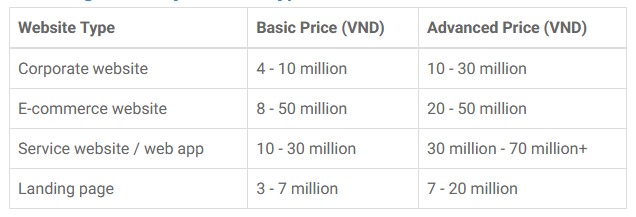
Reference prices by website type
The following price ranges are general references rather than fixed market rates.
| Website type | Typical scope | Reference investment range |
|---|---|---|
| Landing page | One focused page, contact form, responsive layout, basic tracking | Approximately VND 3–10 million |
| Basic business website | Company introduction, services, blog, contact form, basic SEO foundation | Approximately VND 7–20 million |
| Professional corporate website | Customized design, multiple templates, multilingual content, advanced administration | Approximately VND 20–50 million |
| Basic e-commerce website | Product catalog, shopping cart, checkout, payment, order management | Approximately VND 15–40 million |
| Custom e-commerce website | Custom UI/UX, advanced sales functions, customer accounts, integrations | Approximately VND 40–100 million or more |
| Booking or membership platform | User accounts, schedules, payments, notifications, reports | Approximately VND 30–120 million or more |
| Custom web application | Business workflows, databases, APIs, permissions, advanced reports | Quoted according to scope |
Advantages of working with a Vietnamese provider
For businesses operating in Vietnam, a local provider may offer several practical advantages:
- Communication in Vietnamese
- Understanding of the local market
- Knowledge of common Vietnamese payment and shipping services
- Easier meetings and project coordination
- Local invoicing and contracts
- Faster post-launch communication
- Potentially lower development costs than some high-cost markets
Potential limitations to evaluate
Quality varies between providers in every market. Businesses should evaluate:
- Whether the provider has a documented process
- The quality of UI and UX work
- Testing and quality assurance
- Source code standards
- Security practices
- Project documentation
- Warranty and maintenance capability
- Experience with international requirements
These limitations should be assessed on a provider-by-provider basis rather than assumed for the entire Vietnamese market.
International website design pricing
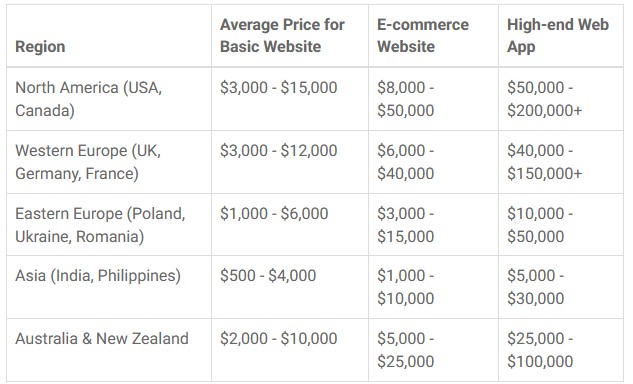
International website quotations vary widely between countries, cities, service models, and provider types.
A freelancer in one country may charge more than an agency in another. A specialist product design firm may also charge significantly more than a general website company.
Common international pricing levels
| Provider or market type | Common characteristics | Pricing considerations |
|---|---|---|
| Independent freelancer | Direct communication, flexible scope, individual expertise | Depends heavily on experience and availability |
| Small overseas agency | Design and development team, project management, remote delivery | May offer competitive pricing depending on location |
| Specialized UX or branding agency | Research, strategy, custom design, brand systems | Higher fees due to specialist expertise |
| Custom software company | Complex platforms, integrations, long-term product development | Quoted according to team size, duration, and complexity |
| Enterprise consultancy | Strategy, compliance, security, governance, large project teams | Usually positioned at the highest cost level |
Potential advantages of international providers
Depending on the selected provider, potential advantages may include:
- Experience with a particular international market
- Specialist knowledge in a niche industry
- Experience with global platforms and systems
- Advanced product design or research capabilities
- Experience with international accessibility or compliance standards
- Support for global branding and multilingual projects
Potential challenges of international outsourcing
Businesses should also consider:
- Time-zone differences
- Language and communication challenges
- Currency fluctuations
- International transfer fees
- Different legal jurisdictions
- Tax and invoice requirements
- Remote approval and testing
- Post-launch support availability
- Data protection and hosting location
Vietnam vs. international website design comparison
| Criteria | Vietnamese provider | International provider |
|---|---|---|
| Communication | Convenient for Vietnamese-speaking businesses | May require English or another language |
| Time zone | Suitable for businesses operating in Vietnam | May require scheduled overlap hours |
| Market knowledge | Strong understanding of common Vietnamese requirements | May provide stronger knowledge of a specific foreign market |
| Pricing | Can be competitive depending on provider and scope | Varies significantly by country and provider type |
| Contracts and payments | Local currency, contracts, and invoicing may be simpler | May involve foreign currency, transfer fees, and foreign law |
| Specialist expertise | Available across many website and software categories | May offer access to niche international specialists |
| Post-launch support | Easier local communication in many cases | Depends on support schedule and time zone |
| Quality | Depends on the individual provider | Depends on the individual provider |
The location of a provider does not guarantee a particular level of quality. Businesses should evaluate the actual team, portfolio, process, technical standards, and contract.
When should you choose a local website provider?
A local provider may be appropriate when:
- The project requires frequent communication.
- The website targets Vietnamese customers.
- The project uses local payment, shipping, or business systems.
- The business prefers Vietnamese contracts and invoices.
- Post-launch support needs to follow Vietnam working hours.
- In-person meetings are important.
When should you choose an international provider?
An international provider may be appropriate when:
- The business targets a specific overseas market.
- The project requires specialist knowledge that is difficult to source locally.
- The provider has proven experience in the required industry.
- The website must comply with specific international standards.
- The business already operates with an international team.
- The project requires a design or technology specialization offered by that provider.
A Vietnamese business can also combine local project management with international specialists when the project requires both local market knowledge and specialized expertise.
Current website design pricing models
1. Fixed project price
The provider defines a fixed price for an agreed scope.
This model works well when:
- Requirements are clear
- Pages and functions are defined
- The number of revisions is limited
- Acceptance criteria are documented
Changes outside the agreed scope are normally quoted separately.
2. Time-and-materials pricing
The client pays according to the actual time and resources used.
This model may be suitable for:
- Projects with changing requirements
- Long-term development
- Custom web applications
- Continuous improvements
The contract should define hourly or daily rates, reporting methods, approval procedures, and budget limits.
3. Dedicated team model
The client hires a dedicated team or selected specialists for a defined period.
The team may include:
- Project manager
- UI and UX designer
- Front-end developer
- Back-end developer
- Quality assurance specialist
- DevOps engineer
This model is commonly used for large or ongoing software projects.
4. Subscription or Website-as-a-Service model
The client pays a monthly or annual fee that may include:
- Website use
- Hosting
- Maintenance
- Technical support
- Selected updates
Businesses should confirm:
- Website ownership
- Data export rights
- Usage limits
- Customization limits
- Termination conditions
- What happens when payments stop
5. Value-based pricing
Some providers set fees according to the business importance or potential value of the project rather than only the estimated development hours.
This model may consider:
- Revenue opportunity
- Business risk
- Strategic importance
- Required expertise
- Delivery urgency
Value-based pricing requires clear expectations and should not be confused with a guaranteed return on investment.
6. Website and marketing bundles
Some providers combine website services with:
- SEO
- Content production
- Google Ads
- Social media advertising
- Analytics
- Conversion optimization
- Ongoing website management
Businesses should confirm which services are included, the duration, performance metrics, and renewal conditions.
How does AI affect website design costs?
AI may reduce the time required for selected tasks, but it can also introduce new development, integration, usage, and monitoring costs.
AI website functions may include:
- Customer service chatbots
- Product recommendations
- Semantic search
- Lead qualification
- Content suggestions
- Automated summaries
- Internal data assistance
Cost depends on:
- The selected AI provider
- API usage
- Required data integration
- Security and privacy requirements
- Expected accuracy
- Human review
- Ongoing monitoring
AI should only be added when it supports a clear user or business need.
How to optimize website design costs without sacrificing quality
1. Start with clear business objectives
Define whether the website is primarily intended to:
- Introduce the company
- Generate inquiries
- Sell products
- Accept bookings
- Publish content
- Support customers
- Operate as a software platform
A clear objective prevents unnecessary features from being added.
2. Use an MVP approach
An MVP, or Minimum Viable Product, includes the minimum functions required to launch and test the website with real users.
This approach can help businesses:
- Launch earlier
- Collect user feedback
- Validate assumptions
- Reduce initial risk
- Prioritize future improvements
The MVP still needs an appropriate technical foundation. It should not be interpreted as accepting poor quality or weak security.
3. Separate essential and future functions
Divide the project requirements into:
- Essential for launch
- Useful but not urgent
- Future development
This makes it easier to control the initial investment and create a development roadmap.
4. Use templates and existing components selectively
A suitable template or reliable existing component can reduce implementation time for standard functions.
This approach may be appropriate for:
- Small corporate websites
- Portfolio websites
- Content websites
- Simple e-commerce stores
- Campaign landing pages
Businesses should still check licensing, performance, accessibility, security, and future customization limits.
5. Invest in content and information architecture
Clear content and logical navigation often create more business value than unnecessary visual effects.
Prioritize:
- Clear value propositions
- Useful service and product information
- Strong calls to action
- Simple navigation
- Customer questions
- Trust information
- SEO content planning
6. Prepare content before development
Projects are often delayed because text, product data, images, policies, and translations are not ready.
Preparing content early can reduce:
- Project delays
- Content-entry fees
- Layout revisions
- Last-minute changes
7. Choose the right team size
A small project may not need a large agency team. A complex platform may require more than one developer and designer.
Choose the team according to:
- Project complexity
- Required expertise
- Timeline
- Risk level
- Support requirements
8. Consider total cost of ownership
The lowest initial quotation may not be the least expensive option over time.
Total ownership cost may include:
- Initial design and development
- Hosting
- Software licenses
- Maintenance
- Security
- Content updates
- Technical support
- Future upgrades
- Migration costs
How to compare local and international website quotations
Compare the same project scope
Ensure that each quotation includes the same pages, functions, integrations, content responsibilities, and support requirements.
Check the project team
Ask which roles are included:
- Project manager
- Designer
- Developer
- Quality assurance specialist
- SEO specialist
- Infrastructure specialist
Check communication and availability
Confirm:
- Working hours
- Meeting schedule
- Response time
- Project management tools
- Language used
- Emergency support
Check contract and ownership
The agreement should clearly state:
- Source code ownership
- Database ownership
- Domain and hosting control
- Third-party licenses
- Intellectual property
- Confidentiality
- Data protection
- Website transfer rights
- Governing law
Check payment and currency
International contracts may involve:
- Foreign currency
- Exchange-rate changes
- Bank transfer fees
- International payment fees
- Tax requirements
Check warranty and maintenance
Confirm:
- Warranty duration
- Issues covered
- Support hours
- Response time
- Maintenance fees
- Software update responsibilities
- Future development rates
Common mistakes when comparing website prices
- Comparing only the final price
- Comparing projects with different scopes
- Assuming a foreign provider is automatically better
- Assuming a local provider is automatically cheaper
- Ignoring communication and time-zone costs
- Failing to clarify source code ownership
- Ignoring maintenance and recurring fees
- Choosing technology without considering future support
- Not preparing content before development
- Assuming technical SEO guarantees rankings
- Adding AI without a clear business purpose
Frequently asked questions about website design pricing
Is website design cheaper in Vietnam?
Vietnamese providers may offer competitive prices compared with some international markets, but the difference depends on project scope, provider expertise, process, and support. Businesses should compare detailed quotations rather than relying on a general country-level assumption.
Can Vietnamese website providers meet international quality standards?
Yes. Many Vietnamese teams serve both domestic and international clients. Quality depends on the provider’s experience, process, technical standards, testing, communication, and project management.
Should a Vietnamese business hire an overseas agency?
An overseas agency may be suitable when it has relevant market knowledge, specialist experience, or capabilities that directly match the project. Businesses should also consider time zones, communication, contracts, taxes, payments, and post-launch support.
Is an international agency always more expensive?
No. International prices vary widely. A small agency in one country may charge less than a specialist team in Vietnam, while a large consultancy may charge substantially more.
What is the best website pricing model?
A fixed project price may suit a clearly defined website. Time-and-materials or a dedicated team may be better for projects with changing requirements. Subscription services may suit businesses that prefer predictable recurring costs.
Does a higher price guarantee better quality?
No. A higher price may reflect a larger team, more research, greater specialization, or additional services, but businesses should still evaluate the actual scope, portfolio, process, and deliverables.
How can a business reduce website costs?
Businesses can reduce costs by clearly defining objectives, launching an MVP, separating essential and future functions, preparing content early, using reliable existing components, and choosing a team appropriate for the project.
Should a website include AI?
Only when AI solves a clear customer or operational need. AI integration may create additional API, development, data, security, and maintenance costs.
Conclusion
Website design pricing is influenced by many factors, including:
- Website type
- Design requirements
- Technology
- Functions and integrations
- Content
- SEO and performance
- Security
- Team structure
- Location
- Warranty and maintenance
Vietnam can be a competitive website development market for both domestic and international projects. However, businesses should avoid making decisions based only on location or the lowest quotation.
The right provider is the one that understands the business objective, defines a clear scope, communicates effectively, uses suitable technology, and can support the website after launch.
Cost optimization should not mean removing essential quality. A smarter approach is to launch the right scope, build a stable foundation, measure actual user needs, and expand the website according to business results.
If you are comparing website design services in Vietnam and international markets, contact Viet SEO for a detailed consultation. Our team will help you define the appropriate scope, select a suitable development model, and prepare a transparent quotation based on your business requirements.


Questions & Comments
You can ask a question about this article. Viet SEO will review and reply after moderation.