Professional Website Design Services
Professional Website Design Services for Business Growth
A professional website is more than an online company profile. It is a central digital platform where potential customers can discover your business, understand your services, evaluate your credibility, and take action.
Website design services cover the planning, design, development, testing, and launch of a functional website for a business, organization, or individual. Depending on the project, a website may support:
- Corporate and brand communication
- Product and service presentation
- Online sales and payment processing
- Lead generation and quotation requests
- Content publishing and digital marketing
- Customer support and account management
- Internal business operations
At Viet SEO, we do not approach website development as a purely visual project. We combine user experience, technical performance, search engine optimization, content structure, and conversion planning to create websites that support long-term business objectives.
What Is Included in Viet SEO’s Website Design Services?
Each website is planned according to the client’s industry, audience, brand, technical requirements, and growth strategy. The final scope may vary, but a typical project includes the following areas.
1. Business and Requirement Analysis
Before design begins, we review the purpose of the website and the needs of its users.
This stage may include:
- Business goals and project priorities
- Target customers and markets
- Products, services, and content requirements
- Competitor and industry references
- Required website features
- Language and localization requirements
- SEO and digital marketing objectives
This discovery process helps ensure that the website is designed around real business needs rather than a generic template.
2. UI and UX Design
User interface design determines how the website looks, while user experience design determines how easily visitors can understand and use it.
Our UI and UX work may include:
- Visual direction aligned with the brand identity
- Clear and consistent page layouts
- Logical navigation and information hierarchy
- Accessible typography and spacing
- Responsive layouts for desktop, tablet, and mobile devices
- Conversion-focused calls to action
- Design patterns appropriate for international audiences
The objective is to create a website that looks professional while helping users find information and complete important actions efficiently.
3. Website Development
We select the technology according to the website’s purpose, management requirements, expected traffic, available budget, and future expansion plans.
Depending on the project, development may use:
- WordPress
- WooCommerce
- Laravel
- Custom PHP and MySQL
- Other suitable content management or application frameworks
Development priorities may include:
- Clean and maintainable code
- Stable website operation
- Responsive frontend implementation
- Secure form and data handling
- Content management flexibility
- Compatibility with future integrations
- Scalable website architecture
4. SEO-Ready Website Architecture
SEO should be considered during the planning and development stages rather than added only after the website has launched.
An SEO-ready architecture may include:
- Logical page hierarchy
- Search-friendly URLs
- Consistent heading structure
- Internal linking pathways
- Editable page titles and meta descriptions
- XML sitemap support
- Robots and indexation controls
- Canonical URL implementation
- Structured data where appropriate
- Search-friendly image and media handling
This foundation makes it easier to develop and scale a search strategy after launch.
5. Custom Functions and Integrations
Websites can include functions tailored to the client’s operational and customer-service needs.
Examples include:
- Product catalogs and online ordering
- Shopping carts and checkout systems
- Payment gateway integration
- Customer registration and login
- Quotation and consultation forms
- Booking and appointment systems
- Membership and subscription features
- Multilingual content management
- Customer relationship management integrations
- Inventory, order, or internal workflow systems
- Third-party API integrations
6. Testing, Launch, and Training
Before launch, we test the website across relevant devices, browsers, and user scenarios.
Testing may cover:
- Page layouts and responsive behavior
- Forms and interactive functions
- Navigation and internal links
- Checkout and payment processes
- Content display
- Basic security configuration
- Performance and technical issues
- Search engine access and indexation settings
After delivery, the client can receive guidance on updating pages, publishing content, managing products, and handling routine website operations.
7. Post-Launch Support and Maintenance
A website requires ongoing attention after launch. Software, browsers, security requirements, business information, and user expectations continue to change.
Depending on the selected service agreement, post-launch support may include:
- Technical troubleshooting
- Software and plugin updates
- Website backup support
- Security monitoring
- Content and layout adjustments
- Performance reviews
- Feature enhancements
- SEO and analytics support
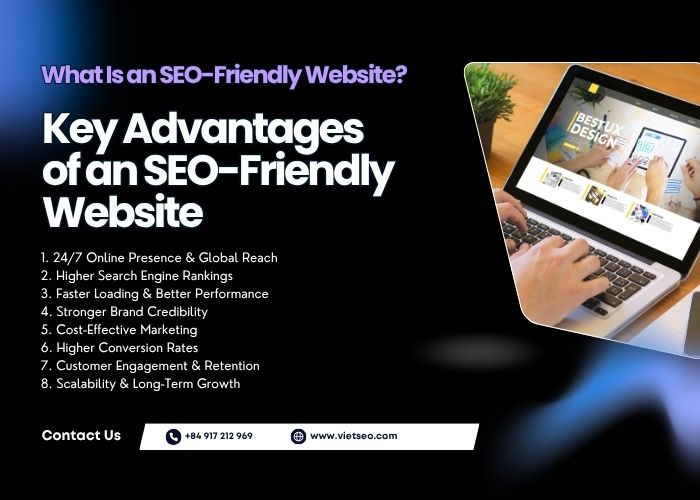
What Is an SEO-Friendly Website?
An SEO-friendly website is planned and developed so that search engines can access, understand, index, and evaluate its content efficiently.
However, being SEO-friendly does not guarantee a particular ranking. Search visibility also depends on content quality, competition, website authority, search intent, market conditions, and ongoing optimization.
A strong SEO foundation helps reduce technical barriers and gives the website a better platform for future content and marketing activities.
Essential Features of an SEO-Friendly Website
1. Logical Site Structure
The website should organize pages in a way that is easy for both visitors and search engines to understand.
A clear structure may follow a hierarchy such as:
Homepage → Service or Product Category → Detail Page → Supporting Content
Useful structural elements include:
- Simple and predictable navigation
- Descriptive category names
- Breadcrumb navigation
- Contextual internal links
- XML sitemap generation
- Accurate robots directives
- Search-friendly pagination where needed
2. Meaningful and Consistent URLs
URLs should be readable, concise, and representative of the page content.
For example:
/website-design-services/
is generally easier to understand than:
/page.php?id=385&cat=7
Keywords may be included when they naturally describe the page. URLs should not be overloaded with repeated search terms.
3. Website Performance
Performance affects usability and can influence how visitors engage with the website. Pages should load efficiently across different devices and network conditions.
Performance optimization may include:
- Appropriately sized and compressed images
- Modern image formats where suitable
- Efficient CSS and JavaScript delivery
- Server and database optimization
- Page and browser caching
- Content delivery network integration when beneficial
- Controlled use of plugins and third-party scripts
- Lazy loading for appropriate media
Performance should be evaluated using real website conditions rather than relying on a single score or an absolute load-time promise.
4. Responsive and Mobile-Friendly Design
The website should adapt to different screen sizes and remain usable on desktop computers, tablets, and smartphones.
A responsive website should provide:
- Readable text without unnecessary zooming
- Buttons and links that are easy to select
- Layouts that adapt without horizontal scrolling
- Accessible forms and menus
- Properly resized images and media
- Consistent functionality across devices
5. On-Page SEO Controls
Website administrators should be able to manage important SEO elements without modifying the source code for every page.
These controls may include:
- Page titles
- Meta descriptions
- Heading content
- URL slugs
- Canonical tags
- Image alternative text
- Index and noindex directives
- Open Graph and social-sharing metadata
Titles and descriptions should be written for relevance and clarity. Fixed character limits should be treated as practical guidelines rather than universal rules.
6. Content and Heading Structure
Each page should have a clear primary purpose and an organized heading hierarchy.
Recommended practices include:
- Using one descriptive H1 for the primary page topic
- Using H2 headings for major sections
- Using H3 headings for supporting topics
- Keeping paragraphs focused and readable
- Using lists and tables where they improve comprehension
- Avoiding artificial keyword repetition
7. Appropriate Structured Data
Structured data can help search engines interpret specific information about a page, business, person, product, article, or other supported entity.
Depending on the visible content and page type, suitable markup may include:
- Organization
- LocalBusiness
- WebSite
- BreadcrumbList
- Article
- Product
- Service
- Person
- VideoObject
Structured data should accurately reflect the visible page content. It does not guarantee rich results or AI citations.
8. Technical SEO and Indexation
The website should provide search engines with clear and consistent technical signals.
Important considerations may include:
- HTTPS implementation
- Correct HTTP status codes
- Redirect management
- Canonical URL consistency
- Duplicate-content controls
- XML sitemap configuration
- Robots.txt configuration
- Mobile rendering
- JavaScript accessibility
- Broken-link monitoring
9. Website Security
Security helps protect customer information, website availability, and business reputation.
Security practices may include:
- HTTPS encryption
- Secure administration access
- Strong password policies
- Regular software updates
- Form validation and sanitization
- Protection against common injection and scripting attacks
- Scheduled website and database backups
- Access and activity monitoring
No website can be described as completely immune to hacking or service disruption. Security should be treated as an ongoing risk-management process.
10. User Experience and Conversion Design
A website should help users understand where they are, what the business offers, and what they can do next.
Conversion-focused elements may include:
- Clear service and product descriptions
- Visible contact information
- Relevant calls to action
- Simple inquiry and ordering processes
- Trust signals such as reviews and case studies
- Transparent pricing or quotation information where appropriate
- Accessible navigation and search functions
Designing Websites for AI-Powered Search
Search is expanding beyond conventional listings. Users can now receive answers through features and platforms such as Google AI Overviews, Google AI Mode, ChatGPT Search, Microsoft Copilot, Perplexity, and other AI-assisted discovery tools.
Google states that established SEO practices remain relevant for its generative AI search features. There is no separate technical requirement that guarantees appearance in AI Overviews or AI Mode. A website should therefore prioritize sound SEO, useful content, accessibility, and clear information rather than unverified shortcuts.
A website prepared for AI-powered discovery may include:
- Clear answers to important customer questions
- Accurate and well-supported information
- Consistent business, author, product, and service entities
- Logical headings and content organization
- Original insights and first-hand experience
- Relevant internal links
- Reliable supporting references
- Appropriate structured data
- Accessible text, images, and video content
SEO Website vs. SEO and GEO-Ready Website
| SEO-Ready Website | SEO and GEO-Ready Website |
|---|---|
| Designed for crawling, indexing, and organic search visibility | Built on the same SEO foundation with additional focus on clear, reusable information |
| Targets relevant topics and search queries | Also addresses conversational and comparison-based questions |
| Uses logical pages and internal links | Develops connected topic clusters and clearly defined entities |
| Measures rankings, clicks, traffic, and conversions | May also monitor AI referrals, source mentions, and assisted discovery |
| Supports traditional search results and rich features | Also improves eligibility for AI-assisted search and answer experiences |
GEO does not mean writing only for artificial intelligence. The strongest content remains useful, accurate, natural, and trustworthy for human readers.
Benefits of SEO-Ready Website Design
1. Stronger Organic Search Foundation
A properly structured website reduces technical barriers and makes it easier for search engines to discover and evaluate important pages.
Potential benefits include:
- More efficient crawling and indexation
- Clearer page relationships
- Better support for future content expansion
- Fewer technical issues during SEO campaigns
2. Improved Brand Credibility
Visitors often judge a business based on the quality of its website.
A professional website can strengthen credibility through:
- Consistent visual branding
- Clear company and service information
- Secure browsing
- Accurate contact details
- Professional writing and imagery
- Case studies, reviews, and qualifications
3. More Efficient Digital Marketing
A strong website can improve the effectiveness of multiple marketing channels.
It may support:
- Organic search campaigns
- Google Ads landing pages
- Social media advertising
- Email marketing
- Content marketing
- Affiliate and partner referrals
SEO can reduce long-term dependence on paid traffic, but the actual financial impact varies according to industry, competition, campaign quality, and business model.
4. Higher-Quality Lead Generation
Pages designed around customer needs and search intent can attract users who are actively evaluating a product or service.
Useful lead-generation elements include:
- Focused service landing pages
- Clear value propositions
- Relevant case studies
- Frequently asked questions
- Quotation and consultation forms
- Visible contact options
5. Better Conversion Opportunities
Website traffic creates value only when visitors can complete meaningful actions.
Conversion improvements may come from:
- Faster and more stable pages
- Clear content hierarchy
- Relevant calls to action
- Reduced form complexity
- Transparent service information
- Simplified checkout and ordering
- Trust-building content
6. Better User Experience
A well-designed website helps customers complete tasks with less confusion.
UX benefits may include:
- Simple navigation
- Readable content
- Consistent page layouts
- Mobile-friendly interactions
- Accessible buttons and forms
- Clear feedback after user actions
7. Long-Term Scalability
A well-planned architecture makes it easier to add new services, products, locations, languages, and integrations.
This helps businesses avoid rebuilding the entire website whenever their requirements change.
8. Support for AI-Powered Discovery
Clear and accessible website information can create additional opportunities for discovery through AI-assisted search experiences.
However, no designer or SEO agency can guarantee a citation, mention, or permanent position within an independent AI platform.

Types of Websites We Design
1. Corporate Websites
Corporate websites present a company’s identity, expertise, services, experience, and contact information.
They are suitable for:
- Professional service providers
- B2B companies
- Manufacturers and distributors
- Construction and engineering companies
- Educational organizations
- Finance, accounting, and legal businesses
- International companies entering Vietnam
Typical functions may include service pages, project portfolios, case studies, recruitment sections, multilingual content, and quotation forms.
2. E-Commerce Websites
E-commerce websites allow businesses to present and sell products online.
Common functions include:
- Product and category management
- Search and filtering
- Shopping cart and checkout
- Payment gateway integration
- Shipping configuration
- Order and customer management
- Promotional codes
- Product reviews
- Inventory integration where required
The website can also be structured to support product SEO, category optimization, merchant feeds, and other digital sales channels.
3. Landing Pages
Landing pages are focused pages created for a specific product, service, campaign, or customer segment.
They may be used for:
- Google Ads campaigns
- Social media advertising
- Product launches
- Event registration
- Quotation requests
- Lead-generation campaigns
An effective landing page should align its message, visuals, and call to action with the campaign audience.
4. News and Content Websites
Content-focused websites require efficient publishing workflows and clear organization.
Important features may include:
- Category and tag management
- Author profiles
- Search and filtering
- Related-content recommendations
- Advertising placements
- Newsletter integration
- Article and breadcrumb structured data
- Performance optimization for large content libraries
Structured data can support search engines in understanding content, but it does not automatically make a website eligible for every news or rich-result feature.
5. Multilingual and International Websites
International websites require more than translating visible text.
Planning may include:
- Language and regional URL structure
- Localized navigation and content
- Hreflang implementation where appropriate
- Local contact and business information
- International keyword research
- Cultural and user-experience adaptation
- Regional legal and privacy requirements
6. Custom Websites and Web Applications
Some businesses require systems that go beyond standard company or e-commerce websites.
Custom projects may include:
- Customer portals
- Learning management systems
- Human resource systems
- Order and project management systems
- Membership platforms
- Booking systems
- Internal dashboards
- Custom reporting tools
These projects require detailed requirement analysis, system architecture, security planning, and ongoing maintenance.
Website Design Packages and Reference Pricing
The following prices provide an initial reference. Final pricing depends on the confirmed scope, content volume, design requirements, integrations, and technical complexity.
| Package | Reference Price | Suitable For |
|---|---|---|
| Basic Website | From 5,000,000 VND | Small corporate or service-introduction websites with standard functions |
| Standard Website | From 7,000,000 VND | Businesses requiring product management, expanded content, or additional integrations |
| Premium Website | From 9,000,000 VND | Brands requiring more advanced design, customization, and business functions |
| Custom Project | Quotation required | Web applications, specialized workflows, portals, or complex integrations |
Reference prices should be confirmed through a formal proposal before the project begins.
Depending on the selected package, delivery may include:
- Website administration training
- Basic Google Search Console setup
- Google Analytics integration
- Technical warranty under the agreed terms
- Post-launch support options
What Affects Website Design Cost?
Website pricing depends on the amount of work, customization, and technical responsibility involved.
Key factors include:
1. Website Size and Content Volume
A small service website requires less planning and implementation than a multilingual website with hundreds of products or articles.
2. Design Customization
Using an existing layout generally requires less design work than creating a fully custom interface, design system, or set of interactive elements.
3. Functional Complexity
Functions such as payments, subscriptions, customer accounts, advanced filtering, booking, reporting, and workflow automation increase the development and testing scope.
4. Content and Localization
Content writing, editing, translation, image processing, product entry, and multilingual management may be priced separately.
5. SEO and GEO Scope
A basic SEO-ready structure differs from a complete project involving keyword research, content mapping, technical SEO, structured data, topic clusters, and AI search monitoring.
6. Third-Party Integrations
Integrations with payment providers, customer relationship management systems, enterprise resource planning platforms, logistics providers, email services, and APIs require additional implementation and testing.
7. Hosting, Security, and Maintenance
Domain registration, hosting, server administration, backups, monitoring, security services, and ongoing maintenance may be included or quoted as separate services.
Viet SEO’s Website Design Process
Step 1: Consultation and Requirement Analysis
We discuss the business, target customers, required functions, preferred design direction, available content, timeline, and budget.
Step 2: Sitemap and Content Planning
We organize the main pages, navigation, content hierarchy, and key conversion pathways.
Step 3: UI and UX Design
We develop layouts and visual elements aligned with the brand and user requirements.
Step 4: Development and Integration
The approved design is implemented, and the required content-management tools, forms, functions, and third-party integrations are developed.
Step 5: Content and SEO Configuration
Content is added or migrated, while relevant SEO settings, URLs, metadata controls, internal links, redirects, and structured data are configured.
Step 6: Testing and Quality Assurance
We review website behavior, responsive layouts, forms, integrations, content, security settings, and technical search accessibility.
Step 7: Launch and Training
After approval, the website is deployed to the production environment. We then provide the agreed administrative guidance and handover materials.
Step 8: Support and Continuous Improvement
Post-launch work may include issue resolution, maintenance, security updates, performance improvements, new content, feature development, and SEO support.
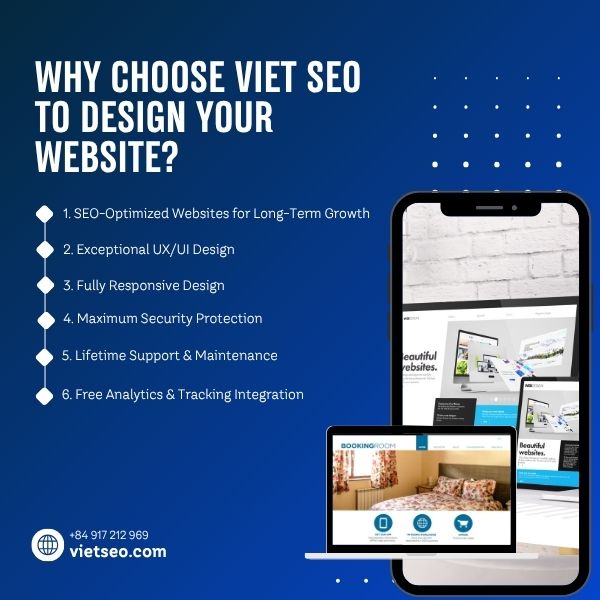
Why Choose Viet SEO?
Viet SEO has provided website development and search engine optimization services since 2007. This combined experience allows us to address design, development, technical SEO, content structure, and long-term digital performance within one project.
Clients choose Viet SEO for:
- More than 18 years of website and SEO experience
- Experience supporting Vietnamese and international businesses
- SEO planning from the beginning of the project
- Customizable and scalable technical solutions
- Responsive and user-focused interface design
- Experience with WordPress, WooCommerce, Laravel, PHP, and custom systems
- Transparent project scope and reference pricing
- Website administration training
- Optional maintenance and long-term technical support
We do not promise that design alone will guarantee rankings, revenue, or AI citations. We build a strong technical and user-experience foundation that gives each website a better opportunity to support SEO, advertising, content marketing, and business development.
Frequently Asked Questions About Website Design
How long does it take to build a website?
The timeline depends on the size of the website, design complexity, required functions, content readiness, approval process, and integrations. A small corporate website may require less time than an e-commerce platform or custom web application.
Will the website be mobile-friendly?
Yes. Responsive design is included in modern website projects so that the layout can adapt to desktop, tablet, and mobile screens. Specific functions should still be tested across relevant devices before launch.
Will the website rank on Google?
An SEO-ready website provides a strong technical foundation, but rankings are not guaranteed. Organic visibility depends on competition, content quality, authority, search intent, ongoing SEO work, and other factors.
Can I update the website myself?
Yes, when the project uses an appropriate content management system. Viet SEO can provide guidance for editing pages, adding articles, managing products, and completing common administrative tasks.
Does the price include domain and hosting?
Domain, hosting, server management, email, and maintenance may be included or quoted separately depending on the selected package. These items should be confirmed in the project proposal.
Can you redesign an existing website?
Yes. We can review an existing website and recommend whether it should be redesigned, migrated, technically upgraded, or partially improved.
Can you build a multilingual website?
Yes. Viet SEO can develop multilingual websites and plan language structures, content management, navigation, technical SEO, and localization requirements for international audiences.
Is maintenance required after launch?
Yes. Regular maintenance helps reduce security risks, address compatibility issues, update software, protect data, and keep the website operating effectively.
Can the website be optimized for AI search?
The website can be structured with accessible content, clear entities, helpful answers, appropriate schema, and strong SEO foundations. These practices may improve its eligibility for AI-powered discovery, but no company can guarantee inclusion or citation by an independent AI platform.
Request a Website Design Consultation
Whether you need a corporate website, online store, landing page, multilingual website, or custom business platform, Viet SEO can help you plan a solution around your audience and commercial objectives.
We will review your requirements, recommend a suitable structure and technology, and prepare a transparent proposal based on the confirmed scope of work.
Contact Viet SEO:
- Phone: +84 917 212 969
- Contact person: Mr. Viet
- Service area: Vietnam and international markets
Build a professional website designed for users, search engines, and long-term business growth.

Questions & Comments
You can ask a question about this article. Viet SEO will review and reply after moderation.
David Anderson
18/09/2026The first step is to review the existing website from both a business and technical perspective. We normally evaluate the current design, mobile experience, website speed, code quality, content management system, SEO structure, security, functions, and future expansion requirements.
If the existing platform is still stable and flexible, it may be possible to improve the website through:
• UI and UX updates
• Mobile and responsive improvements
• Speed and performance optimization
• SEO structure improvements
• Content and navigation restructuring
• Security updates
• New functions or integrations
However, a full redesign may be more suitable when the current website has outdated technology, difficult-to-maintain code, serious performance problems, poor mobile compatibility, limited SEO controls, or a structure that cannot support future business requirements.
Viet SEO can first review the existing website and identify which parts can be retained, which should be improved, and whether a full rebuild would provide better long-term value.
This approach helps avoid unnecessary redevelopment while ensuring that the final website is easier to manage, more user-friendly, SEO-ready, and suitable for future growth.