Professional Web Hosting Services
Professional Web Hosting Services
Web hosting is the infrastructure that stores and delivers a website’s files, databases, applications, and other resources to users through the internet.
When someone enters a domain name into a browser, the browser connects to the hosting server associated with that domain. The server then processes the request and returns the website content required to display the page.
A hosting service may support:
- Website files
- Images and videos
- Databases
- PHP or other server-side applications
- Email services
- APIs and integrations
- Scheduled tasks
- Backups and logs
The quality of the hosting environment can influence website availability, loading performance, scalability, security, and the ability to handle traffic.
At Viet SEO, we provide hosting solutions for corporate websites, WordPress websites, e-commerce stores, custom PHP systems, and growing online businesses.
What Is Web Hosting?
Web hosting is a service that provides server resources and connectivity so that a website or online application can be accessed through the internet.
Depending on the hosting plan, the available resources may include:
- Storage capacity
- Processor resources
- Memory
- Bandwidth or data transfer
- Database capacity
- Email accounts
- Subdomains
- Control-panel access
Hosting does not replace a domain name. The domain is the website’s address, while hosting is the environment where the website operates.
How Does Web Hosting Work?
The basic process usually follows these steps:
- A user enters the website’s domain name.
- DNS directs the request to the appropriate hosting server.
- The server receives and processes the request.
- The website application retrieves the required files or database information.
- The server sends the result back to the browser.
- The browser displays the page to the user.
Actual page-loading speed also depends on the website source code, database, media files, third-party services, user device, network connection, and physical distance from the server.
Why Does Reliable Web Hosting Matter?
1. Website Availability
A website can receive visitors only while its hosting environment, network, DNS, and connected services are available.
Reliable hosting can reduce the risk of avoidable outages, but no provider can guarantee uninterrupted availability under every circumstance.
2. Website Performance
Hosting performance affects how quickly the server begins responding and processes application requests.
Important factors include:
- Server hardware
- Storage technology
- Available CPU and memory
- Server load
- Database performance
- Server location
- Caching configuration
- Web server software
3. Website Security
A professional hosting environment may provide security controls such as:
- Firewall rules
- Malware scanning
- SSL support
- Account isolation
- Access logging
- Software updates
- Backup options
- DDoS mitigation measures
Hosting security is only one part of website security. The website software, administrator accounts, plugins, passwords, and application code must also be maintained securely.
4. Scalability
As a website grows, it may require more storage, memory, processing power, bandwidth, or database capacity.
A suitable hosting provider should offer a practical upgrade path when current resources are no longer sufficient.
5. Technical Support
Technical support can help resolve issues related to hosting accounts, server access, DNS, SSL, backups, email, resource limits, and website availability.
Support hours, response targets, and included responsibilities should be stated clearly in the service agreement.
What Is Shared Hosting?
Shared hosting is a hosting model in which multiple customer accounts operate on the same physical or virtual server environment.
Server resources are shared between the accounts according to the provider’s system configuration and usage policies.
Shared hosting is commonly suitable for:
- Small business websites
- Personal websites
- Blogs
- Portfolio websites
- Basic company profiles
- Low-traffic landing pages
Advantages of Shared Hosting
- Lower cost
- Simpler management
- Control-panel access
- Suitable for basic websites
- Limited server-administration requirements
Limitations of Shared Hosting
- Shared processing and memory resources
- Less configuration control
- Resource limits
- Potential performance variation during peak usage
- Not ideal for large or resource-intensive applications
Shared Hosting Pricing
The following plans are provided as reference packages. Final availability, specifications, and pricing should be confirmed before purchase or renewal.
Linux Hosting Plans
| Plan | Storage | Data Transfer | Subdomains | PHP Support | MySQL Databases | Reference Price |
|---|---|---|---|---|---|---|
| Plan 1 | 800 MB | Subject to fair-use and resource policies | 5 | Yes | 1 | 900,000 VND per year |
| Plan 2 | 1 GB | Subject to fair-use and resource policies | 15 | Yes | 2 | 1,056,000 VND per year |
| Plan 3 | 1.5 GB | Subject to fair-use and resource policies | 20 | Yes | 4 | 1,560,000 VND per year |
| Plan 4 | 2 GB | Subject to fair-use and resource policies | 25 | Yes | 5 | 1,860,000 VND per year |
Advanced Linux Hosting Plans
| Plan | Storage | Data Transfer | Subdomains | PHP Support | MySQL Databases | Reference Price |
|---|---|---|---|---|---|---|
| Plan 5 | 3.5 GB | Subject to fair-use and resource policies | 40 | Yes | 8 | 2,880,000 VND per year |
| Plan 6 | 5 GB | Subject to fair-use and resource policies | 60 | Yes | 10 | 4,440,000 VND per year |
| Plan 7 | 7 GB | Subject to fair-use and resource policies | 100 | Yes | 15 | 2,910,000 VND per 6 months |
| Plan 8 | 10 GB | Subject to fair-use and resource policies | According to package limits | Yes | 30 | 4,110,000 VND per 6 months |
Reference prices exclude 10% VAT unless otherwise stated. Prices, specifications, support terms, and resource policies may change over time.
Plans 7 and 8 are listed with six-month billing terms in the supplied price list. Clients should confirm the equivalent annual cost before purchase.

What Does “Unlimited Bandwidth” Mean?
Some shared hosting plans use terms such as “unlimited bandwidth” or “unmetered data transfer.”
This does not usually mean that a website can consume unlimited server resources without restrictions.
The account may still be subject to:
- CPU limits
- Memory limits
- Concurrent process limits
- Input/output limits
- File-count limits
- Fair-use policies
- Abuse or excessive-traffic policies
Businesses expecting large traffic volumes, downloads, streaming, or resource-intensive applications should confirm the actual limits before selecting shared hosting.
Popular Types of Web Hosting
1. Shared Hosting
Shared hosting provides an affordable environment for relatively small and straightforward websites.
It is generally best suited for:
- Low to moderate traffic
- Basic content websites
- Small WordPress websites
- Simple company profiles
2. VPS Hosting
A virtual private server, or VPS, provides allocated virtual resources within a larger physical server.
Compared with shared hosting, a VPS generally provides:
- More predictable resources
- Greater configuration control
- More software flexibility
- Improved isolation
- Better support for growing applications
A VPS may require server-administration knowledge or a managed support service.
3. Dedicated Server
A dedicated server provides an entire physical server for one customer or organization.
It may be suitable for:
- High-traffic websites
- Large databases
- Resource-intensive systems
- Applications requiring specialized configuration
- Organizations with strict infrastructure requirements
A dedicated server does not automatically guarantee better security or performance. It must still be configured, monitored, updated, and maintained correctly.
4. Cloud Hosting
Cloud hosting uses virtualized infrastructure that can allocate computing resources from a broader cloud environment.
Depending on the provider and architecture, it may support:
- Flexible resource allocation
- Scaling
- Geographical deployment options
- Load balancing
- Redundancy
- Automated infrastructure management
Cloud hosting does not always eliminate downtime. Availability depends on architecture, configuration, provider services, and application design.
5. WordPress Hosting
WordPress hosting is configured specifically for WordPress websites.
Depending on the plan, it may include:
- WordPress installation tools
- Server-side caching
- WordPress-focused security controls
- Backup features
- Plugin or theme management
- WordPress technical support
6. Managed Hosting
Managed hosting includes additional technical administration by the provider or service team.
This may include:
- Server updates
- Monitoring
- Backup management
- Security configuration
- Troubleshooting
- Performance tuning
The exact meaning of “managed” varies between providers and should be defined in the proposal.
Shared Hosting vs. VPS vs. Dedicated Server
| Criteria | Shared Hosting | VPS Hosting | Dedicated Server |
|---|---|---|---|
| Cost | Generally the lowest | Moderate | Generally the highest |
| Resources | Shared with other accounts | Allocated virtual resources | Entire physical server |
| Control | Limited | Greater administrative control | High level of control |
| Technical management | Usually handled largely by provider | May be managed or unmanaged | Usually requires professional administration |
| Suitable for | Small and basic websites | Growing websites and custom applications | Large or specialized systems |
How to Choose the Right Hosting Plan
1. Identify the Website Type
Different websites have different hosting requirements.
- Basic company website: Shared hosting may be sufficient.
- WordPress business website: Shared or managed WordPress hosting may be suitable.
- Growing e-commerce store: VPS or scalable cloud hosting may be more appropriate.
- Custom PHP or Laravel application: VPS, cloud, or dedicated infrastructure may be required.
- Large content platform: A scalable environment with suitable database and caching resources may be needed.
2. Estimate Storage Requirements
Storage is used by:
- Website files
- Images and videos
- Databases
- Backups
- Logs
Backups stored in the same hosting account may consume a significant portion of the available space.
3. Estimate Traffic and Resource Use
Traffic volume alone does not determine resource use.
A website may require more resources because of:
- Complex database queries
- Many plugins
- Dynamic pages
- Heavy search functions
- Large product catalogs
- Frequent API calls
- Logged-in users
- Media downloads
4. Review Application Requirements
Confirm whether the hosting supports:
- The required PHP version
- MySQL or another database
- Scheduled tasks
- SSH access
- Composer
- Node.js or build tools
- Custom extensions
- Background processes
5. Consider Server Location
A server closer to the primary audience may reduce network latency.
A content delivery network can also help serve static content from locations closer to users.
6. Review Backup Options
Ask:
- How frequently are backups created?
- Where are they stored?
- How long are they retained?
- Is restoration included?
- Has restoration been tested?
7. Review Security Features
Important features may include:
- SSL support
- Account isolation
- Firewall protection
- Malware scanning
- Access logs
- Multi-factor authentication
- Backup and recovery options
- DDoS mitigation
8. Evaluate Technical Support
Confirm:
- Support hours
- Available support channels
- Average response targets
- Scope of included support
- Emergency procedures
- Additional fees
9. Review Upgrade Options
The provider should offer a practical way to increase resources or migrate to a more suitable hosting environment when necessary.
10. Understand the Total Cost
The total cost may include:
- Hosting subscription
- VAT
- Domain registration
- Email hosting
- SSL certificates
- Control-panel licenses
- Backup storage
- Server management
- Migration
- Support or maintenance
Key Hosting Performance Factors
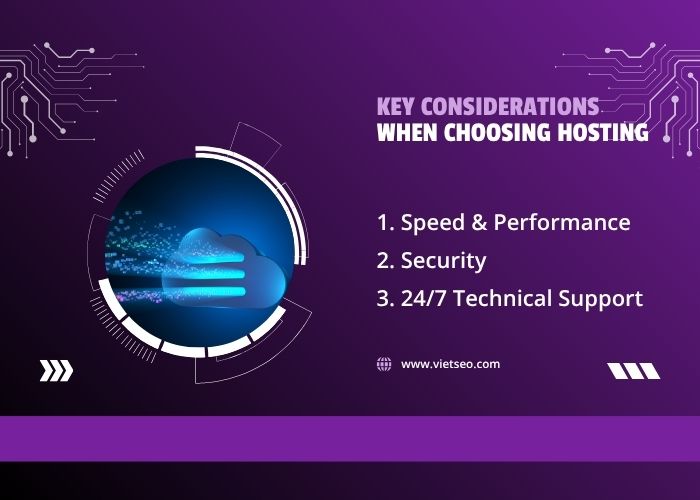
1. Server Response Time
The hosting environment should process requests efficiently and provide sufficient resources for the website application.
2. Storage Technology
SSD or NVMe storage can improve file and database access compared with older storage technologies, although overall performance also depends on the full system configuration.
3. Web Server Configuration
Web server technologies and settings may affect:
- Request handling
- Compression
- Browser caching
- HTTP protocol support
- Static-file delivery
- Application compatibility
4. Caching
Caching can reduce repeated processing and improve response times.
Caching may occur at several levels:
- Browser
- Web server
- Application
- Database
- CDN
5. Database Performance
Slow queries, oversized tables, poor indexes, and limited memory can reduce website performance even when the server hardware is sufficient.
6. Resource Isolation
Better resource isolation can reduce the effect of other accounts on the same server.
Does Web Hosting Affect SEO?
Hosting can support SEO indirectly by helping maintain:
- Website availability
- Reasonable response times
- HTTPS support
- Reliable crawling
- Stable page delivery
- Appropriate geographical performance
Hosting alone does not guarantee higher search rankings.
Search visibility also depends on:
- Content quality
- Search intent
- Technical SEO
- Website architecture
- Internal linking
- Authority
- Competition
Hosting Security Considerations
1. SSL and HTTPS
SSL certificates support encrypted connections between users and the website.
HTTPS does not protect against every website vulnerability, but it is an essential security layer.
2. Backups
Backups should be stored securely and, where possible, separately from the production website.
3. Account Security
Hosting accounts should use:
- Strong passwords
- Multi-factor authentication where available
- Limited user access
- Secure recovery information
4. Software Updates
Server software, website applications, plugins, and themes should be reviewed and updated appropriately.
5. Malware and Activity Monitoring
Monitoring can help identify suspicious files, account activity, or unusual resource usage.
6. DDoS Mitigation
Hosting providers may use network filtering, firewalls, CDNs, and rate limiting to reduce the impact of selected DDoS attacks.
No hosting service can guarantee protection from every possible attack.
Domain Name vs. Web Hosting
| Criteria | Domain Name | Web Hosting |
|---|---|---|
| Purpose | Provides the online address | Provides the server environment |
| Example | vietseo.com |
The server storing and running the Viet SEO website |
| Renewal | Usually renewed by registration period | Usually renewed monthly, quarterly, semi-annually, or annually |
| Can providers differ? | Yes. A domain can be registered with one provider and hosted with another. | |
Website Migration to New Hosting
Website migration is the process of moving a website from one hosting environment to another.
A migration may include:
- Website files
- Databases
- Email accounts
- DNS records
- SSL configuration
- Scheduled tasks
- Application settings
Typical Hosting Migration Process
- Review the current website and hosting environment.
- Confirm compatibility with the destination server.
- Create a complete backup.
- Transfer files and databases.
- Configure the destination environment.
- Test the website before changing DNS.
- Update DNS records.
- Monitor the website after migration.
Migration may be included for eligible websites or quoted separately depending on size, email volume, application complexity, and access conditions.
Completely interruption-free migration cannot always be guaranteed because DNS, external services, email, software compatibility, and third-party systems may affect the process.
Common Web Hosting Mistakes
1. Choosing Hosting Only by Price
The lowest-cost plan may not provide the resources, support, backups, or scalability required by the website.
2. Buying More Resources Than Needed
A large server does not automatically improve a poorly optimized website.
3. Ignoring Resource Limits
Storage and bandwidth are not the only limits. CPU, memory, processes, and database connections can also affect performance.
4. Storing All Backups on the Same Server
A server failure or compromise may affect both the production website and local backups.
5. Using Outdated Software
Old PHP versions, plugins, frameworks, or server packages may create compatibility and security risks.
6. Ignoring Renewal Pricing
Promotional or initial prices may differ from later renewal costs.
7. Assuming “Unlimited” Means There Are No Limits
Shared hosting remains subject to technical and fair-use restrictions.
8. Not Monitoring Resource Usage
Resource reports can help identify when a website needs optimization or an upgrade.
9. Giving Away Account Control
The business should retain appropriate ownership and access to hosting, domain, backup, and DNS accounts.
Why Choose Viet SEO for Web Hosting?
Viet SEO has provided domain, hosting, server administration, website development, maintenance, and SEO services since 2007.
Our combined experience allows us to evaluate hosting as part of the complete website environment.
Clients choose Viet SEO for:
- Shared hosting, VPS, cloud, and server support
- Experience with WordPress, WooCommerce, PHP, Laravel, and custom websites
- Domain and DNS assistance
- Website migration support
- SSL and backup configuration
- Technical troubleshooting
- Website maintenance and security services
- Support for Vietnamese and international businesses
- Transparent reference pricing
We do not promise that a hosting service will deliver uninterrupted uptime, complete protection, or fixed website speed in every circumstance. Our goal is to provide a suitable, well-managed environment based on the agreed plan and technical scope.
Frequently Asked Questions About Web Hosting
Do I need to renew web hosting?
Yes. Hosting is normally provided for a defined billing period and must be renewed to keep the service active.
What happens if hosting expires?
The website, database, email, and connected services may stop working. Data-retention policies vary between providers, so renewal should be completed before expiry.
Can I transfer my website to Viet SEO?
Yes, subject to a technical and access review. Migration requirements depend on the website platform, files, databases, email, and current provider.
Is website migration free?
Migration may be included for eligible websites under selected packages. Large, custom, compromised, or technically complex websites may require a separate quotation.
Does hosting include a domain name?
Not automatically. Hosting and domain registration are separate services unless included together in a package.
Does hosting include email?
Some hosting plans include basic email services, while others require separate business email hosting. The features and storage should be confirmed before purchase.
Does hosting include SSL?
Some plans may support or include suitable SSL certificates. The applicable certificate type, renewal method, and configuration should be confirmed.
Which hosting is best for WordPress?
The right plan depends on traffic, plugins, content volume, e-commerce functions, and performance requirements. Small WordPress websites may use shared hosting, while larger sites may require a VPS or cloud environment.
Does a large website need a dedicated server?
Not necessarily. Some large websites operate effectively on scalable cloud or VPS infrastructure. The decision should be based on actual resource use and technical requirements.
Can I upgrade my hosting plan?
Hosting plans can generally be upgraded or migrated when more resources are required. The process and possible downtime depend on the current and destination environments.
Does faster hosting guarantee better Google rankings?
No. Reliable and responsive hosting supports website quality, but rankings depend on many technical, content, authority, and competitive factors.
Is technical support available 24/7?
Support availability depends on the selected plan and service agreement. Monitoring, emergency response, and standard support may have different terms.
Request a Web Hosting Consultation
Whether you need hosting for a small business website, WordPress site, online store, Laravel application, or a growing digital platform, Viet SEO can help review your technical requirements.
We can recommend a suitable hosting environment based on:
- Website platform
- Storage and database requirements
- Expected traffic
- Performance needs
- Security requirements
- Backup requirements
- Support expectations
- Available budget
Contact Viet SEO:
- Phone and Zalo: +84 917 212 969
- Contact person: Mr. Viet
- Service area: Vietnam and international markets
Choose a hosting environment that provides the right balance of performance, security, scalability, support, and cost for your website.




Questions & Comments
You can ask a question about this article. Viet SEO will review and reply after moderation.
Michael Brown
01/10/2026Can Viet SEO check the current hosting and website performance first and recommend whether we should optimize the existing setup, upgrade the hosting plan, or move to a VPS?
A larger hosting package does not automatically solve performance problems if the website itself has inefficient code, slow database queries, too many plugins, heavy media files, insufficient caching, or resource-intensive background processes.
Viet SEO can first review the current environment, including:
• Server response time
• CPU and memory usage where available
• Storage and input/output limits
• Database performance
• PHP version and configuration
• WordPress plugins and themes
• Page and server-side caching
• Large images or media files
• Cron jobs and background processes
• Website traffic patterns
• Error logs and resource-limit events
• CDN and DNS configuration where applicable
If the current hosting still has sufficient resources, optimization may be more appropriate than upgrading immediately.
If the website regularly reaches CPU, memory, process, database-connection, or other resource limits after optimization, then moving to a larger shared-hosting plan, VPS, cloud environment, or another hosting architecture may be justified.
For a growing WordPress or WooCommerce website, VPS may provide more predictable resources and greater configuration control, but it also requires suitable server administration or managed support.
Viet SEO can review the existing website and hosting first, then recommend the most appropriate option based on actual resource usage, traffic, website complexity, performance requirements, security, backup needs, and budget.