On-Page SEO Services: Complete Guide and Checklist
What Is On-Page SEO?
On-page SEO, also called on-site SEO, is the process of improving the content, HTML elements, structure, internal links, media, and user experience of individual webpages so that users and search engines can understand them more easily.
Effective on-page optimization helps a page:
- Match the user’s search intent
- Communicate its main topic clearly
- Provide useful and trustworthy information
- Load and function properly across devices
- Connect logically with related website content
- Guide visitors toward an appropriate next action
Understanding the benefits of SEO helps businesses see why on-page optimization is essential for sustainable organic visibility.
On-page SEO does not guarantee a top ranking. Search performance also depends on competition, technical accessibility, website authority, backlinks, brand reputation, content quality, and the overall search landscape.
What Is an On-Page SEO Service?
An on-page SEO service is a structured process for reviewing and improving individual webpages and the way they connect within a website.
A professional service may include:
- Website and content auditing
- Search-intent and keyword research
- Page-title and metadata optimization
- Heading and content-structure improvements
- Internal-link optimization
- Image and multimedia optimization
- URL and canonical review
- Structured-data implementation
- Mobile usability and page-performance improvements
- Conversion and user-experience optimization
- Performance monitoring and content maintenance
The purpose is not merely to insert keywords. It is to improve the page’s relevance, clarity, usability, technical quality, and ability to support business objectives.
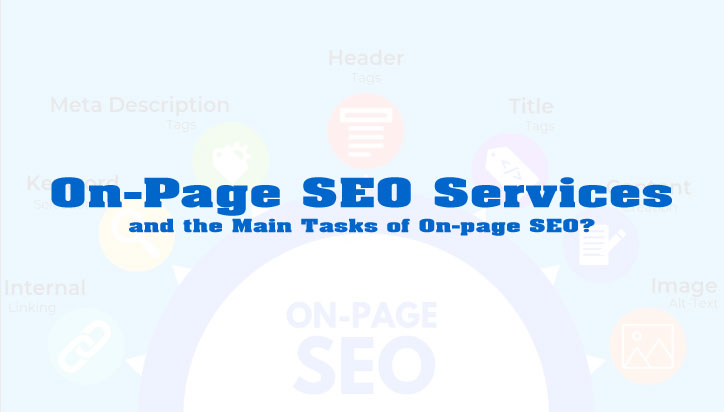
Main Components of On-Page SEO
1. Search Intent and Keyword Research
Keyword research should identify not only what people search for, but also what they expect to accomplish.
Common search intents include:
- Informational: The user wants to learn something.
- Commercial: The user wants to compare possible solutions.
- Transactional: The user is ready to purchase, register, or request a service.
- Navigational: The user wants to reach a specific website or page.
- Local: The user wants a nearby business or location-specific service.
A strong research process should:
- Identify the primary topic of each page.
- Group related queries by meaning and intent.
- Review competition and search-result patterns.
- Map one clear purpose to each important URL.
- Avoid creating several pages for minor keyword variations.
- Use relevant terminology naturally.
Tools such as Google Keyword Planner, Google Search Console, Ahrefs, Semrush, and Google Trends can provide useful data, but their metrics should support rather than replace professional judgment.
2. Page Title Optimization
The title tag helps search engines and users understand the page topic. It may also appear as the clickable title in search results, although search engines can rewrite it.
An effective title should:
- Describe the page accurately.
- Reflect the primary search intent.
- Include the main topic naturally.
- Differentiate the page from competing results.
- Avoid keyword stuffing and exaggerated claims.
- Place important wording near the beginning when practical.
There is no universal character limit that guarantees full display. Prioritize clarity and relevance rather than writing solely to reach a fixed number.
Example:
Professional On-Page SEO Services for Business Websites
3. Meta Description Optimization
The meta description summarizes the page for potential visitors. Search engines may use it in the search-result snippet, but they may also generate a different description based on the query.
A useful meta description should:
- Accurately summarize the page.
- Explain its main benefit.
- Use natural language.
- Include a relevant call to action when appropriate.
- Avoid misleading promises.
Example:
Improve content relevance, internal links, metadata, page speed, and user experience with professional on-page SEO services from Viet SEO.
4. URL Optimization
A URL should be concise, stable, and descriptive enough to communicate the page topic.
Recommended practices include:
- Use lowercase letters.
- Separate words with hyphens.
- Avoid unnecessary parameters and session IDs.
- Remove words that add no useful meaning.
- Avoid changing established URLs without a valid reason.
Clear URL:
https://vietseo.com/en/on-page-seo-services/
Less useful URL:
https://example.com/index.php?p=12345
If a URL must change, implement an appropriate permanent redirect and update internal links.
5. Content Quality and Usefulness
Content should satisfy a real user need and provide enough depth to complete the intended task.
High-quality content may include:
- A direct answer to the main question
- Accurate explanations
- Practical examples
- Step-by-step guidance
- Original research or experience
- Benefits and limitations
- Supporting visuals
- Frequently asked questions
There is no ideal word count for every page. A concise definition may require only a few hundred words, while a detailed technical guide may need several thousand.
The page should be as long as necessary to satisfy its intended purpose without repetition or filler.
6. Content Originality and Information Gain
Originality does not require discussing a topic that has never appeared online. It means offering meaningful value beyond a generic summary.
A page can provide original value through:
- First-hand experience
- Real case studies
- Expert analysis
- Original data
- Industry-specific advice
- Unique images or diagrams
- A clearer method or framework
Publishing many similar pages with only minor wording changes can create duplication and keyword cannibalization.
7. Heading Structure
Headings organize content and help users scan the page.
A logical structure usually includes:
H1for the main page headingH2for major sectionsH3for subsectionsH4for additional detail when required
A page should normally have one clear primary heading. Multiple H1 elements can be technically valid in some HTML structures, but using one descriptive H1 is usually simpler and clearer for editorial management.
Do not select heading levels based only on their visual size. Use CSS for appearance and heading tags for semantic organization.
8. Keyword Placement and Natural Language
There is no required keyword-density percentage.
The primary topic may appear naturally in:
- The title tag
- The H1
- The introduction
- Relevant subheadings
- The body content
- The URL
- The meta description
Use synonyms, entities, subtopics, and natural variations where they improve clarity. Avoid repeating the same exact phrase simply to reach a target percentage.
9. Image Optimization
Images should support the content without slowing down the page.
Recommended practices include:
- Use descriptive filenames when practical.
- Compress files appropriately.
- Choose suitable image dimensions.
- Use modern formats when supported.
- Specify width and height.
- Lazy-load images below the initial viewport.
- Add useful captions when needed.
- Provide accurate ALT text for informative images.
ALT text should describe the image’s purpose for users who cannot see it. Do not insert keywords unnaturally.
Descriptive filename:
on-page-seo-audit-checklist.jpg
Unclear filename:
img-12345.jpg
10. Internal Linking
Internal links connect related pages and help users continue their journey.
They can also help search engines:
- Discover important URLs
- Understand website structure
- Recognize topical relationships
- Identify important pages
Use internal links that are contextually useful. Anchor text should describe the destination naturally.
Avoid:
- Linking every occurrence of the same keyword
- Using the same exact-match anchor repeatedly
- Adding unrelated links solely for SEO
- Leaving important pages orphaned
11. External Links and Source Citations
External links can support factual claims and help readers access primary sources.
Link to reliable sources when discussing:
- Research and statistics
- Official documentation
- Laws and regulations
- Technical standards
- Industry reports
The relevance and authority of the source matter more than the number of outgoing links.
12. Canonical Tags
A canonical tag indicates the preferred URL when multiple URLs contain identical or substantially similar content.
<link rel="canonical" href="https://example.com/preferred-page/" />
Canonical signals should align with:
- Internal links
- XML sitemaps
- Redirects
- Preferred HTTPS and hostname versions
A canonical tag is a signal, not an instruction that always overrides every other signal.
13. Structured Data
Structured data helps search engines understand specific page elements and entities. It may also make a page eligible for supported search features.
Common schema types include:
ArticleProductOrganizationLocalBusinessBreadcrumbListVideoObjectEvent
Structured data must accurately represent visible page content. It does not guarantee higher rankings or rich results.
14. Page Speed and Core Web Vitals
Page performance affects user experience and can influence whether visitors remain on the page.
Review:
- Largest Contentful Paint
- Interaction to Next Paint
- Cumulative Layout Shift
- Server response time
- Image loading
- JavaScript execution
- CSS delivery
Common improvements include:
- Compressing images
- Using caching
- Removing unnecessary scripts
- Reducing render-blocking resources
- Improving hosting performance
- Using a CDN when appropriate
A high performance score alone does not guarantee rankings. Speed optimization should support both usability and technical reliability.
15. Mobile Usability
Pages should work properly across mobile, tablet, and desktop devices.
Review:
- Responsive layouts
- Readable text
- Tap-friendly controls
- Mobile navigation
- Forms and checkout
- Image scaling
- Pop-ups and overlays
16. Accessibility
Accessible pages serve a wider audience and usually have clearer semantic structure.
Important considerations include:
- Keyboard navigation
- Form labels
- Color contrast
- ALT text
- Captions and transcripts
- Descriptive link text
- Logical headings
17. HTTPS and Website Security
HTTPS encrypts data between the user and the website.
On-page and technical reviews should confirm:
- A valid SSL/TLS certificate
- Automatic renewal
- HTTP-to-HTTPS redirects
- No mixed-content warnings
- Secure forms
- Updated software and plugins
HTTPS is essential for trust and security, but installing a certificate alone will not produce strong rankings.
18. Author and Business Trust Signals
Users should be able to understand who created the content and which organization is responsible for the website.
Useful trust elements include:
- Author names and biographies
- Relevant professional experience
- Business contact details
- About and service pages
- Editorial policies
- Publication and review dates
- Source citations
- Customer policies and terms
19. Call to Action and Conversion Path
On-page SEO should support business outcomes without reducing informational value.
Depending on the page, the next step may be:
- Read a related guide
- Request an SEO audit
- Compare services
- Download a checklist
- Contact a consultant
- Purchase a product
The call to action should match the user’s stage in the customer journey.
On-Page SEO vs. Technical SEO vs. Off-Page SEO
| SEO Area | Main Focus | Examples |
|---|---|---|
| On-Page SEO | Individual page content and presentation | Titles, headings, content, links, images, metadata |
| Technical SEO | Crawling, indexing, rendering, and website infrastructure | Sitemaps, robots, canonicals, server errors, JavaScript |
| Off-Page SEO | External authority and reputation | Backlinks, mentions, reviews, digital PR |
These areas overlap. A complete SEO strategy should coordinate all three rather than treating them as isolated activities.
On-Page SEO Process at Viet SEO
Step 1: Audit the Current Website
The audit reviews:
- Existing rankings and traffic
- Page titles and metadata
- Content quality
- Search intent
- Duplicate and overlapping pages
- Internal links
- Images and media
- Page performance
- Structured data
- Conversion paths
Step 2: Create a Keyword and Page Map
Each important page is assigned a clear topic and search intent.
This helps prevent:
- Several pages competing for the same intent
- Important keywords having no suitable landing page
- Content being published without a business purpose
Step 3: Prioritize Pages
Pages may be prioritized according to:
- Business importance
- Traffic potential
- Current performance
- Conversion opportunity
- Technical severity
- Implementation effort
Step 4: Optimize Content and HTML Elements
This stage may include improvements to:
- Page titles
- Meta descriptions
- Headings
- Introductions
- Body content
- Images
- Internal links
- Structured data
- Calls to action
Step 5: Implement Technical Improvements
Depending on the audit, implementation may involve:
- Canonical corrections
- Redirects
- Performance optimization
- Mobile fixes
- HTTPS corrections
- Structured-data validation
- Broken-link repairs
Step 6: Test and Measure
After implementation, review:
- Indexing
- Search impressions
- Organic clicks
- Query coverage
- Engagement
- Conversions
- Technical errors
Step 7: Maintain and Refresh Content
Pages should be reviewed when:
- Information becomes outdated.
- Search intent changes.
- Traffic declines for an identifiable reason.
- Products or services change.
- New internal-link opportunities appear.
- Several pages begin competing with one another.
Benefits of Professional On-Page SEO Services
1. Clearer Search-Engine Understanding
Well-organized content, metadata, internal links, and structured information make it easier to understand the page topic and purpose.
2. More Relevant Organic Traffic
Matching content with search intent helps attract users who are more likely to engage or convert.
3. Better User Experience
Clear navigation, readable content, fast pages, and useful internal links help users find information efficiently.
4. Stronger Conversion Potential
A relevant landing page with a clear offer and appropriate CTA can turn organic visits into qualified leads or sales.
5. More Efficient Content Management
Keyword mapping, content audits, and internal-link planning reduce duplication and make future publishing easier to manage.
6. A Stronger Foundation for Off-Page SEO
Backlinks and promotion are more valuable when the destination page is useful, accessible, and well optimized.
How to Measure On-Page SEO Performance
Success should be measured using several categories of data.
Search Performance
- Impressions
- Clicks
- Click-through rate
- Average position
- Number of relevant queries
- Indexed pages
Engagement
- Engaged sessions
- Average engagement time
- Scroll depth
- Internal-link clicks
- Returning visitors
Business Outcomes
- Form submissions
- Phone calls
- Purchases
- Bookings
- Qualified leads
- Organic revenue
- Assisted conversions
A page with modest traffic but a strong conversion rate may be more valuable than a high-traffic page attracting the wrong audience.
Common On-Page SEO Mistakes
- Writing for keywords instead of search intent
- Using fixed keyword-density targets
- Making every article the same length
- Publishing generic AI-generated content without review
- Creating several pages for the same intent
- Using misleading titles
- Ignoring internal links
- Stuffing keywords into ALT text
- Changing established URLs unnecessarily
- Adding schema that does not match visible content
- Optimizing only the homepage
- Measuring success only by rankings
On-Page SEO Checklist
- Does the page serve one clear search intent?
- Does the title describe the page accurately?
- Is the H1 clear and relevant?
- Does the introduction answer the main need quickly?
- Is the information accurate and useful?
- Does the page offer original value?
- Are headings organized logically?
- Are keywords used naturally?
- Are internal links useful and descriptive?
- Are images compressed and accessible?
- Is structured data accurate?
- Is the canonical URL correct?
- Does the page work well on mobile?
- Does it load reliably?
- Is there an appropriate call to action?
- Are conversions tracked?
Frequently Asked Questions About On-Page SEO
How Long Does On-Page SEO Take?
Implementation time depends on the website size, platform, content quality, and number of issues. A single page may be improved quickly, while a large e-commerce or multilingual website may require a phased project.
How Long Before On-Page SEO Produces Results?
There is no guaranteed timeline. Search engines must recrawl and reevaluate the affected pages. Results also depend on competition, authority, technical quality, and the significance of the improvements.
What Is the Ideal Word Count?
There is no universal ideal. The page should provide enough information to satisfy the search intent without unnecessary repetition.
What Is the Best Keyword Density?
There is no required percentage. Use the primary topic and related terms naturally and prioritize readability.
Does Every Page Need Exactly One H1?
Using one clear main H1 is generally recommended for consistency and clarity. More important than the exact count is having a logical, understandable heading hierarchy.
Does the Meta Description Affect Ranking?
The meta description is mainly used to summarize the page and can influence whether users click. It is not a simple direct ranking factor.
Does Schema Guarantee Rich Results?
No. Correct structured data may make a page eligible for supported features, but search engines decide whether to display them.
Can On-Page SEO Work Without Backlinks?
Some low-competition pages may perform with strong content and technical optimization alone. Competitive topics often require broader authority, reputation, and external links.
Should Old Content Be Updated Regularly?
Update content when information becomes inaccurate, incomplete, less useful, or poorly aligned with current search intent. Avoid changing dates without meaningful improvements.
Conclusion
On-page SEO is the process of improving individual webpages so that they are easier for users and search engines to understand, navigate, and evaluate.
Effective on-page optimization combines:
- Search-intent research
- Useful and original content
- Clear titles and headings
- Natural keyword use
- Internal linking
- Image and media optimization
- Canonical and structured-data review
- Page performance and mobile usability
- Trust signals
- Conversion-focused user experience
On-page SEO should be coordinated with technical SEO, content strategy, off-page authority, and ongoing performance measurement. It is not a one-time checklist but a continuous process of improving pages as user needs, business offerings, and search environments change.
Viet SEO provides on-page SEO audits, keyword mapping, content optimization, metadata improvements, internal-link planning, structured-data implementation, page-performance review, and conversion-focused recommendations.
A professional on-page SEO strategy does not simply aim to increase rankings. Its broader purpose is to attract relevant visitors, help them find useful information, and turn organic visibility into measurable business value.


Questions & Comments
You can ask a question about this article. Viet SEO will review and reply after moderation.