Knowledge Base and FAQ Optimization for SEO, AEO/GEO & CRO
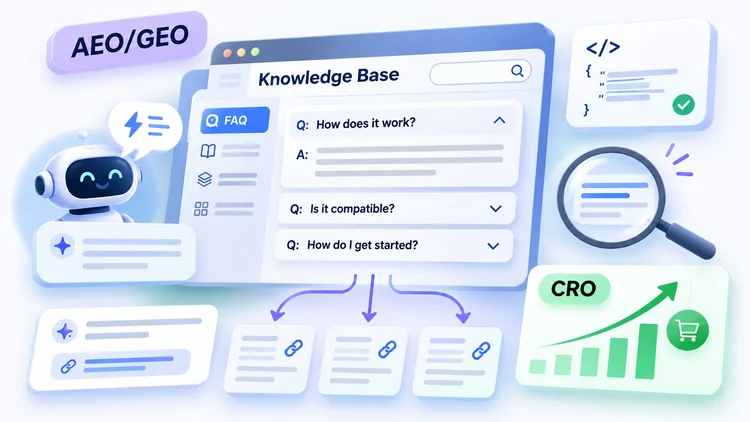
A well-managed Knowledge Base or FAQ helps visitors find reliable answers, supports search visibility, and guides users toward a relevant next step. For SEO, AEO (Answer Engine Optimization), GEO (Generative Engine Optimization), and CRO (Conversion Rate Optimization), success depends on clear content, verifiable information, accessible pages, and measurable user outcomes—not simply adding schema or an AI chatbot.
1. Knowledge Base vs. FAQ: Which should you build?
A FAQ provides concise answers to recurring questions. A Knowledge Base is a broader self-service library containing tutorials, troubleshooting articles, policies, product guidance, and related FAQ entries. Many websites benefit from both: FAQs handle quick decisions, while detailed articles resolve more complex problems.
| Content type | Best use | Recommended page structure |
|---|---|---|
| FAQ section | Common questions about a product or service | Question, direct answer, conditions, relevant link |
| Knowledge Base guide | Complex tasks or troubleshooting | Problem, prerequisites, steps, examples, next action |
| Topic hub | Organizing multiple guides around one subject | Overview, category navigation, links to detailed guides |
| Community Q&A | One question receiving user-submitted answers | Question, answers, moderation, accepted answer where applicable |
2. Use an answer-first content model
Every important answer should follow a consistent sequence: question → direct answer → explanation → evidence or conditions → next step. A brief opening answer helps readers determine whether the page addresses their needs. The fuller explanation should preserve exceptions, limitations, and examples rather than forcing everything into an arbitrary word limit.
- Question: Use the words customers actually use in support requests and site searches.
- Direct answer: State the answer immediately and avoid vague promotional claims.
- Supporting detail: Explain steps, prerequisites, limits, and when the answer may differ.
- Trust: Cite the responsible team, relevant source or policy, and review date when useful.
- Next action: Link to a tutorial, product page, contact form, or support channel when it genuinely helps.
Example: “Can I change my order after payment?” Answer with the actual eligible time window and process, then link to the current order policy. Never invent a policy or deadline to make an answer appear complete.
3. Plan topics, URLs, and internal links
- Collect recurring queries from customer support, onsite search, sales conversations, Google Search Console, and product documentation.
- Group questions by user task and intent—not keyword similarity alone.
- Choose a stable hub page for each topic and create standalone guides where additional depth is genuinely useful.
- Link from short answers to the most relevant detailed guides and back to their topic hubs.
- Review overlapping URLs before merging; unrelated language variants should not canonicalize to one another.
For multilingual sites, each substantive language version normally has its own self-referencing canonical. Use hreflang where applicable to connect equivalent language pages. Do not canonicalize a unique English page to the Vietnamese version merely because both address the same topic.
4. Choose structured data by actual page type
Structured data describes information that people can also see on the page. It does not guarantee a rich result, indexing, AI access, or an AI citation.
- Article / BlogPosting: A reasonable fit for editorial guides where the details are accurate.
- BreadcrumbList: Useful for communicating website navigation when matching visible breadcrumbs.
- FAQPage: Describes publisher-provided questions and answers, but Google retired FAQ rich results in May 2026; do not treat this markup as an SEO shortcut.
- QAPage: Intended for a page centered on one question where users can contribute answers—not a standard business FAQ with one publisher-authored answer.
- HowTo: Can represent genuinely procedural content in schema.org, but Google no longer provides How-to rich results.
For an ordinary company FAQ, clear visible HTML often matters more than adding markup that has no supported Google Search feature. If your CMS creates JSON-LD automatically, validate it against page content and avoid duplicating schema generated elsewhere.
5. Publish content that users and crawlers can access
- Ensure core questions and answers are available in rendered HTML; avoid making essential content depend solely on inaccessible interactions.
- Use descriptive headings, readable URLs, meaningful links, and accessible accordion controls.
- Check robots directives, HTTP status, canonical tags, sitemap entries, mobile usability, and loading performance.
- Where JavaScript is required, test the rendered result with appropriate inspection tools. Server-side rendering is an option, not a universal requirement.
- Confirm visible answers, structured data, and source-system values agree after each release.
6. Connect PIM, CRM, Helpdesk, and UGC safely
Designate a source of truth for each fact. Product specifications may live in PIM; shipping policies may be owned by operations; troubleshooting instructions may come from a support team. A CMS can present these facts, but it should not silently override authoritative records.
- Record the source system, content owner, effective date, and date reviewed.
- Import or propose changes using an API, webhook, or scheduled job where appropriate.
- Place sensitive or consequential changes in an editorial review queue.
- Publish approved changes and retain a revision record and rollback path.
- Moderate user-generated questions, comments, and uploaded media; protect personal information.
Automated synchronization needs error handling: a failed import should not replace a valid answer with a blank or stale response.
7. Improve CRO without turning answers into advertisements
Choose a next step that reflects the visitor's actual need. A technical troubleshooting answer may lead to a support ticket; a product comparison may lead to a specification sheet; a service qualification answer may lead to a consultation form.
- Put the direct answer before the CTA, particularly for informational queries.
- Offer a relevant link rather than repeating the same sales banner after every answer.
- Keep forms concise and explain what happens after submission.
- Test accordion labels, navigation, CTA clarity, and mobile interactions.
- Measure completed forms, qualified leads, and successful self-service—not only button clicks.
8. Measure SEO, AI visibility, and CRO separately
| Area | Useful indicators | Limitations |
|---|---|---|
| SEO | Search Console queries, impressions, clicks, CTR, indexed pages | Search performance does not identify every AI citation |
| AI visibility | Saved answer snapshots, cited URLs, platform and date, repeatable test questions | Samples are not a complete count of all AI responses |
| CRO | Qualified inquiries, purchase events, form completion, self-service success | Engagement actions are not necessarily conversions |
| Content quality | Outdated answers, failed searches, support escalation, correction time | Lower ticket volume may have more than one cause |
GA4 records activity associated with website interactions and identifiable referrals; it cannot record a no-click AI citation as a website event. For AI visibility testing, save the prompt, language, date, region when known, platform/mode, answer text, cited sources, and review decision in a separate log. Never relabel a page view or an estimated mention as an observed citation.
9. Test answer formats and user journeys
For CRO, test meaningful changes such as CTA wording or form length, choose a primary conversion metric, and determine a suitable sample before launch. Keep tracking consistent across variants and check that the user experience remains accessible.
For SEO and AEO/GEO, comparisons between groups of pages can be informative, but indexing delays, changes in search results, and variation in AI answers make causal claims difficult. Record the test period and confounding factors. Do not show search crawlers materially different content to manipulate search results.
10. Practical briefs for editors and developers
Editorial brief
- Target audience, question, intent, short answer, and expanded explanation.
- Verified source, owner, review schedule, applicable region/language, and exceptions.
- Related guide links, appropriate CTA, and required approvals.
Developer brief
- Page template, accessible accordion behavior, stable URLs, canonical/hreflang, and breadcrumbs.
- Structured data only when appropriate; test content consistency and duplicate output.
- Event definitions, consent configuration, source synchronization, audit log, and rollback tests.
11. Pre-publication and ongoing QA checklist
- All prominent answers are fact-checked, useful, and dated where appropriate.
- Each page has a unique purpose and meaningful internal links.
- Mobile navigation, keyboard access, and form submissions work.
- HTTP response, indexability, canonical, sitemap, and applicable hreflang are checked.
- Structured data, if included, matches visible information and current search documentation.
- Analytics events reflect actual user actions and consent.
- Editors can identify stale information and publish corrections safely.
- Monitoring reports distinguish organic traffic, AI citations, and business outcomes.
12. Frequently asked questions
Does FAQ schema guarantee AI citations?
No. Structured data does not guarantee that an AI service will discover, use, or cite a page. For Google Search, FAQ rich results were retired in May 2026.
Should every question have its own URL?
No. Group related short questions on useful category pages. Create a separate URL when the answer needs substantial detail or serves a distinct search intent.
Does a Knowledge Base require server-side rendering?
Not always. The important requirement is that users and relevant crawlers can access the content. Test how your technology renders and serves the page before selecting an architecture.
How can I measure AI citations without clicks?
Use a controlled monitoring process that archives AI responses and cited links. Treat the findings as a sample, not as a complete audience or conversion figure.
Conclusion
An effective Knowledge Base combines accurate answers, clear information architecture, safe publishing workflows, accessible UX, and meaningful conversion paths. Start with frequently asked questions that users struggle to resolve, maintain trustworthy source data, and measure SEO, AI visibility, and CRO with separate methods.
For help planning a search-friendly, maintainable website, explore Viet SEO's website and search optimization services.




Questions & Comments
You can ask a question about this article. Viet SEO will review and reply after moderation.