On-Page SEO: Optimization, Benefits and Best Practices
On-Page SEO: The Foundation of Sustainable Search Growth
In today’s competitive digital marketplace, every business is fighting for visibility on Google. Having a website is no longer enough. To attract qualified visitors, build trust, and generate consistent leads, your website must be easy for both users and search engines to understand.
This is where On-Page SEO becomes essential.
On-Page SEO is not simply about inserting keywords into an article, adding alt text to images, or placing a keyword in the title. It is a comprehensive optimization process that improves your website’s content, structure, technical performance, usability, and internal connections.
When these elements work together, your website becomes:
- Easier for search engines to crawl and understand
- Faster and more convenient for visitors to use
- More relevant to the audience’s search intent
- Better positioned to earn sustainable organic rankings
- More effective at converting traffic into inquiries and customers
In other words, On-Page SEO strengthens your website from the inside out. It creates the foundation that supports content marketing, link building, paid advertising, and long-term digital growth.
What Is On-Page SEO?
On-Page SEO refers to the optimization activities performed directly on a website to improve its visibility in search results and provide a better experience for users.
These activities may include optimizing page titles, headings, URLs, content, images, internal links, structured data, page speed, mobile usability, and technical crawlability.
Think of your website as a house. On-Page SEO is the process of improving everything inside that house:
- The website code is the foundation and structural framework.
- The site architecture is the arrangement of rooms and hallways.
- The content is the furniture and information visitors interact with.
- The navigation is the system that helps people move from one area to another.
- The user experience is the lighting, comfort, and overall atmosphere.
A beautiful house with a confusing layout is difficult to use. Similarly, a website may look professional but still perform poorly if its content is unclear, its pages load slowly, or search engines cannot crawl it efficiently.
Unlike Off-Page SEO, which focuses on external signals such as backlinks, digital PR, reviews, and brand mentions, On-Page SEO concentrates on the elements you can control directly within your own website.
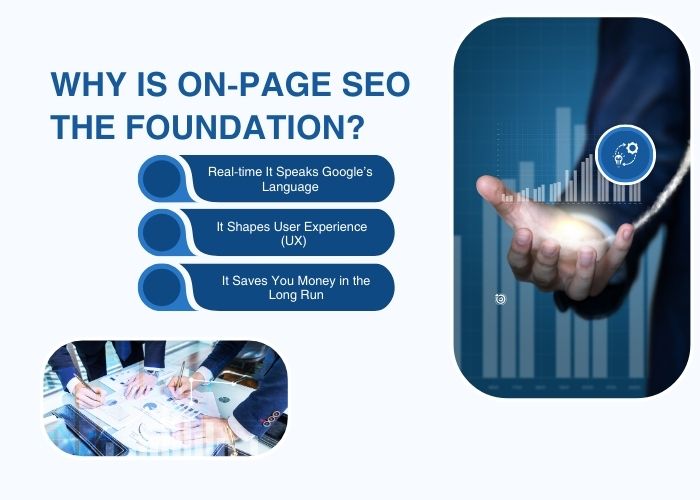
Why Is On-Page SEO Important?
Backlinks, advertising, and social media promotion can bring attention to a website. However, they cannot fully compensate for weak content, poor navigation, technical errors, or a frustrating user experience.
A successful SEO strategy therefore begins with a strong On-Page foundation.
1. It Helps Search Engines Understand Your Content
Search engines analyze many signals to determine what a page is about and which searches it should appear for. These signals include:
- Title tags and meta descriptions
- Heading structure
- Page content and keyword context
- URLs and breadcrumbs
- Internal links
- Image descriptions
- Structured data
- Website architecture
On-Page SEO organizes these signals clearly. This helps search engines understand the topic, purpose, and relationship of each page within your website.
Without a clear structure, even high-quality content may be difficult to discover, index, or rank appropriately.
2. It Improves User Experience
Visitors expect websites to load quickly, work smoothly on mobile devices, and provide straightforward answers. If a page is slow, difficult to navigate, or filled with distracting elements, users may leave before taking action.
On-Page SEO supports a better user experience by improving:
- Page loading speed
- Mobile responsiveness
- Content readability
- Navigation and information architecture
- Buttons, forms, and calls to action
- Visual stability and layout consistency
These improvements do more than support rankings. They also help visitors stay longer, explore additional pages, and move more confidently toward contacting or purchasing from your business.
3. It Aligns Content with Search Intent
Ranking for a keyword is only valuable when the page satisfies what the searcher actually wants.
For example, a person searching for “what is On-Page SEO” is probably looking for an explanation. Someone searching for “On-Page SEO services” is more likely comparing providers or looking for professional support.
A strong On-Page strategy identifies this difference and creates content that matches the appropriate intent, format, and stage of the customer journey.
4. It Supports Sustainable Organic Traffic
Paid advertising can generate immediate traffic, but that traffic usually declines when the campaign stops. On-Page SEO creates long-term value by helping useful pages earn and maintain organic visibility.
A well-optimized website can continue attracting potential customers around the clock without requiring payment for every click.
This does not mean SEO is free. It requires research, content development, technical improvements, and ongoing maintenance. However, its cumulative value can reduce long-term dependence on paid acquisition channels.
5. It Makes Other Marketing Activities More Effective
A strong website improves the performance of more than organic search. It can also support:
- Google Ads and paid landing pages
- Social media campaigns
- Email marketing
- Content marketing
- Digital PR and link building
- Lead generation and sales campaigns
When users arrive on a fast, relevant, and trustworthy page, they are more likely to engage and convert regardless of which marketing channel brought them there.
What Is Included in Professional On-Page SEO Services?
Professional On-Page SEO involves more than editing a few title tags. It requires a coordinated review of technical performance, content quality, website structure, and user experience.
A comprehensive On-Page SEO service may include the following areas.
1. Website Audit and SEO Analysis
The process normally begins with an audit to identify the issues that may be limiting the website’s performance.
The audit may examine:
- Website structure and URL organization
- Indexing and crawlability
- XML sitemap and robots.txt configuration
- Broken links and 404 errors
- Redirect chains and redirect loops
- Duplicate pages and canonical tags
- Page loading performance
- Mobile usability
- Core Web Vitals
- Existing content quality and keyword coverage
- Internal linking and click depth
The purpose of the audit is not only to list errors. It should also prioritize each issue according to its potential impact, urgency, and implementation effort.
2. Technical On-Page Optimization
Technical On-Page SEO helps search engines access, render, understand, and index website content efficiently.
Common optimization activities include:
- Creating short, descriptive, and consistent URLs
- Correcting heading hierarchy from H1 to H6
- Improving canonical tag implementation
- Optimizing robots.txt and XML sitemaps
- Resolving broken links and redirect problems
- Adding relevant structured data
- Improving page speed and server response time
- Compressing and resizing images
- Reducing unnecessary CSS and JavaScript
- Improving mobile responsiveness
- Preventing important pages from being accidentally blocked or excluded
Technical improvements should be implemented carefully. For example, a URL does not need to contain every keyword, and structured data does not guarantee rich results. The goal is to create a clean and understandable technical environment rather than simply checking items off a list.
3. Keyword and Search Intent Research
Effective keyword research is not based only on search volume. It should also consider:
- The user’s actual search intent
- The relevance of the keyword to the business
- The level of competition
- The likelihood of generating a lead or sale
- The type of page currently ranking
- The relationship between primary and supporting topics
The result should be a clear keyword map that assigns appropriate topics to appropriate pages. This helps prevent keyword cannibalization, duplicated content, and pages competing against one another.
4. Content Optimization
Content optimization improves both search relevance and usefulness for readers.
This may involve:
- Improving page titles and meta descriptions
- Rewriting introductions to address search intent quickly
- Organizing content with clear headings and subheadings
- Adding useful examples, definitions, and explanations
- Removing repetitive or outdated information
- Improving readability and paragraph length
- Adding relevant images, tables, lists, or comparison sections
- Optimizing image file names and alternative text
- Adding contextual internal links
- Improving calls to action
High-quality SEO content should demonstrate genuine experience and expertise. It should answer the reader’s questions clearly instead of repeating generic information already available on hundreds of other websites.
5. Information Architecture and Internal Linking
Information architecture determines how pages are grouped and connected across a website.
A logical structure helps visitors understand where they are, locate related information, and reach important pages with fewer clicks. It also helps search engines discover pages and understand relationships between topics.
Internal linking optimization may include:
- Linking related articles and service pages contextually
- Directing authority toward important conversion pages
- Using descriptive and natural anchor text
- Reducing orphan pages that have no internal links
- Building topic clusters around core services
- Improving navigation menus and breadcrumbs
Internal links should be useful to the reader. Adding large numbers of unrelated links simply for SEO can make the page confusing and reduce trust.
6. User Experience and Conversion Optimization
Traffic alone does not generate business results. Visitors must also be able to understand the offer and take the next step easily.
UX and conversion improvements may include:
- Creating cleaner and more readable page layouts
- Improving font sizes, spacing, and visual hierarchy
- Making important information easier to scan
- Removing intrusive pop-ups and unnecessary distractions
- Improving button labels and calls to action
- Simplifying forms
- Making contact information easy to find
- Ensuring buttons and forms work correctly on mobile devices
- Adding trust signals such as reviews, certifications, case studies, or company information
A holistic On-Page SEO service combines all these areas. The goal is not merely to increase rankings, but to create a website that attracts the right visitors and helps them become customers.
Common On-Page SEO Mistakes to Avoid
Many websites struggle with SEO not because they do nothing, but because they apply outdated, incomplete, or excessive optimization techniques.
1. Keyword Stuffing
Keyword stuffing occurs when a keyword is repeated unnaturally throughout a page in an attempt to influence rankings.
This approach makes the content difficult to read and may cause the page to appear low-quality or spammy. Instead of forcing an exact keyword into every paragraph, content should use natural language, related concepts, and clear explanations.
2. Optimizing for Keywords Instead of Search Intent
A page may contain the correct keyword and still fail to rank or convert if it does not provide the type of information users expect.
Before optimizing a page, consider whether the user wants:
- A definition or educational guide
- A product or service page
- A comparison
- A price estimate
- A local provider
- A step-by-step tutorial
The content format should match the searcher’s goal.
3. Neglecting Internal Links
Publishing articles without connecting them to related pages creates isolated content.
Internal links help visitors continue their journey and allow search engines to discover important pages. They also clarify which pages are central to a particular topic.
However, internal links should be relevant and placed naturally within useful context.
4. Publishing Thin or Duplicate Content
Short content is not automatically poor, and long content is not automatically valuable. The real issue is whether a page provides enough original information to satisfy the user’s need.
Pages that merely rewrite generic definitions, copy manufacturer descriptions, or repeat content from other pages may struggle to demonstrate unique value.
Each important page should have a clear purpose and provide information that is useful, accurate, and specific to the intended audience.
5. Ignoring Mobile Users
A page that works well on a desktop computer may still create problems on a smartphone.
Common mobile issues include:
- Text that is too small
- Buttons placed too close together
- Images wider than the screen
- Menus that are difficult to use
- Pop-ups that cover the main content
- Slow loading caused by oversized images or scripts
Mobile usability should be reviewed as part of every On-Page SEO project.
6. Using Unclear Title Tags and Headings
Titles and headings should help users understand the page before they read every paragraph.
Common problems include:
- Multiple H1 headings used without a clear purpose
- Headings selected for visual size rather than structure
- Generic titles that do not describe the page
- Titles overloaded with repetitive keywords
- Headings that do not match the content below them
A clear heading hierarchy improves readability, accessibility, and topical understanding.
7. Optimizing Once and Never Reviewing Again
SEO is not a one-time task. Competitors publish new content, user behavior changes, websites grow, and technical issues can appear after design or code updates.
Important pages should therefore be reviewed periodically to assess:
- Ranking and organic traffic changes
- Search queries and click-through rates
- Content freshness
- Broken links and technical errors
- Conversion performance
- New internal linking opportunities
On-Page SEO: From Technical Tricks to a User-Focused Strategy
Search engines have evolved significantly over the years. Algorithm systems and quality updates have increasingly emphasized relevance, helpfulness, usability, and content created for real people.
As a result, modern On-Page SEO cannot be reduced to a checklist of keyword placements. It must be integrated into a broader holistic SEO strategy that considers:
- User behavior and expectations
- Business goals
- Brand positioning
- Website performance
- Content quality
- Technical accessibility
- Conversion pathways
A truly optimized website does not rank simply because it repeats the right words. It ranks and performs because it delivers the right information to the right audience in a clear, credible, and accessible way.
Benefits of Professional On-Page SEO Services
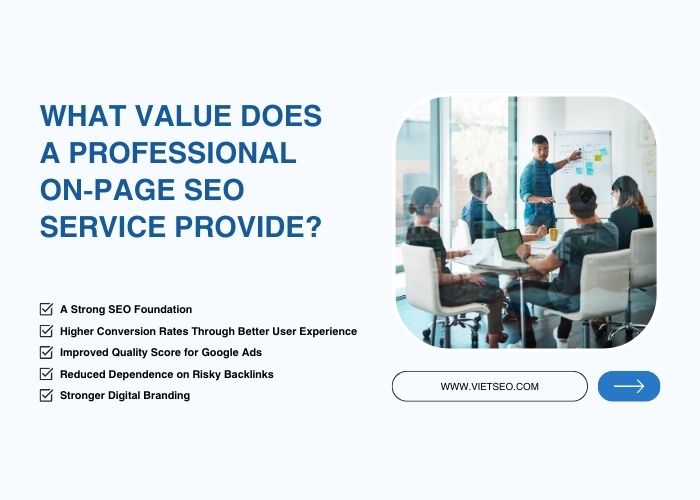
Professional On-Page SEO provides value beyond technical corrections. It helps turn a website into a stronger marketing and business asset.
1. A Stronger SEO Foundation
Clean technical implementation, logical architecture, and useful content make future SEO activities more effective.
Once the foundation is stable, businesses can invest in content development, link building, digital PR, and other growth strategies with greater confidence.
2. Better Organic Visibility
When important pages are properly structured and aligned with search intent, search engines can understand and rank them more accurately.
This can improve visibility for relevant keywords and attract visitors who are actively looking for the products, services, or information the business provides.
3. Higher Conversion Potential
On-Page SEO improves the complete user journey, not just the search result.
Visitors are more likely to take action when a page:
- Loads quickly
- Explains the offer clearly
- Answers common questions
- Provides evidence of credibility
- Includes an appropriate call to action
- Works smoothly on every device
4. Better Paid Advertising Performance
Landing page experience is an important component of paid search performance. Pages that are relevant, transparent, mobile-friendly, and easy to use can support stronger campaign results.
Improving On-Page elements may help increase engagement and conversion rates while making advertising budgets more efficient.
5. Less Dependence on Aggressive Link Building
Backlinks can support SEO, but links alone cannot make a weak page useful or trustworthy.
By improving content, structure, and user experience first, businesses can reduce their dependence on risky or excessive link-building practices.
6. Stronger Digital Brand Credibility
A clear and well-organized website creates a stronger first impression.
Accurate information, professional presentation, transparent business details, and a consistent user experience help potential customers feel more confident about contacting or purchasing from the company.
7. More Useful SEO Data
A well-structured website makes performance easier to measure. Businesses can better understand which pages attract visitors, which search queries generate opportunities, and where users leave the conversion journey.
This information supports more informed decisions about content, marketing, and website development.
Who Needs On-Page SEO Services?
On-Page SEO can benefit almost any organization with an online presence, but it is especially valuable in the following situations.
Small and Local Businesses
Small businesses often compete with larger companies that have significantly greater advertising budgets. On-Page SEO helps them improve local and organic visibility by presenting their services, locations, and expertise more clearly.
Startups and New Websites
A new website should be built with a logical structure from the beginning. Correcting architecture, URLs, and content organization after hundreds of pages have been published can be more complicated and expensive.
Early On-Page optimization creates a scalable foundation for future growth.
Websites with Low or Declining Traffic
Traffic decline may result from many factors, including outdated content, stronger competitors, technical problems, search intent changes, or poor user experience.
An On-Page audit can help identify the most likely causes and establish a prioritized improvement plan.
E-Commerce Websites
Online stores often contain large numbers of category, product, filter, and search-result pages. Without proper optimization, they may experience duplicate content, crawl inefficiency, weak product information, or confusing navigation.
On-Page SEO helps organize the catalog, improve product discovery, and support a smoother purchasing journey.
Service-Based Businesses
Service companies need clear pages for each important solution, industry, or location. On-Page SEO helps these pages target relevant searches while explaining the service, process, benefits, and next steps effectively.
News Websites and Content Publishers
Content-heavy websites depend on efficient indexing, logical categorization, readable article layouts, and strong internal linking.
On-Page optimization makes it easier for readers to discover related content and for search engines to understand large content libraries.
Businesses Running Google Ads
Businesses investing in paid traffic should ensure that their landing pages are fast, relevant, credible, and conversion-friendly. Otherwise, advertising costs may increase while potential customers leave without taking action.
How to Choose an On-Page SEO Provider
Not every SEO provider follows the same process. Before choosing a partner, ask how they approach the following areas:
- Technical website auditing
- Keyword and search intent research
- Content quality and optimization
- Internal linking and website architecture
- Page speed and mobile usability
- Measurement and reporting
- Prioritization of recommendations
- Implementation support
A reliable provider should be able to explain why each recommendation matters. Be cautious of services that promise guaranteed rankings, rely heavily on keyword density, or provide only automated audit reports without practical implementation guidance.
Frequently Asked Questions About On-Page SEO
Is On-Page SEO the Same as Technical SEO?
No. The two areas overlap, but they are not identical.
On-Page SEO focuses on the elements of individual pages and the internal website experience, including content, headings, titles, images, internal links, and usability. Technical SEO focuses more broadly on crawling, indexing, rendering, website infrastructure, performance, and technical accessibility.
A complete SEO strategy normally requires both.
How Long Does On-Page SEO Take to Show Results?
The timeframe depends on the website’s current condition, competition, crawl frequency, content quality, and the scope of the changes.
Some technical improvements can be detected relatively quickly, while significant ranking and traffic growth may take longer. SEO performance should be assessed over time rather than judged immediately after implementation.
Can On-Page SEO Work Without Backlinks?
Some pages can rank with limited backlink support, particularly when competition is low and the content strongly satisfies search intent.
However, competitive industries may also require brand authority, references, mentions, and high-quality backlinks. On-Page SEO should generally be completed before investing heavily in Off-Page activities.
How Often Should On-Page SEO Be Reviewed?
Important pages should be monitored regularly and reviewed whenever there is a significant decline, website redesign, content update, service change, or technical migration.
A broader SEO audit can also be performed periodically to identify new issues and opportunities.
Does Every Page Need to Be Optimized?
Every indexable page should have a clear purpose, but not every page requires the same level of optimization.
Priority should usually be given to:
- Core service pages
- Product and category pages
- Location pages
- High-traffic articles
- Pages with strong conversion potential
- Pages ranking near the first page of search results
Build a Stronger Website with On-Page SEO
You can invest in advertising, publish blog articles, create videos, and build backlinks. However, if the website’s foundation is weak, these activities may not deliver their full potential.
On-Page SEO is the process of making your website clearer, faster, more useful, and easier to discover. It connects technical performance with content quality and user experience.
When implemented correctly, On-Page SEO does more than improve keyword rankings. It helps your website attract relevant visitors, communicate your value, build trust, and generate sustainable business results.
If your website is receiving limited organic traffic, losing rankings, or failing to convert visitors into inquiries, a comprehensive On-Page SEO audit can help identify what needs to be improved and which actions should be prioritized.
Contact Việt SEO to evaluate your website and develop an On-Page optimization strategy aligned with your industry, target customers, and long-term business goals.


Questions & Comments
You can ask a question about this article. Viet SEO will review and reply after moderation.