The Future of Web Design and SEO: Trends and Business Strategy
Web design and SEO are evolving together.
Businesses can no longer treat design as a visual project and SEO as a separate task added after launch. Website structure, content, performance, accessibility, analytics, conversion paths, and search visibility increasingly depend on one another.
The future of web design and SEO will therefore be shaped less by isolated trends and more by integrated digital systems that help users find information, complete tasks, and interact with businesses across search engines, AI assistants, mobile devices, social platforms, and websites.
This guide explores the most important developments businesses should monitor and explains how to prepare without chasing every new technology.
The Current State of Web Design and SEO
Modern website projects already require collaboration across several areas.
Modern Web Design Priorities
- Mobile usability
- Clear navigation
- Accessible interfaces
- Fast and reliable performance
- Secure forms and transactions
- Consistent branding
- Analytics and conversion tracking
- Integration with CRM, payment, and automation systems
Modern SEO Priorities
- Search intent
- Useful and original content
- Technical crawlability and indexing
- Website architecture
- Internal linking
- Relevant authority and references
- Mobile experience
- Conversion and business outcomes
SEO is no longer limited to inserting keywords into pages. Web design is no longer limited to visual appearance. Both disciplines contribute to the same objective: helping the right users discover, understand, trust, and use the website.
Businesses exploring this shift may also review how AI is changing website SEO services.

Why Five-Year Predictions Should Be Treated Carefully
Technology changes quickly, but not every highly discussed trend becomes commercially important.
Businesses should distinguish between:
- Established shifts: Mobile usage, accessibility, AI-assisted workflows, performance, privacy, and integrated analytics
- Developing areas: Generative interfaces, multimodal search, adaptive content, and composable systems
- Speculative areas: Large-scale decentralized websites, universal immersive browsing, or complete replacement of websites by AI
A responsible digital strategy should prepare for change while continuing to solve current customer problems.
Web Design Trends to Watch
1. AI-Assisted Web Experiences
AI may increasingly support website interactions such as:
- Product recommendations
- Search assistance
- Customer support
- Content summarization
- Form completion
- Lead qualification
- Personalized onboarding
However, personalization should not become intrusive or misleading.
Businesses should clearly define:
- Which data is collected
- Why the data is needed
- How recommendations are generated
- Whether users can control or disable personalization
- How sensitive information is protected
Responsible AI-assisted design should improve task completion rather than merely demonstrate technology.
2. Adaptive Content and Personalization
Websites may increasingly adjust content according to:
- Language
- Location
- Customer status
- Device
- Previous interactions
- Selected preferences
Useful examples include:
- Showing relevant delivery information by region
- Displaying documentation for the selected product model
- Presenting content in the user’s preferred language
- Providing different onboarding steps for new and returning customers
Personalization should be supported by privacy, consent, accessibility, and accurate fallback content.
3. Accessibility as a Core Design Requirement
Accessibility is becoming an essential part of professional website design rather than an optional improvement.
Accessible design includes:
- Logical heading structure
- Keyboard navigation
- Readable color contrast
- Descriptive labels
- Alternative text for meaningful images
- Captions and transcripts
- Forms that communicate errors clearly
Improving accessibility can also improve usability for mobile users, older users, and visitors in difficult browsing conditions.
4. Performance by Design
Performance should be planned before development rather than addressed only after launch.
Design teams should consider:
- Image dimensions and formats
- Font loading
- Animation cost
- Third-party scripts
- Video delivery
- JavaScript dependencies
- Layout stability
A visually complex page is not necessarily better. The design should support the user’s main task without creating unnecessary delay or distraction.
5. No-Code, Low-Code, and Visual Development
No-code and low-code platforms can help businesses launch websites and applications more quickly.
They may be suitable for:
- Landing pages
- Small business websites
- Simple e-commerce stores
- Internal tools
- Campaign prototypes
However, visual tools do not remove the need for professional planning.
Businesses still need to manage:
- Website architecture
- Performance
- Accessibility
- Security
- Data ownership
- SEO controls
- System integrations
- Long-term maintenance
6. Composable and API-Connected Websites
Websites increasingly connect with multiple systems through APIs.
These systems may include:
- Content management
- E-commerce platforms
- CRM software
- Inventory
- Payment processing
- Marketing automation
- Customer support
- Analytics
A composable architecture can provide flexibility, but it also increases technical and operational complexity.
Businesses should consider whether the benefits justify the development, monitoring, security, and maintenance requirements.
7. Multimodal and Visual Interactions
Users increasingly interact with digital systems using more than typed text.
Possible inputs include:
- Voice
- Images
- Video
- Screenshots
- Uploaded files
- Mixed text and visual instructions
This creates opportunities for:
- Visual product search
- Image-based support
- Voice-assisted navigation
- Interactive product demonstrations
- AR product previews
These features should be implemented only when they solve a real customer need.
8. Immersive Experiences Where They Add Value
AR, 3D, and immersive experiences may be useful in specific industries such as:
- Furniture
- Interior design
- Real estate
- Education
- Tourism
- Industrial equipment
They are unlikely to be necessary for every website.
Businesses should evaluate:
- Customer value
- Device compatibility
- Performance impact
- Accessibility
- Development cost
- Maintenance requirements
SEO Trends to Watch
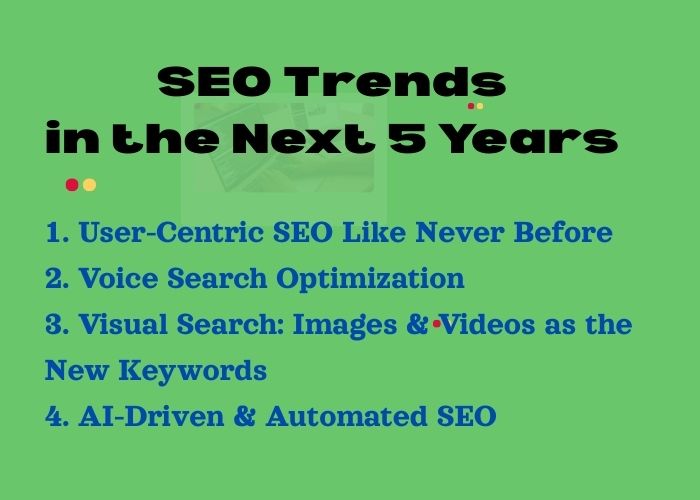
1. Search Is Becoming More Conversational
Users increasingly ask longer and more specific questions.
Instead of searching only:
“website design price”
A user may ask:
“How much should a small manufacturing company budget for a multilingual website with CRM integration?”
SEO content should therefore address complete customer needs rather than only exact-match keywords.
2. AI-Generated Search Experiences
Search platforms increasingly combine generated answers with links, images, videos, products, local results, and traditional listings.
This means businesses should provide content that is:
- Technically accessible
- Clearly structured
- Factually accurate
- Specific
- Supported by evidence
- Connected to a recognizable brand or expert
No optimization technique can guarantee inclusion in an AI-generated answer.
3. Multimodal Search
Search increasingly includes images, videos, voice, and visual inputs.
Businesses should improve:
- Original image quality
- Product photography
- Video explanations
- Image context
- Captions and transcripts
- Structured product data
Alternative text should describe images accurately for accessibility rather than function as a keyword list.
4. Brand and Entity Consistency
Search systems need consistent information about organizations, products, services, locations, and authors.
Businesses should maintain accurate information across:
- Official website pages
- Business profiles
- Product feeds
- Professional profiles
- Industry directories
- Structured data
5. Original Information Will Become More Valuable
As generic AI-generated content becomes easier to produce, original information becomes more important.
This may include:
- Firsthand experience
- Original research
- Customer data
- Expert interviews
- Product testing
- Local knowledge
- Original images and videos
- Practical limitations and trade-offs
6. Technical SEO Will Remain Essential
New search interfaces do not remove the need for websites to be crawlable, indexable, and understandable.
Technical priorities include:
- Valid status codes
- Canonical URLs
- Internal linking
- XML sitemaps
- Mobile rendering
- Structured data where appropriate
- JavaScript accessibility
- International SEO
7. Automation Will Support SEO Workflows
AI and automation may help with:
- Website crawling
- Issue classification
- Content inventory
- Internal-link suggestions
- Metadata drafts
- Performance reporting
- Content-gap identification
Automated recommendations still require human review.
Systems may misinterpret page purpose, business priorities, technical constraints, or search intent.
8. Conversion and Business Results Will Matter More
Traffic and rankings alone do not show whether SEO supports business growth.
Businesses should connect search performance with:
- Qualified enquiries
- Bookings
- Orders
- Revenue
- Lead quality
- Customer acquisition cost
- Assisted conversions
What About Voice Search?
Voice input remains useful in certain contexts, including mobile devices, vehicles, smart speakers, accessibility tools, and hands-free tasks.
However, businesses should not create a separate voice-search strategy based only on adding long question keywords.
A practical approach is to:
- Use natural language.
- Answer common customer questions clearly.
- Provide accurate local information.
- Use logical headings.
- Make important actions easy to complete on mobile.
These improvements support voice, conversational, and traditional searches at the same time.
Visual Search and Video Content
Images and videos can help users evaluate products, locations, processes, and services.
Image Optimization Priorities
- Use clear and relevant images.
- Provide appropriate dimensions.
- Compress files without excessive quality loss.
- Use descriptive filenames where practical.
- Add accurate ALT text.
- Place images near relevant text.
Video Optimization Priorities
- Use descriptive titles.
- Provide transcripts or summaries.
- Add chapters where useful.
- Create useful thumbnails.
- Embed videos on relevant pages.
- Ensure the main information is also accessible outside the video where necessary.
The Convergence of Web Design, SEO, and Conversion
Web design and SEO should be integrated from the beginning of a project.
Planning Stage
Teams should define:
- Target audiences
- Business objectives
- Search demand
- Website architecture
- Content requirements
- Conversion paths
- Analytics requirements
Design Stage
Design decisions should support:
- Readable content
- Logical headings
- Mobile usability
- Accessible interactions
- Clear navigation
- Fast and stable layouts
Development Stage
Development should support:
- Crawlable navigation
- Valid HTML
- Metadata controls
- Canonical URLs
- Structured data
- Performance
- Secure integrations
Content Stage
Content should satisfy search intent, explain the offer, support customer decisions, and connect to appropriate next actions.
Measurement Stage
Analytics should connect design and SEO activity to actual business results.
Why Dynamic Content Requires Careful Implementation
Dynamic and personalized content can improve relevance, but it can also create technical problems.
Potential risks include:
- Important content not appearing in the initial HTML
- Different users seeing inconsistent information
- Search engines receiving incomplete content
- Incorrect caching
- Privacy concerns
- Testing complexity
Critical product, service, pricing, and contact information should remain stable and accessible.
Privacy, Security, and Data Governance
Future websites will likely depend on more integrations, personalization, and automation. This increases responsibility for user data.
Businesses should define:
- Which data is collected
- Who can access it
- How long it is retained
- Which third parties process it
- How consent is obtained
- How security incidents are handled
Personalization based on sensitive traits, assumed income, health, emotion, or identity can create ethical and legal concerns.
Challenges Ahead
1. Increasing Technology Complexity
Businesses may need to coordinate CMS platforms, APIs, analytics, CRM systems, AI services, payment gateways, and automation tools.
2. Skills and Training
Teams may need combined knowledge of:
- Design
- SEO
- Development
- Analytics
- Privacy
- AI governance
- Content strategy
3. Content Quality at Scale
AI makes it easier to produce more content, but also easier to publish inaccurate, repetitive, and generic material.
4. Vendor Dependence
Businesses may become dependent on platforms that control hosting, data, payments, design, or content workflows.
Review:
- Data portability
- Export options
- Account ownership
- Integration limits
- Migration costs
5. Measurement and Attribution
Customer journeys increasingly cross search, AI tools, social media, email, and direct visits.
It may become harder to attribute a conversion to one source accurately.
6. Continuous Maintenance
Websites require ongoing updates for:
- Security
- Accessibility
- Performance
- Content accuracy
- Tracking
- Integrations
How Businesses Can Prepare
1. Build a Flexible Foundation
Choose technologies that support current needs and allow reasonable expansion without unnecessary complexity.
2. Integrate SEO Before Design and Development
Plan website architecture, content, URLs, redirects, analytics, and indexing before launch.
3. Prioritize Accessibility and Performance
These improvements create value across devices, audiences, and search experiences.
4. Collect First-Party Data Responsibly
Use forms, surveys, CRM data, and customer interactions to improve services while respecting consent and privacy.
5. Create Original Content Assets
Invest in:
- Customer research
- Product data
- Case studies
- Expert interviews
- Original images
- Useful tools
- Video demonstrations
6. Measure Business Outcomes
Evaluate whether the website generates useful customer actions rather than focusing only on design awards, traffic, or keyword positions.
7. Test New Technologies Selectively
Use small pilot projects to test AI, personalization, AR, visual search, or new interfaces before adopting them across the entire website.
Future-Ready Website Checklist
| Area | Question to review |
|---|---|
| Business goals | Does the website support measurable customer and business outcomes? |
| Architecture | Can users and search engines navigate important content easily? |
| Accessibility | Can people with different abilities use the website? |
| Performance | Does the website load reliably across devices and networks? |
| Content | Does the website provide accurate and original information? |
| AI use | Does AI support real user needs with appropriate oversight? |
| Privacy | Are data collection and personalization transparent and controlled? |
| Integrations | Are connected systems secure, documented, and maintainable? |
| SEO | Are important pages crawlable, indexable, and clearly structured? |
| Multimedia | Are images, video, and interactive content useful and optimized? |
| Conversion | Can users complete important actions easily? |
| Measurement | Are traffic, engagement, leads, and revenue tracked appropriately? |
Frequently Asked Questions
Will AI replace web designers?
AI may automate parts of research, prototyping, coding, and content production. Designers will still be needed to understand users, define interactions, maintain accessibility, solve business problems, and make responsible decisions.
Will no-code tools replace developers?
No-code tools can reduce development needs for simpler projects. Developers remain important for custom systems, integrations, security, performance, scalability, and long-term maintenance.
Will Web3 change every website?
Not necessarily. Decentralized technology may be useful for specific applications, but most businesses should adopt it only when it solves a clear problem better than conventional systems.
Is voice search the future of SEO?
Voice is one of several input methods. Businesses should create clear, conversational, mobile-friendly content rather than depend on a separate voice-search formula.
Will AI-generated search reduce website traffic?
It may reduce clicks for simple informational queries while creating opportunities for original, commercial, local, visual, and specialist content. The effect will vary by industry and search intent.
Is page speed more important than content?
No. Performance is important for usability, but it cannot replace relevance, accuracy, useful information, and a clear customer experience.
Should web design and SEO be planned together?
Yes. Architecture, navigation, content, mobile usability, performance, metadata, internal links, and conversion tracking should be considered before development begins.
What is the most important future web trend?
The most important shift is the integration of design, content, technology, data, accessibility, SEO, and conversion into one coordinated website strategy.
Conclusion
The future of web design and SEO will not be defined by one technology.
AI, visual search, automation, personalization, no-code platforms, and immersive interfaces may all influence how websites are created and used. Their importance will differ by business, audience, and industry.
The more durable trend is the convergence of design, SEO, content, data, accessibility, privacy, and conversion.
Businesses should avoid chasing every prediction. A better strategy is to build a technically reliable, accessible, fast, and useful website that can adapt as customer behavior and search technology change.
The strongest competitive advantage will not come from adopting the most fashionable tool first. It will come from understanding customers clearly, maintaining accurate information, improving continuously, and using technology where it creates measurable value.



Questions & Comments
You can ask a question about this article. Viet SEO will review and reply after moderation.