Can’t Sign in to Gmail? Causes, Fixes and Recovery Steps
Being unable to sign in to Gmail can interrupt communication, delay important work, and prevent you from accessing files, contacts, or other services connected to your Google Account.
The problem may be caused by something simple, such as an incorrect password or unstable internet connection. In other cases, Google may require additional identity verification because it detects an unfamiliar sign-in attempt, suspicious activity, or a possible security risk.
This guide explains the most common Gmail sign-in problems, the steps you can take to resolve them, and how to protect your account from future access issues.
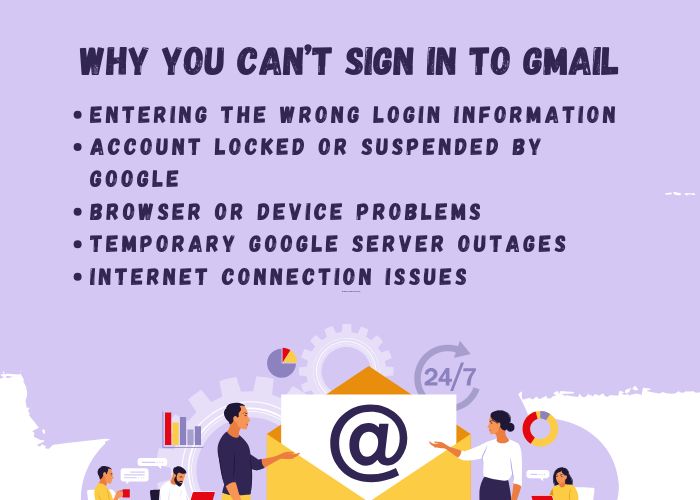
Why Can’t You Sign in to Gmail?
Gmail sign-in problems can originate from your account, browser, device, network, or Google’s security systems. Identifying the likely cause will help you choose the correct solution.
1. Incorrect Email Address or Password
The most common cause is incorrect sign-in information.
Possible mistakes include:
- Entering the wrong Gmail address
- Using the password for another account
- Typing an old password that has already been changed
- Accidentally enabling Caps Lock
- Entering additional spaces before or after the password
- Using an incorrect keyboard language or layout
Check the email address carefully and enter the password manually instead of relying immediately on an outdated password saved in the browser.
2. The Password Was Changed
If a password that previously worked is suddenly rejected, it may have been changed recently.
This can happen because:
- You changed the password on another device
- An administrator changed a work or school account password
- Someone else gained access to the account
- Google required a password reset after identifying suspicious activity
If you do not recognize the password change, begin the official Google Account recovery process immediately.
3. Google Requires Additional Verification
Google may ask you to complete an additional verification step when a sign-in attempt appears unusual.
This may occur when you:
- Sign in from a new computer or phone
- Use a different browser
- Connect from an unfamiliar network or location
- Use a VPN or proxy service
- Delete browser cookies
- Make repeated unsuccessful sign-in attempts
Google may ask you to confirm a recovery phone number, recovery email, trusted device, passkey, security key, or another previously configured verification method.
4. Two-Step Verification Is Not Working
You may know the correct password but still be unable to sign in because you cannot complete the second verification step.
Common causes include:
- The verification code does not arrive
- You changed your phone number
- Your phone is lost, damaged, or unavailable
- The authenticator application was removed
- The phone’s date and time are incorrect
- You no longer have access to the registered security key
When available, Google allows users to try another configured verification method, such as a backup phone, backup code, trusted device, security key, or passkey.
5. Browser Cache, Cookie, or Extension Problems
Damaged cookies, cached login sessions, restrictive privacy settings, or conflicting extensions may prevent the Google sign-in page from working correctly.
Common symptoms include:
- The sign-in page continuously reloads
- A blank page appears
- The account selection screen does not open
- The browser returns to the login page after verification
- Buttons do not respond
6. Outdated or Unsupported Browser
Gmail works best with a current version of a supported browser. An outdated browser may not support the security or web technologies required by the latest version of Gmail. Google recommends using current versions of commonly supported browsers.
7. Incorrect Device Date and Time
Google authentication depends on secure connections and time-sensitive verification processes.
If your computer or phone displays a significantly incorrect date, time, or time zone, authentication codes and secure connections may fail.
8. Internet or Network Problems
An unstable connection can interrupt the sign-in process before authentication is completed.
Possible network-related causes include:
- Weak Wi-Fi
- Unstable mobile data
- DNS problems
- Firewall restrictions
- Office or school network policies
- VPN or proxy interference
9. The Google Account Has Been Disabled
A disabled account is different from a temporary sign-in or verification problem.
Google may disable an account when it believes the account or its activity violates applicable policies. When an account is disabled, the user may be offered an option to request a review through the instructions displayed during sign-in.
10. Temporary Gmail or Google Service Problem
Although uncommon, a temporary service disruption may prevent Gmail from loading or processing sign-ins.
If Gmail fails on several devices and networks, check the official Google Workspace Status Dashboard or try again later before changing account settings repeatedly.
Common Gmail Sign-In Errors and Their Solutions
“Incorrect Password”
First, check Caps Lock, keyboard language, and whether the browser is automatically entering an old password.
If the password is still rejected:
- Select Forgot password?
- Enter the most recent password you remember.
- Complete the verification steps offered by Google.
- Create a new and unique password if recovery succeeds.
“Google Couldn’t Verify This Account Belongs to You”
This message means Google could not confirm account ownership using the information provided.
Google recommends trying the recovery process again and answering as many questions as accurately as possible. Using a familiar device, browser, and location may make it easier for Google to recognize the recovery attempt.
Verification Code Not Received
Try the following:
- Confirm that the displayed phone number is correct.
- Check whether the phone can receive calls or SMS messages.
- Restart the phone.
- Wait briefly before requesting another code.
- Select Try another way when the option is available.
- Use a backup phone, backup code, trusted device, authenticator application, passkey, or security key if previously configured.
“Browser Not Supported”
Update the browser to its current version or try a different supported browser.
You should also confirm that:
- JavaScript is enabled
- Cookies are allowed for Google sign-in
- The system date and time are correct
- Security software is not blocking Google pages
Gmail Displays a Blank Page
A blank page is commonly associated with local browser or extension problems.
Try these steps:
- Open Gmail in an Incognito or Private window.
- Temporarily disable browser extensions.
- Clear Google and Gmail site data.
- Update and restart the browser.
- Try another browser or device.
“Your Account Has Been Disabled”
Follow the instructions displayed by Google when you attempt to sign in.
If you believe the account was disabled by mistake and Google provides a review option, submit the requested information honestly and explain the situation clearly.
Do not repeatedly submit conflicting information or pay an outside party that claims it can bypass Google’s review process.
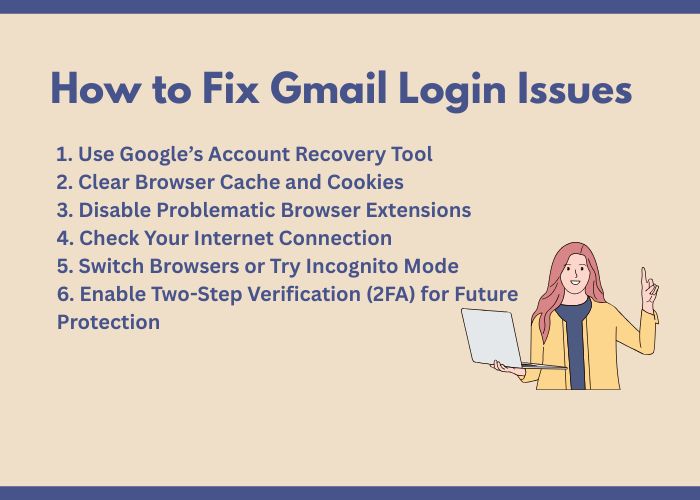
How to Fix Gmail Login Problems Step by Step
Step 1: Check Your Login Information
Confirm that:
- The email address is correct
- You selected the correct Google Account
- Caps Lock is disabled
- The keyboard language is correct
- The password manager is not entering an outdated password
Step 2: Test the Internet Connection
Open another website to verify that the connection is working.
If the connection is unstable:
- Restart the router
- Switch between Wi-Fi and mobile data
- Temporarily disable the VPN
- Try another trusted network
Step 3: Use Incognito or Private Mode
An Incognito or Private window starts a separate browser session without using most existing cookies or extension data.
If Gmail works in private mode, the problem is likely related to cached site data, cookies, or a browser extension.
Step 4: Clear Google Site Data
Instead of immediately deleting all browsing history, begin by removing cookies and cached data associated with Google and Gmail.
After clearing the data:
- Close the browser completely.
- Open it again.
- Visit the official Google sign-in page.
- Enter your account information manually.
Clearing cookies may sign you out of Google and other websites.
Step 5: Disable Browser Extensions
Temporarily disable extensions related to:
- Ad blocking
- Cookie control
- Script blocking
- VPN services
- Password management
- Antivirus browser protection
Test Gmail again and re-enable the extensions one at a time to identify the conflict.
Step 6: Update the Browser and Device
Install available updates for:
- The web browser
- The Gmail application
- Google Play Services on Android
- The phone or computer operating system
Restart the device after completing the updates.
Step 7: Use Google Account Recovery
If you forgot your password, suspect unauthorized access, or cannot complete normal verification, use Google’s official account recovery process.
During recovery:
- Use a device you previously used with the account.
- Use your usual browser whenever possible.
- Connect from a familiar location and network.
- Enter the most recent password you remember.
- Answer each question as accurately as possible.
- Provide a recovery email you can currently access when requested.
Google states that users should answer the recovery questions as accurately as possible and may try the process again if ownership cannot initially be verified.
Step 8: Check for Security Alerts
If the account remains signed in on another device, review recent security activity from that trusted device.
Look for:
- Unknown devices
- Unrecognized locations
- Password changes you did not make
- New recovery phone numbers or email addresses
- Suspicious third-party application access
Step 9: Contact Your Google Workspace Administrator
If the account belongs to a company, school, or organization, it may be managed through Google Workspace.
In this situation, contact the organization’s administrator. The administrator may be able to:
- Reset the password
- Restore a suspended organizational account
- Review login restrictions
- Check account licensing
- Assist with two-step verification policies
What to Do If You Think Your Gmail Account Was Hacked
Take immediate action if you notice an unfamiliar password change, unknown recovery information, suspicious sent messages, or login alerts from devices you do not recognize.
- Begin Google Account recovery.
- Change the password to a new and unique one.
- Sign out of devices you do not recognize.
- Review the recovery phone number and email address.
- Remove suspicious third-party access.
- Check Gmail forwarding addresses and filters.
- Enable or strengthen two-step verification.
- Scan your device for malware.
Do not reuse the new password on another website.
What Not to Do During Account Recovery
- Do not give anyone your Gmail password.
- Do not share verification codes or backup codes.
- Do not install remote-control software for an unknown support provider.
- Do not pay someone who promises to bypass Google security.
- Do not repeatedly guess recovery information.
- Do not submit contradictory answers in repeated recovery attempts.
- Do not create unofficial recovery forms that request sensitive information.
Google states that it does not work with services claiming to provide account or password support. Account recovery should be completed through Google’s official process.
How to Protect Your Gmail Account After Recovery
1. Use a Strong and Unique Password
Create a password that is not used for any other website or application.
A password manager can help generate and store strong passwords securely.
2. Enable Two-Step Verification
Two-step verification adds another identity check after the password.
Available options may include:
- Google prompts
- Authenticator applications
- Passkeys
- Hardware security keys
- Backup codes
- Phone verification where available
Google notes that SMS and phone-call codes can be more vulnerable to phone-number-based attacks than stronger verification methods.
3. Save Backup Codes Securely
Backup codes can help you sign in when your normal second verification method is unavailable.
Store them in a secure location separate from the phone you normally use for verification. Each backup code is intended for limited use.
4. Keep Recovery Information Current
Regularly check that your recovery phone number and recovery email address are still active and accessible.
5. Review Connected Devices and Applications
Remove devices and third-party applications that you no longer use or recognize.
6. Protect the Device
- Keep the operating system and browser updated.
- Use a screen lock.
- Avoid installing software from untrusted sources.
- Do not sign in on public or shared computers unless necessary.
- Sign out after using a shared device.
How Việt SEO Can Help with Gmail Login Problems
Việt SEO can provide general technical guidance to help users identify browser, device, internet, DNS, Google Workspace, and account-recovery issues.
Our support may include:
- Checking whether the problem is browser- or device-related
- Guiding users through clearing cookies and cache
- Checking common network and DNS problems
- Explaining how to use Google’s official recovery process
- Assisting companies with administrator-managed Google Workspace accounts
- Helping configure Gmail or Google Workspace on supported devices
- Providing account-security recommendations
Important Security Notice
Việt SEO cannot bypass Google’s security system, retrieve a Gmail password, guarantee account recovery, or approve a disabled-account appeal.
Only Google can verify ownership of a personal Google Account and decide whether access can be restored.
For your safety, Việt SEO will never ask you to provide:
- Your Gmail password
- A two-step verification code
- A backup code
- A passkey
- A security-key PIN
Contact Việt SEO
- Website: https://vietseo.com/
- Hotline/Zalo: 0917 212 969
Frequently Asked Questions About Gmail Login Problems
Why is Gmail rejecting a password that I believe is correct?
The saved password may be outdated, the password may have been changed on another device, the browser may be entering incorrect information, or the account may require recovery after suspicious activity. Check the keyboard and saved password before starting Google Account recovery.
Can I recover Gmail without my old phone number?
Possibly. Google may offer another verification method based on the recovery options and security information already associated with the account. Select Try another way when it is available and complete the official recovery process.
Why am I not receiving a Gmail verification code?
The phone may be offline, the number may have changed, SMS delivery may be delayed, or the selected verification method may be temporarily unavailable. Try another previously configured method such as a backup code, authenticator application, backup phone, passkey, or security key.
How long does Google Account recovery take?
Some recovery attempts are completed quickly, while others may be delayed for security reasons. Google explains that a recovery request may be placed on hold before it is processed.
Can Google or a support provider tell me my Gmail password?
No legitimate support provider should reveal or request your existing password. When recovery is successful, you may be allowed to create a new password.
Can Việt SEO recover my Gmail account for me?
Việt SEO can guide you through troubleshooting and Google’s official recovery steps, but it cannot verify ownership, bypass security, or guarantee that Google will restore the account.
What should I do if my company Gmail account is locked?
If the address is managed through Google Workspace, contact your organization’s administrator. The administrator may be able to reset the password, review account status, or assist with organizational security policies.
Will clearing browser cache and cookies delete my Gmail messages?
No. Gmail messages are stored in the Google Account, not in the browser cache. However, clearing cookies will usually sign you out and may remove locally stored website preferences.
Should I pay someone to recover my personal Gmail account?
Be cautious. No outside service can legitimately bypass Google’s ownership verification. Never pay someone who asks for your password, verification code, backup code, or remote access to your device.
Restore Access to Gmail Safely
Most Gmail login problems can be traced to incorrect credentials, two-step verification issues, browser conflicts, network problems, or Google security checks.
Start with the simplest troubleshooting steps:
- Check the email address and password
- Test the internet connection
- Try Incognito mode or another browser
- Clear relevant site data
- Use Google’s official recovery process
If the account belongs to a business or school, contact the Google Workspace administrator.
Most importantly, never share passwords or verification codes with anyone claiming that they can bypass Google security. Protecting the account is more important than recovering it through an unsafe method.




Questions & Comments
You can ask a question about this article. Viet SEO will review and reply after moderation.
Freek Human
12/06/2026Please first check that your email address and password are entered correctly, Caps Lock is turned off, and your browser is not automatically using an old saved password. You can also try signing in through an Incognito/Private window or another browser.
If you forgot your password or Google asks for additional verification, please use Google’s official account recovery process and select “Forgot password?” or “Try another way.” For the best chance of recovery, use a device, browser, and internet connection that you have previously used with the account.
If this is a company or school Gmail account managed through Google Workspace, please contact your organization’s administrator, as they may be able to reset the password or check whether the account has been suspended.
For your security, never share your password, verification code, backup code, or remote access to your device with anyone.
Could you please tell us the exact error message shown when you try to log in? This will help us suggest the correct next step.