Similar Domain Names: Brand Risks, Protection and Disputes
A domain name is more than a website address. It is an important digital asset that connects a business with its website, corporate email, advertising campaigns, customer data, and online reputation.
As a brand becomes more recognizable, domain names containing similar words, spelling variations, or different extensions may begin to appear. Some may belong to legitimate and unrelated businesses. Others may be registered for speculation, traffic diversion, impersonation, phishing, or commercial advantage.
Việt SEO has used vietseo.com as its official website and primary digital identity for many years. However, users may also encounter other domains containing the words “Viet SEO” or similar variations.
These domains should not automatically be assumed to belong to Việt SEO. Customers should verify the website address, contact information, corporate email, and official communication channels before submitting information or making a transaction.
This article explains how similar domain names can create brand confusion, how businesses can document their legitimate rights, and what steps can be taken to protect an online brand.
vietseo.com: The Official Domain of Việt SEO
vietseo.com is the official domain used by Việt SEO for its website, service information, customer communication, and online brand presence.
Việt SEO provides services related to:
- Professional website design and development
- Comprehensive SEO services
- Technical SEO and website optimization
- SEO content planning and development
- Digital marketing support
- Business email and hosting solutions
- SEO consulting and training
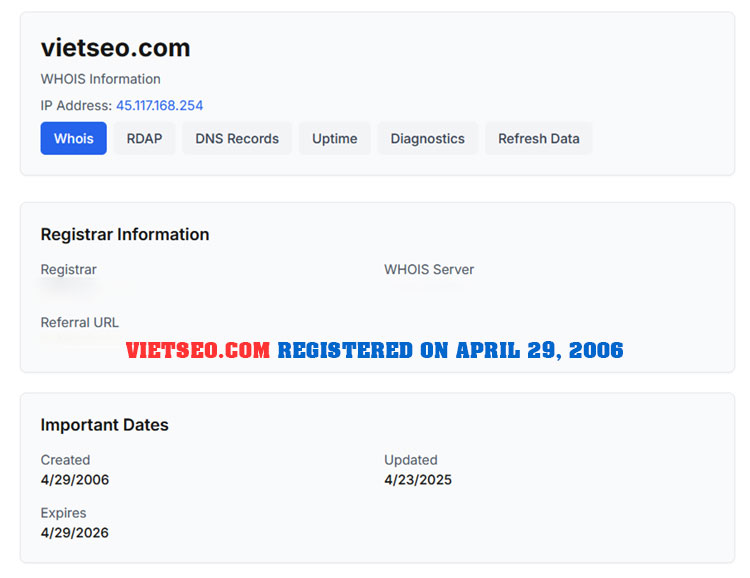
According to the company’s historical records, the domain was registered on April 29, 2006. Before publishing this date as an evidentiary claim, businesses should retain supporting registration records, invoices, archived website captures, company documents, and historical communications.
Public domain-registration lookup services such as ICANN Lookup can help users review currently available registration data. However, public registration records alone may not establish complete legal ownership of a brand.
Why Do Similar Domain Names Appear?
Similar domain names can appear for many reasons. Not every similar registration is an infringement or an attempt to impersonate another company.
Possible explanations include:
- Two businesses independently choosing similar descriptive words
- The same name being used in unrelated industries
- Registration under another country-code or generic extension
- A legitimate distributor, subsidiary, campaign, or project
- Defensive registration by the original brand owner
- Domain investment or resale
- Traffic diversion or deliberate impersonation
The purpose, content, commercial activity, registration history, and manner of use must be examined before drawing conclusions.
What Is a Confusingly Similar Domain Name?
A confusingly similar domain is a domain whose wording, appearance, or pronunciation may cause users to associate it with an existing brand.
Common variations include:
- Using another extension, such as
.net,.org, or.vn - Adding a geographic term
- Adding words such as “group,” “company,” “service,” or “online”
- Removing or adding a letter
- Changing the order of words
- Using hyphens
- Replacing a character with a visually similar character
For example, a user may incorrectly assume that the following patterns belong to the same organization:
brand.com
brand.vn
brandgroup.com
brand-service.com
brannd.com
Under the UDRP framework, confusing similarity is generally assessed by comparing the disputed domain with the textual components of the relevant trademark and considering whether the mark remains recognizable in the domain.
However, similarity alone does not automatically prove cybersquatting, trademark infringement, or bad faith.
Similar Domains, Cybersquatting, and Typosquatting
Several related concepts are often incorrectly treated as if they mean the same thing.
1. Similar Domain Name
A similar domain merely contains words or characters resembling another domain or brand.
The registration may still be legitimate if the owner:
- Has an independent right or interest in the name
- Operates in a different field without creating confusion
- Uses the domain honestly
- Does not impersonate the other business
2. Cybersquatting
Cybersquatting generally refers to registering or using a domain associated with another party’s brand in bad faith, often to profit from that brand’s reputation.
Possible warning signs include:
- Offering the domain to the brand owner at an excessive price
- Copying the original website’s design or identity
- Redirecting users to a competitor
- Using the domain for misleading advertising
- Collecting customer information through impersonation
- Registering many domains based on existing brands
3. Typosquatting
Typosquatting involves registering a domain based on a likely typing mistake or visual variation of another domain.
Examples may include:
- Missing letters
- Repeated letters
- Reversed characters
- Adjacent keyboard characters
- Similar-looking letters or numbers
Typosquatted domains may be used for advertising, traffic diversion, phishing, spam, fake login pages, or malware distribution. Research on typosquatting has documented its use in traffic theft, scams, spam, and other forms of online abuse.
Why Do Some Parties Register Brand-Related Domains?
1. Benefiting from Existing Brand Awareness
A recognizable brand already has customer awareness, search demand, links, mentions, and trust.
A third party may attempt to benefit from this awareness by using a name that creates an apparent connection with the established brand.
2. Reselling the Domain
Some domains are registered as investments with the intention of resale.
Domain investment is not automatically unlawful. However, the legal risk can become much greater when a domain intentionally targets a protected brand and is registered mainly to sell it back to the rights holder.
3. Redirecting Customers or Traffic
A similar domain may be used to redirect users toward:
- A competing business
- An advertising page
- An affiliate offer
- An unrelated service
- A lead-generation form
4. Impersonation or Fraud
The most dangerous cases involve domains used to impersonate a company through:
- Fake websites
- Fraudulent email addresses
- Payment requests
- Fake recruitment messages
- Phishing pages
- Requests for passwords or verification codes
Customers should be particularly cautious when a similar domain requests payments, account credentials, identity documents, or remote access to a device.
5. Unfair Competition or Reputation Damage
In some cases, a domain may be used to publish misleading information, imitate another company, confuse customers, or damage a competitor’s reputation.
These cases require evidence. A business should avoid publicly accusing a domain owner of fraud, copying, or unfair competition before the facts have been investigated properly.
Risks of Building a Business on an Imitative Domain
A domain that resembles an existing brand may appear to offer short-term traffic or recognition, but it can create serious long-term problems.
1. Legal and Domain-Dispute Risk
The original rights holder may send a cease-and-desist request, initiate negotiation, pursue arbitration, file a court action, or use an applicable domain-dispute procedure.
For many generic top-level domains, a UDRP complainant generally needs to establish three elements:
- The domain is identical or confusingly similar to a trademark or service mark in which the complainant has rights.
- The domain holder has no rights or legitimate interests in the domain.
- The domain was registered and is being used in bad faith.
The complainant must provide evidence supporting these elements.
Disputes involving .vn domain names follow the applicable Vietnamese regulatory and dispute-resolution framework. VNNIC identifies negotiation, arbitration, and court proceedings among the possible dispute-resolution channels.
2. Customer Trust Risk
Customers may hesitate to provide personal information or make payments when a website appears to imitate another organization.
Even when no formal violation is established, perceived imitation can damage credibility.
3. Reputation Risk
A company that builds its identity around another brand’s recognition may find it difficult to earn independent trust within its industry.
4. Search and Platform Risk
A domain is not automatically penalized by Google merely because its name resembles another domain.
However, websites involved in deceptive behavior, phishing, malware, spam, copied content, or other policy violations may lose visibility or be restricted by browsers, search engines, advertising platforms, hosting providers, or security services.
5. Limited Independent Brand Value
A business that relies on customer confusion may struggle to build:
- Distinctive brand recognition
- Defensible trademarks
- Direct customer demand
- Strong word-of-mouth referrals
- Long-term domain value
Does Early Domain Registration Prove Brand Ownership?
Early registration is useful evidence of domain history, but it does not automatically establish exclusive ownership of every similar name.
A strong brand-protection position may require several types of evidence.
1. Domain Registration Records
Businesses should retain:
- Registrar invoices
- Registration confirmation emails
- Renewal receipts
- Historical WHOIS or RDAP records
- Registrar account information
- Records showing continuous control of the domain
WHOIS and RDAP information can be helpful, but registration records should be reviewed carefully because public data may be incomplete, privacy-protected, or inconsistent across services.
2. Evidence of Continuous Commercial Use
Useful evidence may include:
- Archived website pages
- Old contracts and quotations
- Invoices using the brand name
- Advertising materials
- Company profiles
- Press coverage
- Customer correspondence
- Historical corporate email
3. Trademark Registration
A registered trademark may provide important legal support, depending on the jurisdiction, protected goods or services, registration status, and facts of the dispute.
However, owning a domain and owning a trademark are not identical rights. Businesses should consult an intellectual-property professional when assessing a real dispute.
4. Company and Business Documents
Registration certificates, tax documents, contracts, licenses, and corporate records can help show when and how the name was used commercially.
5. Consistent Digital Brand Identity
The company should use a consistent identity across:
- Official website
- Domain-based email
- Google Business Profile
- Social media channels
- Contracts and invoices
- Advertising accounts
- Customer support channels
SSL helps encrypt communication with a website, but an SSL certificate alone does not prove that the website belongs to the legitimate owner of a brand.
How Customers Can Identify the Official Việt SEO Website
Before contacting Việt SEO or submitting business information, customers should verify the following details.
1. Check the Domain Carefully
The official website is:
https://vietseo.com/
Pay attention to:
- Spelling
- Additional words
- Hyphens
- Unexpected subdomains
- Different extensions
2. Verify Contact Information
Compare the phone number, email address, company information, and social profiles with information published on the official website.
3. Check the Email Domain
Official business communication should normally use an email address associated with the company’s domain.
Be cautious when someone claiming to represent Việt SEO contacts you using:
- An unrelated free email address
- A misspelled domain
- A domain that was recently created
- An address requesting unusual payments or account credentials
4. Confirm Payment Instructions
Before transferring money, verify the recipient and payment details through a known official contact channel.
5. Do Not Share Sensitive Information Unexpectedly
Do not provide passwords, one-time verification codes, banking credentials, or remote access merely because a website or email uses a familiar-looking brand name.
How Businesses Can Protect Their Domain and Brand
1. Register the Primary Domain Early
Register the domain before publicly launching the brand whenever possible.
Choose a domain that is:
- Short
- Easy to spell
- Easy to remember
- Relevant to the brand
- Unlikely to be confused with an existing business
2. Consider Defensive Domain Registration
Businesses may consider registering:
- Important country-code extensions
- Common spelling variations
- Common typing mistakes
- Domains used for major products or campaigns
It is rarely practical or necessary to register every possible variation. Focus on domains with genuine business or security significance.
3. Use Registrar Security Features
Protect the registrar account with:
- A strong and unique password
- Two-factor authentication
- Registrar lock
- Registry lock when appropriate
- Accurate recovery information
- Restricted account access
- Automatic renewal
4. Register Relevant Trademarks
Trademark registration can strengthen the ability to protect a brand, but the application should be planned according to the jurisdictions, services, products, and markets in which the business operates.
5. Monitor Similar Domains
Monitor for:
- New domain registrations containing the brand name
- Common typographical variations
- Fake websites
- Phishing pages
- Fraudulent corporate email
- Unauthorized advertising
6. Preserve Evidence
If a suspicious domain appears, preserve:
- Screenshots
- URLs
- Dates and times
- Emails and message headers
- Payment requests
- Registration data
- Advertising copies
- Customer complaints
Evidence should be collected before contacting the domain holder because the website may later be changed or removed.
7. Publish an Official Brand Notice
Clearly identify the official:
- Website domain
- Corporate email addresses
- Telephone number
- Social media pages
- Payment procedures
What to Do If a Domain Is Impersonating Your Business
Step 1: Investigate the Domain
Review:
- The domain spelling
- The website content
- The products or services offered
- The contact information
- Registration data
- Hosting information
- Whether users are actually being confused
Step 2: Document the Evidence
Create a complete record of the suspicious activity before requesting removal.
Step 3: Assess Rights and Legitimate Interests
Determine whether the other party may have an independent and legitimate reason to use the name.
Similarity alone is not sufficient to prove bad faith.
Step 4: Contact the Relevant Providers
Depending on the situation, the business may contact:
- The domain registrar
- The hosting provider
- The email provider
- The advertising platform
- The browser or security provider
- The payment provider
Reports should explain the specific policy or unlawful activity and include supporting evidence.
Step 5: Consider a Formal Dispute Process
Depending on the domain extension and jurisdiction, available options may include:
- Direct negotiation
- A cease-and-desist notice
- Registrar abuse reporting
- UDRP proceedings
- Applicable
.vndispute procedures - Arbitration
- Court proceedings
Legal advice should be obtained before initiating a formal claim or making public accusations.
Should You Register a Similar Domain or Build an Original Brand?
A domain should support a business’s own identity rather than depend on confusion with another company.
When May a Similar Name Be Legitimate?
A similar name may be reasonable when:
- The business has an independent legal or commercial right to the name.
- The name is descriptive or commonly used.
- The businesses operate in unrelated markets.
- The website does not imitate another organization.
- The domain does not mislead users about affiliation.
Why Is an Original Brand Usually Better?
An original brand makes it easier to:
- Develop distinctive recognition
- Register and defend intellectual-property rights
- Build direct search demand
- Earn customer trust
- Create consistent content and design
- Reduce future legal and commercial risk
Lessons from the Việt SEO Domain History
The history of vietseo.com illustrates several important principles for businesses building a digital brand.
1. Secure Digital Assets Early
Domains, social media usernames, email systems, and trademarks should be considered before the brand is widely promoted.
2. Keep Domain Control with the Business
The business should retain control of the registrar account, billing information, recovery methods, and administrative email.
A domain should not remain solely under the personal account of an employee, designer, or external supplier.
3. Build Consistency Over Time
A recognizable brand is created through consistent service quality, content, customer experience, design, communication, and business conduct.
4. Do Not Rely Only on Domain Age
An older domain can support a company’s historical narrative, but age alone does not guarantee:
- Higher Google rankings
- Trademark ownership
- Superior service quality
- Exclusive rights to every similar phrase
5. Protect Reputation Through Real Value
The strongest protection for a brand is not only a domain registration. It is also the company’s record of useful work, transparent communication, customer relationships, and consistent market presence.
Frequently Asked Questions About Similar Domain Names
Does a similar domain automatically infringe a brand?
No. Similarity is only one factor. The rights of each party, legitimate use, protected trademarks, industry, customer confusion, and evidence of bad faith may also need to be considered.
Does registering a domain first give complete ownership of the brand?
No. Earlier registration can be useful evidence, but domain ownership, trademark rights, company-name rights, and commercial use are separate legal and factual issues.
Is buying and reselling domain names illegal?
Domain investment and resale are not automatically unlawful. Risk increases when a domain deliberately targets another party’s protected brand and is registered or used in bad faith.
Can Google penalize a domain simply because its name resembles another brand?
Not merely because of the name. However, deceptive websites, copied content, phishing, malware, spam, and other policy violations can lead to reduced visibility or security restrictions.
How can I confirm the official Việt SEO website?
The official website is https://vietseo.com/. Verify contact and payment information through the details published on that domain before proceeding with a transaction.
What should I do if I find a website impersonating my company?
Preserve evidence, investigate the domain and provider, assess your legal rights, notify relevant platforms, and obtain appropriate legal advice before initiating a formal dispute.
Should I register multiple extensions for my brand?
Businesses may register strategically important extensions and common variations, but registering every possible domain is rarely practical. Prioritize the main markets, common typing errors, and domains with genuine security or commercial value.
Protect Your Domain and Build an Original Brand
A domain name is one of the central components of a business’s digital identity. It supports the website, email, customer communication, advertising, and online reputation.
Businesses should register important domains early, secure registrar accounts, maintain historical evidence, consider relevant trademark protection, and monitor for misleading registrations.
At the same time, the presence of a similar domain should be assessed objectively. Not every similarity proves copying, fraud, or infringement.
Việt SEO uses vietseo.com as its official website and primary online domain. Customers should verify this address and official contact information before providing data, making payments, or entering into a service agreement.
The most sustainable strategy is not to depend on another organization’s recognition. It is to build a distinct brand supported by useful services, transparent communication, original content, and genuine customer value.




Questions & Comments
You can ask a question about this article. Viet SEO will review and reply after moderation.