How to Choose an SEO Provider and Avoid Project Failure
Businesses can choose from many SEO providers, including independent consultants, specialist teams, web-development companies, and full-service digital agencies.
However, two companies using the same term “SEO service” may provide very different scopes, methods, resources, and reporting standards.
Some campaigns underperform because the provider lacks suitable expertise or uses an ineffective process. Other projects struggle because technical recommendations are not implemented, content approvals are delayed, conversion tracking is missing, or the website and business offer do not meet customer expectations.
This guide explains:
- What an SEO provider actually does
- Why some SEO projects fail to deliver meaningful results
- How to evaluate an agency’s experience and process
- Which KPIs should be included in reporting
- What to review before signing an SEO contract
- How to build an effective working relationship with an SEO provider
What Does Providing SEO Services Mean?
Providing SEO services means helping a business improve its website and organic search presence through research, technical work, content, website structure, authority development, and performance measurement.
The objective should not be limited to placing a website at the top of Google for a few selected keywords.
A professional SEO service should help the business:
- Reach relevant search users
- Improve important website pages
- Resolve technical problems
- Develop useful content
- Generate qualified traffic
- Measure leads, sales, and business contribution
Main Components of an SEO Service
1. Business and Market Research
Before recommending keywords or content, the provider should understand:
- Products and services
- Target customers
- Service locations
- Customer problems and questions
- Main competitors
- Sales process
- Business objectives
2. Technical SEO
Technical SEO helps search systems access, render, understand, and index website content.
It may include:
- Crawling and indexing checks
- XML sitemaps
- robots.txt
- Canonical tags
- Redirects
- HTTP status codes
- Page speed
- Mobile usability
- JavaScript rendering
- Structured data
- Website migrations
3. On-Page SEO
On-Page SEO improves individual pages for clarity, relevance, and usability.
Typical work may include:
- SEO titles
- Meta descriptions
- Heading hierarchy
- Search-intent alignment
- Content quality
- Internal links
- Images and alt text
- Calls to action
4. Content Strategy
Content strategy determines which pages and resources the website needs.
Depending on the business, this may include:
- Service pages
- Product and category pages
- Location pages
- Blog articles
- Pricing guides
- Comparison pages
- Frequently asked questions
- Case studies
5. Website Architecture and Internal Linking
A logical structure helps users and search systems understand the relationship between products, services, locations, and topics.
6. Authority and Reputation Development
Depending on the project, authority development may include:
- Relevant industry citations
- Digital PR
- Expert contributions
- Business directories
- Partnership content
- Customer reviews
- Useful resources that earn references
Social-media activity can support brand exposure, but it should not automatically be treated as a direct substitute for relevant website references or backlinks.
7. Analytics and Conversion Tracking
SEO reporting should connect search performance with meaningful actions such as:
- Phone calls
- Form submissions
- Appointments
- Quotation requests
- Orders
- Qualified leads
- Revenue
Why Do Some SEO Projects Fail?
An underperforming SEO project does not always have one simple cause. Several strategic, technical, operational, and commercial factors may contribute.
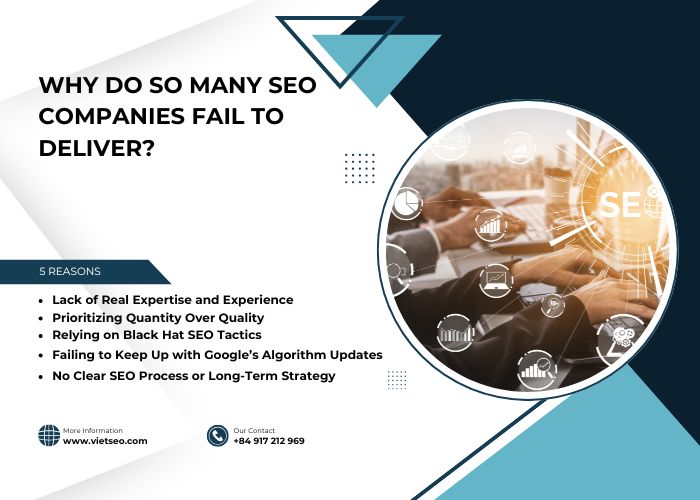
1. The Provider Does Not Understand the Business
A campaign may attract irrelevant traffic when keywords are chosen without understanding:
- The actual products or services
- Target customers
- Service locations
- Sales margins
- Customer value
- Business priorities
2. The Strategy Focuses Only on Rankings
Ranking a keyword does not guarantee:
- Relevant traffic
- Qualified inquiries
- Sales
- Profit
A project should connect keyword visibility with suitable landing pages and customer actions.
3. The Provider Lacks Suitable Technical Capability
An agency may identify problems but lack the ability to implement or coordinate changes involving:
- Website code
- Templates
- Redirects
- Page speed
- JavaScript
- Analytics
- Server configuration
4. Content Is Produced for Quantity Rather Than Purpose
Publishing a large number of articles does not guarantee organic growth.
Content may underperform when it is:
- Generic
- Repetitive
- Factually weak
- Disconnected from commercial pages
- Written for keywords rather than customer needs
- Published without editorial review
5. External-Link Methods Are Poorly Planned
Problems may occur when a provider focuses on link quantity without considering relevance, context, source quality, and business reputation.
Private networks, paid publications, or other link methods should not be evaluated through labels alone. The client should understand the source, purpose, ownership, and risks involved.
6. There Is No Defined Priority Roadmap
SEO tasks should be prioritized according to impact, effort, risk, and business value.
Without prioritization, teams may spend months making minor changes while critical indexing, content, or conversion problems remain unresolved.
7. Recommendations Are Not Implemented
SEO work may stall when:
- Developers are unavailable.
- Content approvals take too long.
- The business does not provide necessary information.
- Important website changes are rejected.
- No internal project owner is assigned.
8. Tracking Is Missing or Inaccurate
Without suitable tracking, neither the provider nor the client can determine which pages, keywords, and campaigns generate useful outcomes.
9. The Website or Offer Does Not Convert
SEO can attract visitors, but it cannot independently fix every commercial problem.
Conversions may remain low because of:
- Uncompetitive pricing
- An unclear offer
- Poor customer reviews
- Weak sales follow-up
- Complicated forms
- Limited trust information
- Poor mobile usability
10. Expectations Are Unrealistic
SEO cannot guarantee:
- First-place rankings
- Permanent positions
- A fixed volume of traffic
- A fixed number of sales
- Results within one universal timeframe
Does an SEO Provider Need to Follow Every Google Update?
Search systems change regularly, but a professional provider should not rebuild the entire strategy after every reported update.
The agency should focus on durable practices such as:
- Useful and accurate content
- Clear website architecture
- Technical accessibility
- Responsible authority development
- Good customer experience
- Reliable measurement
When performance changes, the team should diagnose the affected pages, queries, markets, and website changes rather than immediately blaming an algorithm update.
How to Evaluate an SEO Provider’s Experience
1. Review Relevant Projects
Ask whether the provider has experience with:
- Your industry
- Your target market
- Your website platform
- Your business model
- A similar project scope
2. Review Case Studies Carefully
A useful case study should explain:
- The client’s starting position
- The project objective
- The problems identified
- The work completed
- The implementation period
- The measurable outcome
- Relevant limitations or context
A list of ranking keywords or an isolated traffic screenshot is not sufficient evidence.
3. Respect Client Confidentiality
An agency may not be able to provide unrestricted access to another client’s Google Analytics or Search Console data.
Evidence should be shared with appropriate permission and protection of confidential information.
4. Ask Who Performs the Work
Clarify who is responsible for:
- Strategy
- Technical auditing
- Development
- Content writing
- Editing
- Authority development
- Reporting
How to Evaluate an SEO Provider’s Process
A typical professional process may include the following stages.
Step 1: Business Discovery
The team reviews the company, target customers, sales process, services, products, locations, and objectives.
Step 2: SEO Audit
The audit may examine:
- Crawling and indexing
- Technical condition
- Website architecture
- Content
- Internal links
- External references
- Analytics and conversions
Step 3: Keyword and Search-Intent Research
Search opportunities should be evaluated according to:
- Business relevance
- Search intent
- Estimated demand
- Competition
- Suitable page type
- Potential business value
Step 4: Website and Content Mapping
Keyword and topic groups are assigned to suitable pages.
Step 5: Priority Planning
Tasks are organized according to impact, effort, risk, and available resources.
Step 6: Implementation
Technical, On-Page, content, internal-linking, and authority work is completed according to the agreed scope.
Step 7: Conversion Tracking
Important business actions are defined and measured.
Step 8: Reporting and Improvement
The provider reports completed work, performance, current issues, and upcoming priorities.
How Should an SEO Provider Define Success?
SEO success should be evaluated at several levels.
| Level | Possible Measurements |
|---|---|
| Implementation | Completed technical, content, and website tasks |
| Technical health | Crawlability, indexing, redirects, mobile usability, and errors |
| Search visibility | Relevant impressions and keyword coverage |
| Traffic | Relevant organic clicks and landing-page visits |
| Conversions | Calls, forms, appointments, orders, and registrations |
| Lead quality | Qualified opportunities generated by organic search |
| Financial impact | Revenue, gross profit, customer acquisition cost, and ROI |
Bounce rate and engagement time should be interpreted according to page purpose and analytics configuration. They should not be treated as universal indicators of SEO quality.
What Should an SEO Contract Include?
1. Project Scope
The contract should define:
- Website sections included
- Keyword and topic scope
- Technical work
- Content deliverables
- Development responsibilities
- Authority-development activities
- Reporting
2. Responsibilities
Clarify which tasks belong to the provider and which require action from the client.
3. KPIs and Measurement
KPIs should be clearly defined, measurable, and connected to the project scope.
4. Payment and Additional Costs
The agreement should identify:
- Service fees
- Content costs
- Development fees
- Paid publications
- Software costs
- Other excluded expenses
5. Content and Account Ownership
The business should retain ownership or appropriate administrative control of:
- Domain names
- Website source code
- Google Search Console
- Google Analytics
- Google Business Profile
- Content and design assets
Backlinks are references on third-party websites and cannot always be “owned” in the same way as website content. The agreement should instead explain the provider’s link methods, paid-placement terms, and what may happen after the contract ends.
6. Access and Security
Access should be provided through individual accounts with suitable permission levels.
7. Cancellation and Handover
The agreement should explain what happens to:
- Accounts
- Content
- Reports
- Files
- Unfinished tasks
- Access permissions
Warning Signs of an Unreliable SEO Provider
Be cautious when a provider:
- Guarantees first-place rankings
- Promises results within a few days
- Refuses to explain its methods
- Provides no technical or content assessment
- Sells large quantities of links without describing the sources
- Reports only keyword positions
- Does not define deliverables
- Requires ownership of the client’s important accounts
- Provides no handover process
Client Responsibilities in an SEO Project
A strong provider cannot complete every project successfully without cooperation from the business.
1. Provide Accurate Business Information
The agency needs correct information about services, products, locations, pricing, customers, and competitive advantages.
2. Assign a Project Owner
One internal contact should coordinate access, approvals, feedback, and implementation.
3. Approve Work Within a Reasonable Time
Long delays can affect publication schedules and technical progress.
4. Support Technical Implementation
The client should provide suitable developer, hosting, or website access when required.
5. Share Lead and Sales Quality
The SEO team needs to understand which inquiries become qualified opportunities and customers.
6. Maintain Product and Service Quality
SEO cannot compensate indefinitely for poor service, misleading information, weak sales follow-up, or an uncompetitive offer.
Potential Benefits of Choosing the Right SEO Provider

1. A Clearer Search Strategy
The business receives a structured plan based on customer demand, website condition, and commercial priorities.
2. An Improved Website Foundation
The project may strengthen:
- Technical stability
- Website architecture
- Content clarity
- Internal linking
- Mobile usability
- Conversion pathways
3. More Relevant Organic Visibility
The website may reach users searching for suitable products, services, locations, and information.
4. Better Customer and Market Data
Search data may reveal:
- Customer language
- Common problems
- Product demand
- Location opportunities
- Questions asked before purchase
5. A More Measurable Marketing Channel
When tracking is configured properly, the business can evaluate organic leads, sales, and revenue.
6. Stronger Internal Capability
Documentation, training, and clear processes can help the client’s internal team manage the website more effectively.
What the Right SEO Provider Cannot Guarantee
Even a capable agency cannot guarantee:
- Permanent rankings
- A fixed number of leads
- Lower costs than every paid channel
- That every search user has purchase intent
- That higher rankings automatically create trust
- That organic traffic continues indefinitely without maintenance
Frequently Asked Questions About SEO Providers
What does an SEO provider do?
An SEO provider may conduct research, technical optimization, content planning, On-Page SEO, internal linking, authority development, and performance measurement.
Why do SEO projects fail?
Possible causes include weak strategy, poor implementation, irrelevant content, missing tracking, unrealistic expectations, delayed approvals, website problems, and a weak business offer.
Can an SEO agency guarantee rankings?
No provider controls Google’s ranking systems. It can commit to agreed work, implementation standards, communication, and reporting.
How long does SEO take?
The timeframe depends on website condition, competition, content, authority, implementation speed, and project scope. No universal period applies to every campaign.
Should an agency show Search Console data from other clients?
Case-study evidence can be useful, but client confidentiality and access permissions should be respected.
Should the client own the SEO accounts?
The business should retain ownership or administrative control of its domain, website, analytics, Search Console, and other important digital assets.
Does SEO always reduce marketing costs?
No. SEO has its own strategy, content, development, and maintenance costs. Its financial value depends on actual leads, revenue, margins, and customer acquisition costs.
Are low-cost SEO services always poor quality?
No. A smaller or focused project may cost less. Businesses should compare scope, capabilities, implementation, reporting, and risk rather than price alone.
Choose an SEO Provider Based on Process and Fit
The right SEO provider is not necessarily the largest agency, the cheapest package, or the company promising the fastest rankings.
Businesses should evaluate:
- Business understanding
- Relevant experience
- Technical capability
- Content quality
- Implementation resources
- Authority-development methods
- Measurement and reporting
- Account ownership
- Contract and handover terms
An effective SEO partnership also requires cooperation from the client, including timely approvals, accurate business information, suitable technical access, and feedback on lead quality.
A suitable provider should help the business build a more useful, technically stable, visible, and measurable website rather than simply deliver a monthly list of tasks.




Questions & Comments
You can ask a question about this article. Viet SEO will review and reply after moderation.