SEO Marketing Strategy: Complete Guide for Business Growth
An SEO marketing plan should account for what happens after a page is published. Products change, customer questions evolve and useful resources can become inaccurate even while they continue receiving visits.
This guide approaches SEO marketing as the management of a useful website over time: choosing which pages to create, maintaining the ones customers rely on and using evidence before consolidating or retiring content.
SEO Marketing Costs: Budget for Creation and Maintenance
Organic clicks have no direct per-click advertising charge, but useful pages need research, implementation and continued care. This article has no fixed service prices; compare quotations by scope and responsibility.
Discovery and planning
Review customer needs, existing pages and measurement. Specify whether the deliverable is an assessment, an implementation plan or both.
Content and expert review
Include writing, editing, factual approval, imagery and publication. Distinguish new pages from updates to existing resources.
Website changes
Identify development, technical checks and release responsibilities. Confirm which work is included and which requires a separate website team.
Ongoing stewardship
Allow for content reviews, product changes, broken journeys and reporting. Agree who maintains each resource and how additional work is approved.
Before expanding production: check whether the team can keep the proposed pages accurate. A publishing schedule that exceeds review capacity can leave the website with more content and less reliable information.
What Is SEO Marketing?
SEO marketing uses search engine optimization within a business’s marketing plan. It connects customer needs with relevant website pages, technical accessibility and appropriate next actions.
The work includes research, content, structure, technical improvements and measurement. The aim is not simply to accumulate keywords or articles, but to help suitable customers find information they can use.
A page can support discovery, comparison, preparation for a consultation or product use after purchase. Its purpose should guide both its content and how performance is evaluated.
Why Can SEO Marketing Be Valuable?
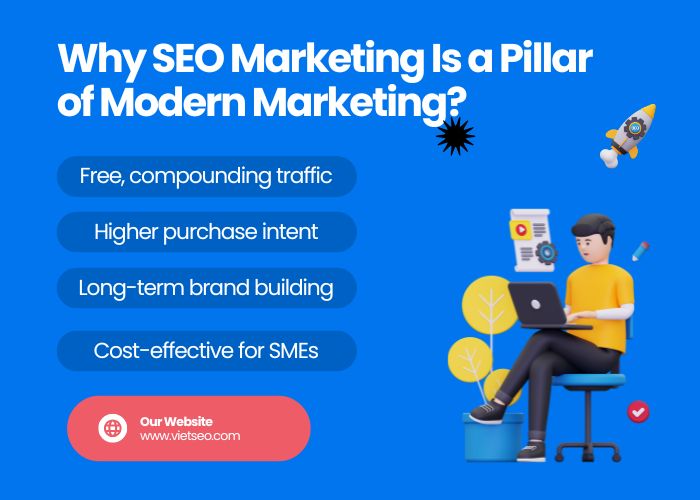
1. Reach Users with Active Search Demand
Search users may already be looking for:
- A product
- A service provider
- A local business
- A price or quotation
- A solution to a problem
- A comparison between available options
This can create valuable opportunities, but not every search indicates immediate purchase intent. The keyword, page type, offer, and customer journey still matter.
2. Build Owned Digital Assets
SEO investments can strengthen assets controlled by the business, including:
- Website content
- Service and product pages
- Website architecture
- Analytics data
- Customer resources
- Internal knowledge
3. Support Longer-Term Organic Discovery
Useful pages may continue generating organic traffic after publication.
However, performance can decline because of:
- Competitors
- Outdated content
- Technical errors
- Search-demand changes
- Website migrations
- Changes in search systems
SEO therefore requires monitoring and maintenance.
4. Improve the Website
SEO projects often improve:
- Page speed
- Mobile usability
- Navigation
- Content clarity
- Internal links
- Landing pages
- Conversion pathways
5. Support Small and Medium-Sized Businesses
SMEs may compete effectively by focusing on:
- Specific services
- Local searches
- Niche customer needs
- Detailed product or service information
- High-value long-tail queries
A smaller business does not automatically have an equal chance of ranking against a large brand, but a focused strategy can create commercially useful opportunities.
How to Build an SEO Marketing Strategy
Step 1: Define Business Objectives
Begin with the outcome the business wants to achieve.
Examples may include:
- Generate more qualified quotation requests.
- Increase online orders from organic search.
- Improve visibility for a priority service.
- Reach customers in a defined local market.
- Reduce dependence on one paid acquisition channel.
Targets should be based on existing data, available resources, market conditions, and sales capacity.
Avoid setting arbitrary ranking or traffic commitments before reviewing the website and competition.
Step 2: Establish a Performance Baseline
Create a record of the pages in scope before changing them. Include the intended audience, purpose, important queries, available traffic data and known customer actions.
- Separate branded and non-branded demand where the distinction matters.
- Record the reporting period, measurement definitions and data gaps.
- Note product launches, campaigns, migrations or other changes that affect comparison.
- Identify resources used by sales or support even when search traffic is limited.
A baseline provides context. It does not make every later difference attributable to the SEO work.
Step 3: Understand the Customer
Collect questions from sales, support and existing customers, then compare them with search observations. Summarize needs without copying unnecessary personal information into the content plan.
Ask what people must understand before choosing, what often causes unsuitable enquiries and which information remains useful after purchase. Have the product owner verify answers before treating them as publishable facts.
Step 4: Map Search Intent to the Customer Journey
Use customer tasks to choose the page format. These examples are illustrative; customers can move between several tasks rather than follow a fixed funnel.
Understand a problem
A guide can explain the issue, possible approaches and when further assessment is needed.
Evaluate a solution
A product or solution page can describe applications, requirements and limitations.
Compare alternatives
A comparison should state criteria and conditions, rather than declare one option universally superior.
Prepare to act
A pricing or enquiry page should explain scope, quotation inputs and what happens after contact.
Related questions can belong on one page when they serve the same task. A separate keyword variation is not sufficient reason to create another URL.
Step 5: Research Keywords and Search Results
Keyword research should consider:
- Business relevance
- Search intent
- Estimated demand
- Competition
- Target location
- Search-result composition
- Suitable page type
- Potential conversion value
Tools may support research, but their volume and difficulty metrics are estimates rather than guaranteed outcomes.
Useful Research Sources
- Google Search Console
- Google Keyword Planner
- Search-result analysis
- Competitor websites
- Sales and customer-support questions
- Professional SEO platforms
Step 6: Prioritize Opportunities
Consider both the value of answering a need and the effort required to keep the answer accurate. A commercially important page with missing conditions may deserve attention before a new high-volume topic.
- Is the need relevant to a product or service the business can deliver?
- Does an existing page already meet it, or need a targeted update?
- Are reliable facts and a qualified reviewer available?
- What development or maintenance work will the page create?
- How will the team evaluate whether the work helped?
Search-volume and difficulty estimates are inputs, not a complete investment decision.
Step 7: Create a Keyword and Page Map
Map related customer needs to pages and record the proposed action: retain, update, add a resource or investigate consolidation. One useful page can answer several closely related queries.
Query overlap between pages does not automatically establish harmful competition. Check whether the pages serve distinct tasks, audiences or product needs before removing or merging them.
Step 8: Plan the Website Architecture
The website should make it easy to understand:
- What the business provides
- How products and services are grouped
- Which locations are served
- How supporting content relates to commercial pages
- What action the customer should take next
Step 9: Create Useful Content
Give each page a brief that identifies the reader, task, factual sources and appropriate next action. State who will approve the content and what business change should trigger a review.
Use the detail needed to answer the question: specifications, conditions, examples, comparisons or preparation steps. Label hypothetical examples and do not present them as customer results.
Content Quality Checklist
- Can the reader complete the intended information task?
- Are important claims supported by approved information?
- Are conditions and limitations visible near the relevant claim?
- Does the page add useful detail beyond generic summaries?
- Do links lead to the right next resource?
- Is the contact or purchase path usable?
- Is there an owner for future updates?
A word count or tool score does not establish quality. Google’s people-first content guidance includes questions for evaluating usefulness, accuracy and original value; apply them critically to the page’s actual purpose.
Step 10: Optimize On-Page Elements
Important elements may include:
- SEO title
- Meta description
- Heading hierarchy
- Introductory content
- Internal links
- Image alt text
- Descriptive filenames
- Calls to action
Primary and secondary phrases should be used naturally. Repeating keywords does not make a page more relevant.
Technical SEO Foundations
Technical SEO helps search systems access, render, understand, and index website content.
1. Crawl and Index Management
Review the role of robots.txt, indexing directives, canonical signals, sitemaps, redirects and response codes on the pages that matter. These mechanisms serve different purposes and should not be treated as interchangeable switches.
A legitimate removed page can return a not-found response. A replacement or moved page may need a suitable redirect. Do not redirect every missing URL to the homepage or assume every non-indexed URL is an error.
2. Mobile Usability
Important pages should work effectively across common screen sizes and devices.
3. Website Security
Use HTTPS correctly and resolve security or mixed-content problems.
4. Page Performance
Choose improvements based on the page and observed bottleneck: image delivery, scripts, caching or server response may require different work. Test important journeys on realistic devices and connections.
Apply loading strategies deliberately. Lazy loading can suit offscreen media, but should not delay an important initial image unnecessarily. A better laboratory score should be checked against real usability and available field evidence.
5. Core Web Vitals
Core Web Vitals can help identify aspects of loading, responsiveness, and visual stability.
They should be treated as part of the overall website experience rather than a guarantee of higher rankings.
6. JavaScript Rendering
Important content should remain accessible to users and search systems. Rendering requirements depend on the website framework and implementation.
It is not necessary for every important page to function without JavaScript, but critical content should not become inaccessible because of rendering errors.
7. Structured Data
Use structured data that accurately describes visible page content and the business facts represented. Check the requirements of any specific search feature being targeted; a schema type existing does not mean it has a corresponding Google rich-result feature.
Keep markup synchronized when prices, availability, service details or page content change. Valid markup does not guarantee a special display or a higher ranking.
Internal Linking Strategy
Link where a reader needs another piece of information. A comparison can lead to detailed product requirements; a service page can lead to preparation instructions or a relevant example.
- Use anchor text that describes the destination.
- Make important resources reachable through logical navigation.
- Check links after pages move, products change or resources are consolidated.
- Avoid sending every informational page to the same sales page regardless of context.
Internal links are part of the customer journey and website structure, rather than a quota to fill on each article.
External Authority Development
Useful external references can come from industry contributions, original resources, partnerships or relevant directories. Evaluate the audience, editorial purpose and accuracy of the representation.
Links created to manipulate rankings can violate Google’s spam policies. If a publication is paid, clarify its purpose, editorial terms and link treatment; do not sell it as a purchase of ranking credit.
An external publisher controls its own pages. Do not assume that references can be owned, transferred or guaranteed to remain indefinitely.
Local SEO for Small and Medium-Sized Businesses
Local SEO may be useful for businesses serving defined cities, districts, or service areas.
Google Business Profile
Check eligibility before creating a profile. A business with a real customer-facing location or that travels to customers may qualify when it meets Google’s requirements; a service-area page alone does not establish eligibility.
Use the actual business name, location or service area, contact details and hours. A service-area business that does not receive customers at its address should follow the applicable address-display rules. Do not create virtual locations to cover more areas.
See Google’s business representation guidelines and keep the website consistent with the real operating model.
Location Pages
Create location pages only when the business genuinely serves those areas and can provide useful, distinct information.
Avoid producing many pages that differ only by city or district name.
Customer Reviews
Invite genuine customers to share honest feedback without selecting only those expected to respond positively. Do not buy reviews, offer incentives in exchange for them or pressure customers to leave a particular rating.
Respond to relevant feedback and use recurring questions to improve service information. A review request is not a substitute for resolving the underlying customer issue.
Local Citations
Use relevant industry and local platforms. Registering in every available directory is unnecessary.
Profile Updates
Publish updates when the business has useful and accurate information to share.
Weekly posting is not required simply to maintain a particular ranking.
SEO Project Management
SEO results depend not only on strategy but also on execution.
1. Define Roles and Responsibilities
Clarify who is responsible for:
- Strategy
- Technical changes
- Development
- Content writing
- Editing
- Design
- Approval
- Reporting
2. Use a Prioritized Backlog
Track the page or template, reason for change, action, owner, dependency and completion check. Add a review trigger where information may change later.
Separate proposed work, approved work, published changes and verified completion. If new work becomes urgent, state which earlier task is deferred rather than silently expanding the plan.
3. Create Quality-Assurance Checklists
Check:
- Titles and descriptions
- Headings
- Links
- Images
- Mobile display
- Tracking
- Indexing directives
- Structured data where appropriate
4. Document Important Changes
Record what changed, where, when and why, including technical releases, content revisions, redirects and measurement changes. Keep the relevant approved information available for future reviewers.
A short record helps explain later performance differences and prevents the team from repeating an unsuccessful change without realizing it. It also makes handover easier when responsibilities change.
5. Choose Tools According to the Team
Project-management platforms and spreadsheets may help organize work, but a specific tool is not required for every project.
The process is more important than the software used.
How to Monitor SEO Performance
1. Measure Implementation
Track whether agreed technical, content, and website tasks are completed.
2. Measure Search Visibility
Useful indicators may include:
- Organic impressions
- Relevant keyword coverage
- Branded and non-branded queries
3. Measure Traffic
Review organic clicks and relevant landing-page visits.
4. Measure Conversions
Define each recorded action and test whether it reflects a completed task. A click on a call link does not establish a connected call; a submitted form does not establish a qualified opportunity.
Reconcile enquiries with sales status where feasible and record duplicates, irrelevant requests and pending decisions separately. State the attribution model and data gaps when reporting revenue; attributed revenue is not proof of additional revenue caused by SEO.
5. Measure Lead Quality
The business should tell the SEO team which inquiries become qualified opportunities and customers.
6. Interpret Engagement Metrics Carefully
Time on page, scroll depth, exit rate, and bounce rate should be interpreted according to page purpose and analytics configuration.
They are not universal measures of SEO success.
How Often Should SEO Be Reviewed?
Use both scheduled reviews and event-driven checks. A page with changing prices or eligibility conditions may need a different review cycle from a stable reference guide.
- Review when a product, price, service area or policy changes.
- Recheck affected pages after template releases or migrations.
- Investigate measurement failures and important customer-journey errors promptly.
- Use periodic reviews to identify stale information, missing resources and unresolved dependencies.
Assign an owner and a review trigger instead of assuming that every page needs a weekly rewrite or that publication completes the work.
How to Improve Existing SEO Content
Choose the action according to the page’s purpose, accuracy and ongoing use. Consider search data, customer needs, links and business changes together.
Retain
Keep a page that remains accurate and useful. Low traffic or an old publication date alone is not a reason to rewrite or remove it.
Update
Correct facts, conditions, examples or next steps that no longer match the offer. Make a substantive improvement rather than only changing the date.
Extend
Add missing information when it belongs to the same customer task. Avoid expanding a focused page with unrelated topics just to increase length.
Consolidate
Consider combining pages when their useful content serves the same task and a clearer destination would help users. Review redirects, navigation and any distinct needs before proceeding.
Retire or replace
When content no longer serves a legitimate need, choose an appropriate removal or replacement approach. Preserve resources still needed by existing customers where relevant.
Hypothetical example: a supplier stops selling an equipment model but still supports installed units. The sales offer should change, while the maintenance guide may remain useful. Removing both merely because new-product enquiries are low would overlook existing customers.
Document the reason and implementation checks, then observe the outcome with an appropriate period. A simple before-and-after comparison cannot isolate the change from all other influences.
SEO Strategy for Small and Medium-Sized Businesses
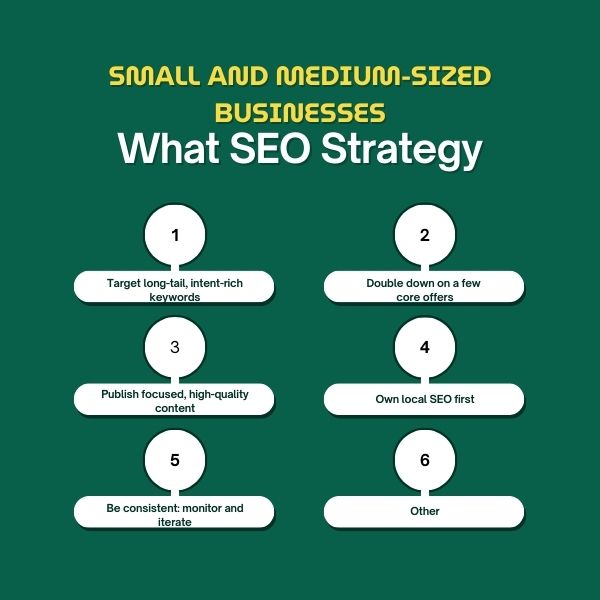
SMEs often have limited time, budgets, and internal resources. A focused strategy is usually more practical than trying to cover every topic and channel.
1. Focus on Priority Products and Services
Select the products or services with suitable demand, margins, delivery capacity, and strategic importance.
2. Improve Commercial Pages Before Publishing at Scale
Priority pages should explain:
- What the business provides
- Who it is for
- Main benefits and limitations
- Pricing or quotation process
- Why customers should consider the business
- What action to take next
3. Target Specific Search Opportunities
Long-tail and local searches may be useful, but they should be selected according to real demand and business value.
4. Build Supporting Content
Create supporting resources to answer specific questions around the priority product or service: suitability, comparisons, costs, preparation and use after purchase.
Before adding a page, confirm that the answer is distinct and maintainable. A concise section on an existing page may be more useful than another article repeating the same explanation.
5. Use Local SEO When Relevant
Local SEO may help businesses with legitimate physical locations or defined service areas.
It is not necessarily the fastest path to leads in every industry.
6. Measure Business Results
Focus on qualified inquiries, sales, revenue, and margin rather than traffic alone.
7. Improve at a Sustainable Pace
Match production to the team’s capacity to fact-check, publish and maintain information. Reserve time for existing pages instead of allocating the full budget to new content.
Review whether the current resources serve customers well before broadening the topic set. A useful library is built through selective additions and care, not a fixed number of articles every month.
Common SEO Marketing Mistakes
- Choosing keywords before defining business goals
- Targeting search volume without considering intent
- Creating one page for every keyword variation
- Publishing generic content at scale
- Ignoring commercial landing pages
- Making technical changes without documentation
- Building links without reviewing relevance and risk
- Creating duplicate local pages
- Measuring rankings without measuring conversions
- Using plugin or tool scores as the final quality standard
Frequently Asked Questions About SEO Marketing
Is SEO marketing free?
No. Organic clicks do not have a direct per-click advertising charge, but SEO requires research, content, technical work, development, and maintenance.
Does SEO traffic always compound over time?
No. Some pages grow, while others decline or remain unchanged. Performance depends on demand, quality, competition, implementation, and maintenance.
Do search users always have high purchase intent?
No. Search intent may be informational, navigational, commercial, local, or transactional.
Are long-tail keywords always easier to rank?
No. Some long-tail searches are competitive or receive little useful demand. They should be evaluated according to relevance and business value.
Do I need paid SEO tools?
No specific paid tool is mandatory. Choose tools for the questions the team needs to answer and its capacity to use the data. Include review and maintenance time in the budget rather than spending only on software.
Do Core Web Vitals guarantee higher rankings?
No. They help evaluate aspects of page experience but do not guarantee a ranking position.
Does structured data improve rankings?
Structured data can help search systems understand eligible content, but it does not guarantee higher rankings or rich results.
Should a Google Business Profile be updated weekly?
Not necessarily. Updates should be published when the business has useful and accurate information to share.
How long does SEO take?
The timeframe depends on website condition, competition, content, authority, implementation speed, and project scope.
Build an SEO System That Supports Business Growth
SEO marketing works best as an ongoing relationship between customer needs, accurate information and a usable website. Publication is one milestone within that work.
Build a manageable set of resources around a priority offer. Give each page a purpose, an owner and a reason to be reviewed. Use search evidence and customer feedback to decide whether it should be kept, improved, combined or replaced.
This makes the next investment easier to explain: the business can identify the information gap being addressed, the work needed and the evidence it will review, while recognizing that search and sales outcomes remain uncertain.
Contact Việt SEO
Việt SEO provides SEO strategy, technical optimization, content development, Local SEO, website improvement, and performance measurement based on each client’s website and business objectives.
- Website: https://vietseo.com/en/
- Hotline: +84 917 212 969
- Service area: Ho Chi Minh City and clients in other locations



Questions & Comments
You can ask a question about this article. Viet SEO will review and reply after moderation.