Comprehensive SEO Services in Ho Chi Minh City
Why Do Businesses in Ho Chi Minh City Need Comprehensive SEO Services?
Ho Chi Minh City is one of Vietnam’s most active and competitive business markets. Customers use Google to compare providers, research products, evaluate prices, read reviews, and decide which company to contact.
In this environment, optimizing only a small number of keywords may not be enough for businesses that offer multiple services, operate in competitive industries, or plan to grow across several customer segments.
Comprehensive SEO, sometimes called holistic or full-site SEO, improves the website as a connected system. Instead of treating every keyword or page as an isolated task, it coordinates:
- Business and market research
- Technical SEO
- Website structure
- Keyword and search-intent strategy
- Content development
- Internal linking
- User experience
- Local visibility
- Authority development
- Conversion measurement
The objective is not merely to increase the number of ranking keywords. It is to attract relevant visitors, guide them toward useful information, and turn organic visibility into measurable business opportunities.
Comprehensive SEO can also reduce excessive dependence on paid traffic over time. However, it does not eliminate the need for advertising automatically, and it should be evaluated according to its actual contribution to leads, sales, and brand growth.
What Is Comprehensive SEO?
Comprehensive SEO is a long-term approach that evaluates and improves the major factors affecting a website’s organic search performance.
It may include the following areas.
1. Business and Market Analysis
SEO strategy should begin with an understanding of:
- Products and services
- Target customers
- Service locations
- Main competitors
- Sales process
- Customer questions and objections
- Most valuable conversion actions
2. Technical SEO
Technical SEO helps search engines access, render, understand, and index website content.
Typical areas include:
- Crawling and indexing
- XML sitemaps
- robots.txt
- Canonical tags
- Redirects and status codes
- Page speed
- Mobile usability
- Structured data
- JavaScript rendering
- Multilingual SEO
3. Website Architecture
A clear website structure helps visitors and search engines understand the relationship between services, products, topics, and locations.
Architecture work may involve:
- Navigation
- Page hierarchy
- Category organization
- URL structures
- Internal links
- Breadcrumbs
4. Keyword and Search-Intent Strategy
Comprehensive SEO does not ignore keywords. Instead, it organizes keywords into groups based on topic, customer need, and search intent.
The strategy may cover:
- Service and product searches
- Local searches
- Informational questions
- Commercial comparisons
- Transactional searches
- Branded queries
5. Content Strategy
Content is planned according to the customer journey and website structure rather than published as unrelated articles.
Possible page types include:
- Service pages
- Product and category pages
- Location pages
- Blog articles
- Buying guides
- Comparison pages
- Pricing guides
- Case studies
- Frequently asked questions
6. User Experience and Conversion
Traffic creates limited value when users cannot find information, trust the business, or complete the intended action.
SEO-related UX improvements may include:
- Clear navigation
- Readable layouts
- Mobile-friendly interfaces
- Visible contact information
- Logical calls to action
- Simple forms
- Relevant trust information
7. Authority and Reputation
Authority development may include:
- Relevant industry references
- Digital PR
- Business citations
- Expert contributions
- Partnership content
- Useful resources that earn links naturally
- Customer reviews
The objective should be relevance and credibility, not producing the largest possible number of backlinks.
Comprehensive SEO vs. Keyword SEO
| Criteria | Keyword SEO | Comprehensive SEO |
|---|---|---|
| Scope | Selected keyword groups and pages | Major sections of the entire website |
| Primary objective | Improve visibility for defined searches | Develop broad organic visibility and website value |
| Content approach | Priority pages and supporting articles | Website-wide content architecture and topic coverage |
| Technical scope | Technical work affecting selected pages | Broader crawling, indexing, speed, templates, and architecture |
| Suitable for | Focused services, smaller websites, controlled starting scope | Growing businesses, larger websites, competitive markets |
| Measurement | Priority keywords, pages, traffic, and conversions | Website-wide visibility, traffic, leads, revenue, and technical improvements |
Neither approach is automatically better in every situation.
Keyword SEO may be appropriate for a business with a focused service offering or limited initial budget. Comprehensive SEO may be more suitable when the website has many services, products, customer questions, locations, or technical issues.
Benefits of Comprehensive SEO in Ho Chi Minh City
1. Broader Search Visibility
A comprehensive campaign can help a website appear for different types of searches, including:
- Primary service keywords
- Long-tail searches
- Customer questions
- Location-based searches
- Comparison and pricing queries
- Product and category searches
2. More Qualified Organic Traffic
The objective is not to attract the largest possible number of visitors. The campaign should prioritize users whose needs match the company’s actual products, services, and service areas.
3. A Stronger Website Foundation
Comprehensive SEO often improves areas that affect every marketing channel, including:
- Page speed
- Mobile usability
- Navigation
- Landing-page quality
- Analytics
- Conversion pathways
4. Better Coverage of the Customer Journey
Customers may perform several searches before contacting a business.
A comprehensive content strategy can support users while they:
- Identify a problem
- Research possible solutions
- Compare providers
- Review prices or processes
- Prepare to purchase or make contact
5. Greater Brand Visibility
Appearing across relevant topics can help users become more familiar with a company. However, search visibility alone does not create trust; the website must also provide accurate information, professional presentation, and a reliable customer experience.
6. Reduced Dependence on One Traffic Source
SEO can complement Google Ads, social media, referrals, and direct sales.
It may reduce excessive dependence on paid traffic over time, but advertising and SEO should be managed according to their own business contribution rather than treated as direct replacements in every situation.
Comprehensive SEO Implementation Process
A successful campaign requires a structured process with clear responsibilities and priorities.
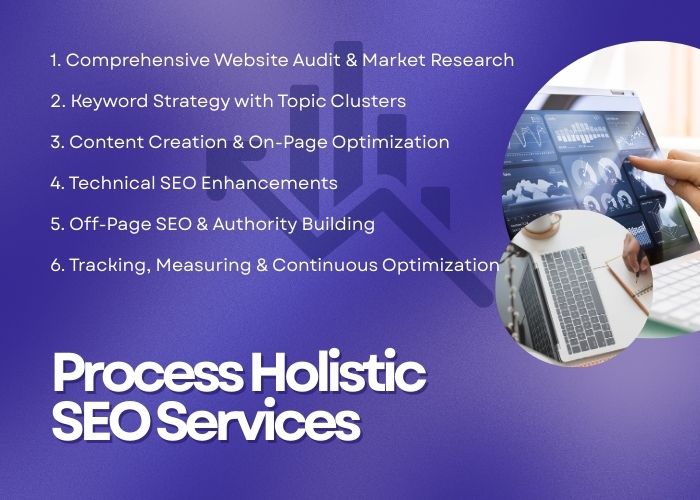
Step 1: Business and Project Discovery
The process begins by reviewing:
- Business objectives
- Products and services
- Target customers
- Target locations
- Sales process
- Competitors
- Available resources
Step 2: Comprehensive SEO Audit
The audit may examine:
- Crawling and indexing
- Technical errors
- Website structure
- Page speed
- Mobile usability
- Current content
- Internal linking
- Backlink profile
- Analytics and conversion tracking
Step 3: Market and Competitor Research
The team reviews competitors to understand:
- Which page types perform well
- Which topics they cover
- How their websites are structured
- Where content or service gaps exist
- What the client can offer that is more useful or distinctive
Step 4: Keyword and Search-Intent Research
Keywords are grouped according to:
- Topic
- Search intent
- Customer stage
- Location
- Suitable page type
- Potential business value
Step 5: Website and Content Mapping
Keyword groups and topics are assigned to suitable pages.
This helps prevent:
- Duplicate pages
- Keyword cannibalization
- Unclear navigation
- Disconnected blog content
Step 6: Technical Implementation
Implementation priorities may include:
- Indexing corrections
- Redirects
- Canonical tags
- XML sitemap improvements
- Page-speed optimization
- Mobile fixes
- Structured data
- Website-template improvements
Step 7: On-Page Optimization
Important pages may be optimized for:
- Titles and meta descriptions
- Heading hierarchy
- Search intent
- Content clarity
- Internal links
- Images
- Calls to action
Step 8: Content Development
Content may include:
- Service pages
- Product and category pages
- Location pages
- Articles
- FAQs
- Comparison pages
- Case studies
Every page should have a defined purpose within the website.
Step 9: Internal-Link Development
Internal links should connect relevant pages and guide visitors toward useful next steps.
Step 10: Authority Development
Depending on the project, this may involve:
- Relevant business citations
- Industry websites
- Digital PR
- Partnerships
- Expert resources
- Customer reviews
Step 11: Conversion Tracking
The project should track the actions that matter to the business, such as:
- Phone calls
- Form submissions
- Appointments
- Quotation requests
- Orders
- Revenue
Step 12: Reporting and Continuous Improvement
Reports should explain:
- Completed work
- Technical changes
- Content published or updated
- Search performance
- Conversions
- Current issues
- Upcoming priorities
How to Measure Comprehensive SEO Results
Comprehensive SEO should not be evaluated only through keyword rankings.
| Metric | What It Helps Measure |
|---|---|
| Organic impressions | Search visibility |
| Organic clicks | Traffic received from search |
| Non-branded traffic | Ability to reach users who do not already know the brand |
| Landing-page performance | Which pages attract useful search traffic |
| Qualified leads | Business opportunities generated by organic traffic |
| Organic revenue | Sales attributed to organic search |
| Conversion rate | How effectively organic visitors complete valuable actions |
| Indexed and valid pages | Technical search accessibility |
| SEO ROI | Financial return compared with investment |
Metrics such as bounce rate, engagement time, and pages per session should be interpreted according to the page purpose and tracking configuration. A user may find an answer and leave quickly without having a poor experience.
How to Calculate SEO ROI
A simplified formula is:
SEO ROI = (Organic profit attributed to SEO - SEO cost) / SEO cost × 100
Businesses should use profit rather than revenue alone and consider:
- Lead-to-customer conversion rate
- Gross margin
- Customer lifetime value
- Offline sales
- Long sales cycles
- Multi-channel attribution
How Much Does Comprehensive SEO Cost in Ho Chi Minh City?
There is no universal monthly price for comprehensive SEO.
The cost depends on:
- Website size
- Technical condition
- Industry competition
- Target locations
- Number of products or services
- Content requirements
- Development requirements
- Multilingual requirements
- Authority-development scope
- Reporting and consulting needs
A small local website and a national e-commerce platform should not receive the same scope or quotation.
Businesses should request a website assessment and compare proposals according to deliverables rather than relying only on published price ranges.
What Should Be Included in a Comprehensive SEO Quotation?
The quotation should define:
- Project objectives
- Pages and website areas included
- Technical work
- Content quantities and types
- Development responsibilities
- Authority-development activities
- Reporting schedule
- KPIs
- Client responsibilities
- Account and content ownership
- Additional costs
- Handover process
Who Should Use Comprehensive SEO?
Comprehensive SEO may be suitable for:
- Businesses offering multiple services
- Manufacturers targeting B2B customers
- Professional service companies
- Educational institutions
- Healthcare providers with appropriate expert review
- Real estate companies
- Technology businesses
- E-commerce websites
- Companies targeting several locations
- Businesses rebuilding or migrating a website
It may not be necessary to begin with a full-scale campaign when the business has only one service, a very small website, or limited implementation capacity. In those cases, the work can be divided into prioritized phases.
Can Comprehensive SEO Be Implemented in Phases?
Yes. A phased approach may include:
- SEO Audit and tracking setup
- Critical technical fixes
- Priority service and product pages
- Website architecture and internal linking
- Content development
- Local SEO
- Authority development
- Conversion optimization
This approach helps businesses control budget and implementation capacity while preserving a coherent long-term strategy.
Common Comprehensive SEO Mistakes
1. Focusing Only on Ranking Counts
A large number of ranking keywords creates little value when those searches are unrelated or do not generate qualified visitors.
2. Publishing Content Without a Plan
Articles should support relevant topics, customer needs, and commercial pages.
3. Creating Thin or Repetitive Pages
A page should be as detailed as necessary to satisfy its purpose. Short content is not automatically poor, and long content is not automatically useful.
4. Ignoring Technical Problems
Crawl restrictions, incorrect canonical tags, slow templates, and poor architecture can limit the performance of strong content.
5. Building Low-Quality Links
Large quantities of irrelevant or manipulative links can create risk and provide little lasting value.
6. Ignoring Conversions
SEO reports should connect organic traffic with leads, sales, and other meaningful actions.
7. Making Too Many Changes Without Measurement
Changes should be documented and evaluated so the team can understand what contributes to improvement.
Comprehensive SEO and AI Search
Search experiences continue to change as users discover information through traditional results, AI-generated summaries, assistants, videos, local results, images, and other platforms.
A website cannot guarantee that it will be included in an AI-generated response. However, many practices that support traditional SEO also improve the clarity and usefulness of information for other discovery systems.
These practices include:
- Clear and accurate content
- Logical website structure
- Consistent company information
- Useful first-hand expertise
- Relevant citations and mentions
- Structured data where appropriate
- Accessible and indexable pages
- Strong entity and brand consistency
Structured data can help machines understand certain page elements, but it does not guarantee rankings, rich results, or AI citations.
Comprehensive SEO Services from Việt SEO
Việt SEO provides comprehensive SEO, technical optimization, content development, website design, and performance measurement for businesses in Ho Chi Minh City and other markets.
Depending on the project scope, services may include:
- Business and market analysis
- SEO Audits
- Keyword and search-intent research
- Website architecture
- Technical SEO
- On-Page optimization
- Content strategy and production
- Internal-link planning
- Local SEO
- Authority development
- Analytics and conversion tracking
- Reporting and consulting
Việt SEO combines SEO and website-development capabilities so that technical and structural recommendations can be implemented within an agreed scope.
Why Choose Việt SEO?
1. Website and SEO Capability
Việt SEO can coordinate content, technical optimization, development, analytics, and user-experience improvements.
2. Customized Strategy
The recommended scope is based on the website, industry, target customers, competition, and available resources.
3. Structured Implementation
Projects are divided into priorities, stages, deliverables, responsibilities, and reporting periods.
4. Transparent Reporting
Reports may include completed work, technical changes, search performance, landing-page traffic, and conversions when tracking is available.
5. Long-Term Website Value
The objective is to strengthen the website’s technical foundation, content, visibility, user experience, and ability to generate relevant business opportunities.
Questions to Ask Before Hiring a Comprehensive SEO Agency
- Which parts of the website will be optimized?
- Which technical changes are included?
- Who implements development work?
- How is content researched and reviewed?
- How are backlinks or external references obtained?
- Which KPIs will be reported?
- How will conversions be tracked?
- Who owns the accounts and content?
- Which costs are excluded?
- What happens when the contract ends?
Frequently Asked Questions About Comprehensive SEO
How long does comprehensive SEO take?
The timeframe depends on the website, industry, competition, implementation speed, and available resources. Early technical or visibility improvements may appear before broader business results, but no fixed period applies to every project.
Is comprehensive SEO better than keyword SEO?
Not in every situation. Comprehensive SEO provides a broader scope, while keyword SEO may be appropriate for focused services and smaller projects. The correct approach depends on the business and website.
How much does comprehensive SEO cost?
Cost depends on website size, competition, technical condition, content needs, development work, target markets, and reporting requirements. An assessment is normally required before preparing an accurate quotation.
Can SEO reduce dependence on paid advertising?
It can generate an additional source of qualified traffic over time. Whether advertising budgets can be reduced depends on campaign performance, customer acquisition goals, and overall marketing strategy.
Can comprehensive SEO help with AI search visibility?
Clear, useful, accessible, and credible content may improve a brand’s overall discoverability. However, no company can guarantee inclusion or citation in AI-generated answers.
Can small businesses use comprehensive SEO?
Yes. The campaign can be divided into phases, beginning with the most important technical issues, pages, and local opportunities.
Does comprehensive SEO guarantee sales?
No. Sales also depend on the offer, pricing, customer demand, website usability, trust, sales process, and service quality.
What is the difference between SEO and AI search optimization?
Traditional SEO focuses primarily on organic search visibility. AI-search optimization considers how clear, credible, and well-structured information may be discovered and used across AI-driven experiences. Many foundational practices overlap.
Build a Sustainable Organic Growth System
Comprehensive SEO helps businesses improve their websites as connected systems rather than treating every keyword and page as a separate campaign.
A strong strategy combines:
- Business understanding
- Technical stability
- Logical website architecture
- Search-intent research
- Useful content
- Internal linking
- Responsible authority development
- User experience
- Conversion measurement
For businesses operating in a competitive market such as Ho Chi Minh City, this approach can create broader search visibility and a more valuable website over time.
Việt SEO provides comprehensive SEO services based on each client’s website, market, objectives, resources, and implementation priorities.



Questions & Comments
You can ask a question about this article. Viet SEO will review and reply after moderation.