Google SEO in Ho Chi Minh City: Trends and Future Strategy
The Future of Google SEO in Ho Chi Minh City
Google SEO in Ho Chi Minh City works best when customers find the same clear information at every step: in search results, on the website, and when they contact the business. A page that promises English-language advice, immediate appointments, or citywide service creates expectations the operations team needs to meet.
This guide explains how to align search visibility with the service a business can actually deliver. It covers SEO fundamentals, local information, new search formats, and the practical checks that turn a website visit into a useful conversation.
SEO Costs and Scope: What to Budget For
There is no fixed service price in this guide. Request a proposal that separates the following cost areas, identifies what is included, and explains which work requires approval or a separate quotation.
Initial assessment and setup
Website review, priority planning, baseline measurement, and tracking checks. Confirm whether technical fixes are included or only documented as recommendations.
Ongoing delivery
Content updates, page optimization, internal linking, local information maintenance, and reporting. Specify pages, languages, deliverables, and review responsibilities.
Website and content production
Development, design changes, translation, photography, and video may involve separate production costs. Include the business team’s time for checking service details.
Tools and additional channels
Hosting, software subscriptions, paid advertising, and platform-specific work should be identified separately. Confirm renewals, licensing, access, and any limits on support.
For a useful quotation, provide the website address, priority services, customer languages, actual service coverage, and the people available to approve and implement changes. Compare proposals using the same scope rather than the monthly fee alone.
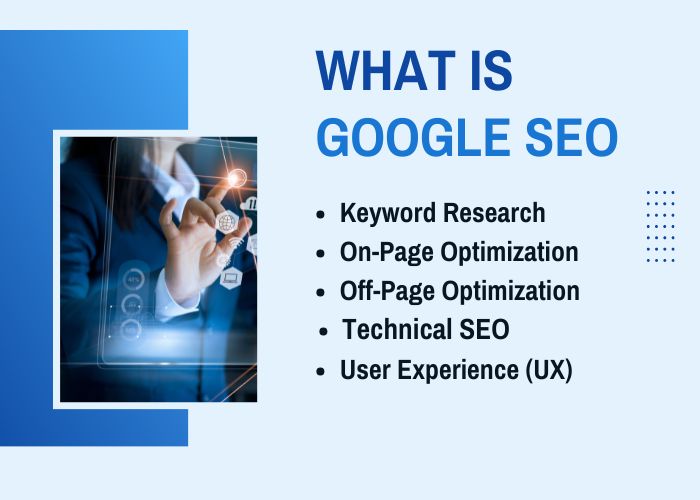
What Is Google SEO?
Google SEO, or search engine optimization, is the process of improving a website so that relevant pages can be discovered, understood, indexed, and presented for suitable searches on Google.
The main objective is to attract users whose needs match the business’s products, services, locations, or information.
SEO may improve:
- Organic search visibility
- Qualified website traffic
- Brand awareness
- Local customer discovery
- Leads and sales
- The long-term value of the website
SEO traffic is not completely free. Businesses still need to invest in research, content, technical improvements, design, development, measurement, and ongoing maintenance. The difference is that organic clicks are not charged individually in the same way as paid advertisements.
The Main Components of Google SEO
1. Keyword and Search-Intent Research
Research should connect a customer question to a service the business can provide and a page that can explain it. Use search data alongside sales questions and inquiry records; label tool estimates separately from observed customer behavior.
- What is the person trying to arrange or understand?
- Can the business serve this customer, location, and language?
- Which existing page answers the need?
- What information is missing before the customer can contact the team?
For example, a hypothetical office-maintenance company may need to distinguish recurring commercial contracts from one-off household repairs. Broad traffic growth could be unhelpful if it mostly attracts work the company does not accept.
2. On-Page SEO
On-Page SEO improves the content and structure of individual pages.
Important areas include:
- SEO titles
- Meta descriptions
- Heading hierarchy
- Search-intent alignment
- Content clarity and usefulness
- Internal links
- Images and alt text
- Calls to action
- URL structure
Optimization should make the page easier to understand for both users and search systems. It should not rely on repeating the exact keyword unnaturally.
3. Technical SEO
Technical SEO supports crawling, rendering, indexing, and website performance.
Common areas include:
- robots.txt
- XML sitemaps
- Canonical tags
- Redirects
- HTTP status codes
- Page speed
- Mobile usability
- JavaScript rendering
- Structured data
- Website migrations
Technical improvements do not automatically create rankings, but serious technical problems can prevent strong content from performing effectively.
4. Content Strategy
Start with information that sales or support staff repeatedly need to clarify: eligibility, service inclusions, exclusions, scheduling, quotation requirements, and the next step after an inquiry.
For a hypothetical business offering office maintenance, a useful page might explain the equipment covered, information needed for a site assessment, and whether support is available in English. Publish only details approved by the team responsible for delivery.
- Use service pages for the offer and its conditions.
- Use guides to explain decisions or preparation tasks.
- Use documented case studies only with reliable evidence and permission.
- Update pages when coverage, processes, or commercial terms change.
This approach gives content a maintenance owner as well as a publication date.
5. Internal Linking and Website Architecture
A logical website structure helps users and search engines understand the relationship between products, services, topics, and locations.
Important elements include:
- Navigation
- Page hierarchy
- Categories
- Breadcrumbs
- Contextual internal links
- Clear URL structures
6. Off-Page SEO and Authority
Off-Page SEO focuses on signals and references outside the website.
Responsible activities may include:
- Relevant backlinks
- Digital PR
- Industry citations
- Expert contributions
- Business directories
- Brand mentions
- Customer reviews
A backlink should not be treated as a simple “vote.” Its value depends on relevance, context, credibility, placement, and whether it was obtained responsibly.
7. User Experience and Conversion
A website can receive traffic without generating useful business outcomes.
SEO-related UX improvements may include:
- Clear navigation
- Readable page layouts
- Fast mobile experience
- Visible contact information
- Simple forms
- Trust and company information
- Relevant calls to action
User experience should be improved because it helps customers use the website effectively, not because every engagement metric is a direct ranking factor.
Why Google SEO Matters in Ho Chi Minh City
1. Customers Research Before Contacting
Before making contact, a customer may need to know whether the business serves their location, accepts their project size, and can communicate in their preferred language. A service page should make those answers easy to find.
Use the questions received by the business to improve the website. If customers keep asking whether a quoted service includes materials or a site visit, that information may need a clearer place on the page.
2. Competition Is Increasing
Assess competition for the actual service and customer need rather than treating every business in the city as a direct competitor. Review the pages customers are likely to compare and identify useful information your own website lacks.
A practical response may be a clearer service page or better inquiry handling. Publishing more articles is not automatically the most useful next investment.
3. SEO Complements Paid Advertising
Paid advertising can create visibility quickly. SEO can build a longer-term source of traffic and customer demand.
Businesses can use both channels for different purposes:
- Google Ads for immediate campaigns and testing
- SEO for long-term search visibility
- Remarketing for returning visitors
- Content for education and trust
4. Local Search Can Drive Real-World Actions
Local search can support:
- Phone calls
- Direction requests
- Store visits
- Appointments
- Local service inquiries
The SEO Market in Ho Chi Minh City
Ho Chi Minh City has a diverse SEO service market that includes freelancers, specialist teams, web-development companies, digital agencies, and in-house marketing departments.
Businesses can choose from services such as:
- Keyword SEO
- Comprehensive SEO
- Local SEO
- Technical SEO
- SEO Audits
- SEO content writing
- E-commerce SEO
- Website migration support
Market Opportunities
SEO opportunities remain strong in industries where customers actively research before purchasing, including:
- Professional services
- Manufacturing
- Education
- Healthcare
- Beauty and personal care
- Real estate
- Tourism
- Technology
- E-commerce
Market Challenges
Businesses may face several challenges:
- Strong competition for commercial searches
- Different service-quality levels between providers
- Unrealistic ranking guarantees
- Low-quality content production
- Manipulative backlink methods
- Limited conversion tracking
- SEO recommendations that are never implemented
The safest approach is to evaluate the provider’s process, deliverables, evidence, communication, and technical capability rather than choosing by price or promises alone.
Local SEO Strategies for Ho Chi Minh City Businesses
1. Optimize the Google Business Profile
First confirm that the business is eligible for a profile. Google’s guidance covers businesses with a location customers can visit or businesses that travel to customers; an online-only operation should not assume it qualifies.
Use the real business name, appropriate categories, accurate hours, contact details, and a truthful address or service area. Do not create a location or describe a customer-facing office merely to target a city.
Check the Google Business Profile representation guidelines when deciding how to display the business. The profile and website should give customers compatible information about how the service operates.
2. Manage Customer Reviews
Invite genuine customers to share honest feedback without incentives or selecting only customers expected to leave positive reviews. Respond constructively and avoid publishing private customer or project information.
Use recurring feedback to identify information the website should explain more clearly. A complaint about response expectations may indicate that the contact page needs clearer hours or next steps.
3. Research Local Search Language
Research Vietnamese and English demand separately where both audiences matter. Language does not identify a person’s nationality or location, and an English-speaking customer may already be based in Vietnam.
Before creating another language version, confirm who can check terminology, approve commercial details, and respond to inquiries. Translated pages should describe the same actual service unless a difference is intentional and clearly explained.
4. Create Useful Location Pages
Create a location page when there is distinct information that helps customers decide whether and how they can use the service. Useful details may include genuine service coverage, scheduling conditions, delivery arrangements, and relevant local work supported by evidence.
If one service page can explain the coverage clearly, a separate page for every area may add little value. Never imply that the business has a branch or staffed office where none exists.
Review place names and operating details when the business changes its coverage. Keep customer-facing information accurate rather than relying on an old page template.
5. Build Relevant Local Citations
Business listings should be accurate and consistent across relevant platforms.
Not every directory is suitable for every industry. For example, food-delivery or restaurant platforms are not appropriate citation sources for unrelated professional or industrial businesses.
6. Improve the Mobile Experience
Local users may need to call, request directions, view prices, or make an appointment quickly.
Make these actions easy to find and complete on a mobile device.
7. Track Local Actions
Separate signs of interest from confirmed outcomes. A call-button click does not prove that a call connected, and a direction request does not prove that someone visited.
- Track website actions using clearly defined events.
- Record valid inquiries, appointments, and completed sales separately where possible.
- Document which data comes from the website, Business Profile, or the sales team.
- Label unknown sources and duplicate inquiries rather than forcing attribution.
Use consistent reporting periods and definitions. Local performance should be read alongside staffing, availability, and service changes.
Important SEO Trends
Long-term forecasts should be treated cautiously because search platforms, user behavior, regulations, and technology can change quickly.
However, several developments are already influencing SEO strategy.
1. AI-Assisted Search
AI-assisted discovery adds another way for customers to encounter business information. Keep facts clear, important service details accessible, and company information consistent across the website and appropriate external profiles.
For AI Overviews and AI Mode in Google Search, Google states that existing SEO fundamentals still apply and no special schema is required. Meeting the requirements does not guarantee inclusion. See Google’s guidance on AI features and websites.
If monitoring AI responses, record the tool, date, language, question, and observed answer. Treat the results as a sample rather than a complete measure of brand visibility across all users.
2. Natural-Language Search
Users increasingly enter complete questions, whether through typing, voice input, or conversational search tools.
Content should answer customer questions naturally and directly, but a separate “voice SEO” strategy is not required for every business.
3. Mobile Usability
Mobile usability remains important because many users visit websites from smartphones.
Businesses should prioritize:
- Responsive layouts
- Readable text
- Fast loading
- Accessible navigation
- Forms that work on small screens
- Limited intrusive elements
4. Video and Visual Search
Video, images, diagrams, and demonstrations can improve how users understand products and services.
Useful practices include:
- Descriptive titles
- Accurate captions
- Relevant surrounding text
- Useful thumbnails
- Accessible transcripts
- Original images where possible
Keeping users on a page longer should not be treated as the objective by itself. The media should help users complete their intended task.
5. Structured Data
Structured data can help search systems understand certain page elements and may make pages eligible for supported search features.
It does not guarantee enhanced results, higher rankings, or AI citations.
6. First-Party Data and Conversion Measurement
Agree on what counts as a valid inquiry before reporting success. A practical definition might require a real contact, a relevant need, and a service area the business can support; the exact criteria should match the business.
Connect website events with sales follow-up only where the data supports the link. Keep missing attribution visible, limit access to customer information, and avoid collecting unnecessary details.
Revenue associated with organic search is not automatically revenue caused by SEO. Advertising, repeat business, referrals, seasonality, and operational changes may contribute to the same sale.
7. Responsible Use of AI Tools
AI tools can support:
- Research organization
- Keyword grouping
- Content outlines
- Data analysis
- Initial drafts
Human review remains necessary for accuracy, originality, business relevance, tone, and risk management.
How SEO Providers Need to Adapt
1. Connect SEO with Business Objectives
Identify which customers the business can serve, what makes an inquiry useful, and who is responsible for the response. Link SEO priorities to those decisions rather than to traffic targets alone.
A service page, translated offer, or new contact route should be checked with the operations team before publication.
2. Combine Strategy with Implementation
An audit creates limited value when recommendations remain unimplemented.
SEO providers should either have appropriate development capabilities or define how implementation will be coordinated.
3. Integrate SEO into Website Design
SEO considerations should be included during website planning.
Important areas include:
- Information architecture
- URL structure
- Page templates
- Internal links
- Performance
- Mobile usability
- Analytics
Structured data should be implemented only where it accurately represents visible page content and is appropriate for the page type.
4. Develop Stronger Content Quality Control
SEO providers need processes for:
- Fact checking
- Editing
- Source review
- Expert input
- Brand consistency
- AI-assisted content review
5. Train Teams Continuously
Teams should stay informed about platform changes, but they should avoid chasing every update as if it requires a complete strategy replacement.
Training should cover:
- Technical SEO
- Content quality
- Analytics
- Conversion measurement
- Security
- AI-assisted workflows
6. Support Multi-Platform Discovery
Depending on customer behavior, a business may also need visibility through:
- YouTube
- Google Maps
- Marketplaces
- Social platforms
- Industry websites
This should not be described as one universal SEO strategy. Each platform has its own audience, algorithms, formats, and commercial purpose.
How to Measure Google SEO Results
Use several layers of evidence to understand where the customer journey works and where it breaks down. The following measures answer different questions; they should not be combined into one success score.
Search visibility
Impressions and clicks show exposure and visits from search. Compare relevant pages and query groups; an impression is not a unique customer.
Brand and service discovery
Separate identifiable brand queries from service-related queries where the data allows. A non-brand search is not proof that the visitor is new to the business.
Website actions
Form submissions, purchases, and contact-button events show different levels of intent. Check event setup and duplicate firing before interpreting a change.
Sales follow-up
Qualified inquiries, appointments, and completed orders indicate what happened after contact. Explain the definition, data source, and any missing records.
Technical coverage
Check whether important pages can be accessed and indexed as intended. A higher total indexed-page count is not automatically an improvement.
Financial assessment
Review attributable revenue, relevant costs, and margin assumptions. Estimated incremental return requires a credible comparison; attribution reports alone do not prove causation.
For example, if relevant organic visits increase but accepted inquiries do not, review the search demand, service conditions, contact process, and follow-up records before commissioning more content. This is a diagnostic scenario, not a performance forecast.
How to Choose an SEO Company in Ho Chi Minh City
Before selecting a provider, evaluate the following areas.
1. Business Understanding
Does the provider ask about products, customers, sales, locations, and business priorities?
2. Clear Strategy
Can the team explain:
- Which problems need to be fixed
- Which pages need to be created
- How keywords are selected
- How content will support services
- How performance will be measured
3. Technical Capability
Can the provider implement or coordinate changes involving code, templates, speed, indexing, and tracking?
4. Content Quality
Review samples for accuracy, clarity, usefulness, structure, and industry relevance.
5. Responsible Authority Development
Ask how backlinks and mentions are obtained.
6. Transparent Reporting
Reports should include completed work, performance changes, problems, and next priorities.
7. Realistic Expectations
Be cautious of guarantees such as:
- Number-one rankings
- Top positions within a few days
- Permanent rankings
- Guaranteed sales
- Guaranteed AI citations
8. Account and Content Ownership
Confirm ownership, administrative access, licensing, and exit arrangements before work begins. The business should control its domain and appropriate access to its website, analytics, Search Console, and eligible business profiles.
Source code, themes, plugins, stock media, and custom assets may have different ownership or license terms. List what will be handed over, what remains licensed, and which subscriptions are needed after the project ends.
Website Design and Google SEO Services from Việt SEO
Việt SEO provides website design, technical optimization, content development, Local SEO, comprehensive SEO, and performance measurement for businesses in Ho Chi Minh City and other markets.
Depending on the project, services may include:
- SEO-ready website design
- SEO Audits
- Keyword and search-intent research
- Technical SEO
- Website architecture
- On-Page optimization
- Content strategy and production
- Internal linking
- Local SEO
- Authority development
- Analytics and conversion tracking
- SEO consulting and training
Việt SEO combines website-development and SEO capabilities so that recommendations can be implemented within the agreed project scope.
1. SEO-Ready Website Design
A website should support organic growth from its architecture, code, content system, and templates.
Important considerations may include:
- Responsive design
- Page-loading performance
- Logical URL structures
- Heading hierarchy
- Internal linking
- Analytics configuration
- Structured data where appropriate
- Security and maintainability
No provider should promise a fixed loading time for every website without considering hosting, page content, scripts, devices, and network conditions.
2. Comprehensive SEO Services
Comprehensive SEO may coordinate technical work, content, website structure, local visibility, authority development, and conversion tracking.
The goal is to build broader organic visibility and website value rather than chase a small set of vanity keywords.
3. Transparent Scope and Reporting
A proposal should define the pages and languages included, content and technical deliverables, approval responsibilities, reporting schedule, and how additional requests are handled.
Reports should distinguish completed work, verified changes on the live website, search observations, and business outcomes. A recommendation marked as delivered is not the same as a change implemented and checked.
When service coverage or contact procedures change, identify who will update the website and associated business information.
4. Multidisciplinary Project Support
Depending on the scope, a project may involve SEO specialists, content writers, developers, designers, and technical staff.
External specialists or contractors may also be used when appropriate. The important requirement is clear responsibility and quality control, not whether every task is completed only by permanent internal employees.

Why Should Businesses Invest in SEO?
1. Build an Owned Digital Asset
SEO improvements strengthen the business’s own website, content, data, and brand presence.
2. Reach Users with Active Demand
Search allows businesses to reach people who are already looking for information, products, or services.
3. Support Long-Term Visibility
Strong pages can continue generating organic traffic, but rankings are not permanent and still require monitoring and maintenance.
4. Improve the Website
SEO projects often improve speed, structure, content, mobile usability, and conversion paths.
5. Generate Measurable Business Opportunities
With suitable tracking, businesses can evaluate calls, forms, sales, revenue, and qualified leads from organic search.
Frequently Asked Questions About Google SEO
How long does Google SEO take?
The timeframe depends on the website, competition, technical condition, content, authority, and implementation speed. No fixed timeframe applies to every project.
Is SEO better than Google Ads?
They serve different purposes. Google Ads can provide immediate paid visibility, while SEO builds organic visibility over time. Many businesses use both.
Can SEO guarantee first-page rankings?
No SEO company controls Google’s ranking systems. A provider can commit to its work, deliverables, communication, and reporting, but not a guaranteed position.
Does user engagement directly control rankings?
Website usability and content usefulness are important for customers, but simplified claims that time on page or bounce rate directly determine rankings should be treated cautiously.
Does schema markup increase rankings?
Structured data can help search systems understand eligible content and may support certain search features. It does not guarantee higher rankings.
Can SEO help with AI search visibility?
Useful, accurate, accessible content supports search discoverability. Google’s AI Overviews and AI Mode use the same SEO fundamentals without a special schema requirement, but inclusion is not guaranteed. Other AI services have their own systems and should be assessed separately.
Is Local SEO only for retail stores?
No. Local SEO can support different businesses serving a geographic area. Google Business Profile eligibility depends on how the business operates; an online-only service should not assume it qualifies for a profile.
Should businesses start SEO now?
Businesses should begin when they have clear goals, a suitable website, appropriate resources, and the ability to implement recommendations. Starting early can be useful, but urgency should not replace proper planning.
Build a Practical and Adaptable SEO Strategy
Start with one important service and inspect the journey from a search query to a completed inquiry. Check whether the page explains who the service is for, where it is available, what customers need to provide, and what happens after contact.
- Confirm the offer with the people delivering the service.
- Make website and profile information consistent.
- Fix the most important access and usability problems.
- Improve missing decision-making information.
- Track valid inquiries separately from button clicks.
- Review results before expanding content or adding channels.
This creates a useful basis for adapting to new search formats without losing sight of the customer experience. Technology can change; accurate information, working contact routes, and reliable follow-up remain practical priorities.
Việt SEO supports website design and Google SEO within an agreed scope. Share your website, priority services, customer languages, and current challenges to discuss a plan and request an itemized proposal.



Questions & Comments
You can ask a question about this article. Viet SEO will review and reply after moderation.