SEO Keywords: Importance, Research, Mapping and Strategy
Keywords help businesses understand customer demand, organize website content, and connect the right pages with the right searches.
When people need information, products, services, or solutions, they often express that need through a search query. The words and phrases they enter into Google provide valuable information about what they want, how they describe their problem, and how close they may be to taking action.
These search terms are commonly called keywords. However, modern SEO is no longer based on repeating individual keywords throughout a page. Effective keyword SEO requires businesses to understand search intent, group related topics, create appropriate pages, and provide content that genuinely helps users.
This guide explains why keywords remain important in SEO, how to build a practical keyword strategy, what businesses should expect from a professional SEO company, and which common mistakes can reduce campaign effectiveness.

What Are SEO Keywords?
SEO keywords are the words, phrases, and questions people use when searching for information through Google and other search engines.
Examples may include:
- Air conditioner repair service in Ho Chi Minh City.
- Reputable SEO company in Saigon.
- How much does website SEO cost?
- Best accounting software for small businesses.
- Website design company near me.
Each query can reveal several useful details:
- The topic the user is interested in.
- The problem they want to solve.
- The language they naturally use.
- Their location.
- The level of detail they require.
- How close they may be to contacting or purchasing.
Keywords therefore act as a connection between customer demand and website content.
Why Are Keywords Important in SEO?
1. Keywords Reveal Customer Demand
Keyword research helps businesses understand what potential customers are actively searching for.
This information can support decisions about:
- Which products or services deserve dedicated pages.
- Which customer questions should be answered.
- Which locations have search demand.
- Which content topics may attract relevant visitors.
- Which problems customers consider most important.
2. Keywords Help Search Engines Understand Pages
Search engines analyze page titles, headings, body content, links, images, structured data, and other signals to understand a page.
Using relevant terminology naturally can help clarify:
- The primary topic of the page.
- The products or services being discussed.
- The audience or location being served.
- The relationship between the page and other website content.
Keywords should support clarity rather than be repeated mechanically.
3. Keywords Connect Pages with Search Intent
Two searches containing similar words may require different types of pages.
For example:
- What is SEO? usually requires an educational article.
- SEO service price may require a pricing or consultation page.
- SEO company in Ho Chi Minh City may require a local service page.
- Viet SEO reviews may indicate brand research.
Understanding intent helps businesses create the right page instead of forcing every keyword into one article.
4. Keywords Support Website Structure
Keyword research can be used to organize products, services, categories, location pages, articles, and frequently asked questions.
A clear structure helps both users and search engines understand how topics relate to one another.
5. Keywords Help Prioritize SEO Investment
Not every keyword has the same value. Some may have high search volume but little connection to the business, while others may receive fewer searches but attract users with strong purchasing intent.
A keyword strategy helps prioritize opportunities according to:
- Business relevance.
- Search intent.
- Conversion potential.
- Competition.
- Current website authority.
- Available resources.
Keywords Are Not the Final Goal of SEO
Ranking for a keyword is useful only when it contributes to a meaningful business objective.
A keyword may generate traffic but provide limited value when:
- The visitors are outside the target market.
- The search intent does not match the offer.
- The landing page does not answer the query.
- The visitors have no realistic opportunity to become customers.
- The keyword is measured without tracking leads or sales.
The final objectives of keyword SEO should be connected to outcomes such as:
- Qualified traffic.
- Customer inquiries.
- Appointments.
- Telephone calls.
- Orders.
- Revenue.
- Brand visibility.
Common Types of SEO Keywords
Primary Keywords
A primary keyword represents the main topic or search intent of a page.
For example, a service page may target the primary topic SEO services in Ho Chi Minh City.
A page should normally have one clearly defined primary purpose, but it can naturally cover many related searches.
Secondary Keywords
Secondary keywords are closely related terms that support the main topic.
They may describe:
- Service variations.
- Benefits.
- Customer concerns.
- Locations.
- Features.
- Related questions.
Long-Tail Keywords
Long-tail keywords are more specific searches, often containing several words.
Examples include:
- Affordable SEO service for small businesses in Ho Chi Minh City.
- How to choose an SEO company in Vietnam.
- Website SEO cost for an e-commerce store.
Long-tail keywords may have lower search volume, but they often reveal clearer needs and may be easier to match with a specific page.
Local Keywords
Local keywords contain a city, district, neighborhood, or nearby intent.
Examples include:
- SEO company in Ho Chi Minh City.
- Laptop repair in District 1.
- Dental clinic near me.
Informational Keywords
Informational keywords indicate that the user is looking for an explanation, guide, definition, or solution.
Examples include:
- What is keyword research?
- How does Technical SEO work?
- Why is my website not indexed?
Commercial Investigation Keywords
These searches indicate that users are comparing options before making a decision.
Examples include:
- Best SEO companies in Vietnam.
- SEO vs Google Ads.
- WordPress SEO agency comparison.
Transactional Keywords
Transactional searches indicate a stronger intention to purchase, book, register, or contact a provider.
Examples include:
- Hire an SEO company.
- Request an SEO quotation.
- Buy accounting software.
Navigational and Brand Keywords
These searches are used to find a particular business, product, or website.
Examples include:
- Viet SEO company.
- Viet SEO reviews.
- Viet SEO contact.
What Is Search Intent?
Search intent is the reason behind a search query. It describes what the user expects to accomplish.
Identifying intent is one of the most important steps in keyword research because Google attempts to show the types of results that best satisfy the query.
For example, the keyword website SEO may be broad. A search for what is website SEO requires an explanation, while website SEO company in Ho Chi Minh City requires a commercial service page.
Before targeting a keyword, businesses should review the current search results and ask:
- Are the ranking pages articles, product pages, service pages, or tools?
- How detailed is the expected answer?
- Does the search have local intent?
- Is the user researching or ready to purchase?
- What information is consistently provided by strong results?
Keyword Research Is More Than Search Volume
Search volume can provide useful context, but it should not determine the entire SEO strategy.
Keyword tools use estimates, and different platforms may report different numbers. A high-volume keyword may also be too broad, highly competitive, or unrelated to actual customers.
A complete evaluation should consider:
- Relevance to products or services.
- Search intent.
- Conversion potential.
- Competition in the search results.
- Website authority.
- Content requirements.
- Seasonality.
- Geographic relevance.
- Current rankings.
What Is Keyword Mapping?
Keyword mapping is the process of assigning keyword groups and search intents to specific website pages.
This helps businesses avoid creating multiple pages that compete for the same intent.
A simplified keyword map may look like this:
| Keyword Group | Search Intent | Recommended Page |
|---|---|---|
| What is SEO? | Informational | Educational guide |
| SEO services in Ho Chi Minh City | Commercial or transactional | Local service page |
| SEO price in Vietnam | Commercial investigation | Pricing or cost guide |
| Technical SEO audit | Commercial or informational | Service page supported by a guide |
| Viet SEO reviews | Brand research | Company, testimonial, or case-study page |
A keyword map should be reviewed as the website grows and search demand changes.
Topic-Based SEO Instead of Isolated Keywords
Modern SEO should organize content around complete topics rather than creating one thin page for every keyword variation.
A topic cluster usually includes:
- A central pillar page covering the main subject.
- Supporting pages exploring related questions and subtopics.
- Internal links connecting the cluster.
- Commercial pages connected to relevant informational content.
For example, an SEO topic cluster may include:
- What is SEO?
- Technical SEO.
- On-page SEO.
- Keyword research.
- SEO content writing.
- Internal linking.
- Backlink development.
- Local SEO.
- SEO service pricing.
This structure helps users explore the topic and helps search engines understand the relationships between pages.
How to Use Keywords Naturally
Keywords should appear where they help communicate the topic clearly.
Relevant locations may include:
- Page title.
- Primary heading.
- Subheadings where appropriate.
- Opening section.
- Body content.
- URL.
- Image alternative text when accurately descriptive.
- Internal-link anchor text.
- Meta description.
There is no ideal keyword-density percentage that applies to every page.
Instead, focus on:
- Answering the user’s question.
- Using natural language.
- Covering important subtopics.
- Avoiding unnecessary repetition.
- Writing for clarity and usefulness.
The SEO Market in Ho Chi Minh City
Ho Chi Minh City has a competitive digital market across retail, real estate, healthcare, education, technology, manufacturing, professional services, hospitality, and many other sectors.
As more businesses invest in websites, Google Ads, social media, and e-commerce, organic search visibility has become increasingly valuable.
Businesses may choose between:
- Building an internal SEO team.
- Hiring individual specialists.
- Working with an SEO agency.
- Combining internal staff with an external provider.
The appropriate model depends on the website size, available budget, technical requirements, internal resources, and growth goals.
Why Do Businesses Outsource SEO?
Outsourcing may provide access to:
- SEO strategy.
- Technical specialists.
- Content writers.
- Web developers.
- Analytics and reporting.
- SEO tools.
- Industry experience.
However, businesses should evaluate providers carefully because service quality, transparency, technical ability, and methods can vary significantly.
How to Choose a Keyword SEO Company in Ho Chi Minh City
1. Review Practical Experience
A reliable SEO provider should be able to explain its experience with relevant industries, platforms, and business models.
Businesses may request:
- Case studies.
- Search-performance reports.
- Traffic and conversion examples.
- Technical-audit samples.
- References when available.
Case studies should be evaluated in context. Results from one industry, website, or period do not guarantee identical outcomes for another project.
2. Avoid Unrealistic Ranking Guarantees
No SEO company controls Google’s ranking systems, competitor activity, or market changes.
Businesses should be cautious with promises such as:
- Guaranteed number-one rankings.
- Top results within a few days.
- Permanent keyword positions.
- Unlimited traffic guarantees.
3. Request a Clear SEO Strategy
The provider should explain:
- How the website will be audited.
- How keywords will be researched and grouped.
- Which pages will be created or optimized.
- How content will be planned.
- Which technical changes may be required.
- How authority will be developed.
- How results will be measured.
4. Evaluate Content Capabilities
SEO content should not be produced only to repeat keywords.
A strong content team should be able to:
- Research customer needs.
- Understand search intent.
- Write clear and original content.
- Organize long-form pages.
- Connect content to products or services.
- Improve existing pages.
5. Evaluate Technical Capabilities
Technical SEO problems may require access to source code, hosting, CMS settings, databases, or development resources.
The agency should clearly explain whether technical implementation is included or must be completed by another team.
6. Review Measurement and Reporting
SEO reports should provide more than keyword screenshots.
Useful reports may include:
- Completed work.
- Search impressions and clicks.
- Organic landing-page performance.
- Technical findings.
- Content progress.
- Conversions.
- Problems and risks.
- Recommended next actions.
7. Retain Access and Data Ownership
The client should retain agreed access to:
- Website administration.
- Domain and hosting accounts.
- Google Search Console.
- Analytics.
- Advertising accounts.
- Created content and reports.
8. Review the Contract Scope
The contract should clearly define:
- Deliverables.
- Timeline.
- Client responsibilities.
- Content volume.
- Technical implementation.
- Reporting frequency.
- Additional costs.
- Termination and handover conditions.
Practical Benefits of Keyword SEO
1. Attract Relevant Organic Traffic
A keyword strategy can help a website appear for searches connected to customer demand.
The objective should be qualified traffic rather than the largest possible number of visitors.
2. Support Brand Visibility
Appearing across related service, product, comparison, and informational searches can help customers become familiar with a brand.
3. Reduce Dependence on Paid Traffic
SEO requires investment, but organic clicks do not require direct payment to Google for each visit.
This can help businesses diversify customer-acquisition channels.
4. Improve Website Content
Keyword research often reveals missing service pages, incomplete product details, unanswered questions, and opportunities to update old content.
5. Understand Customer Behavior
Search data can help businesses understand:
- Which problems customers consider important.
- How customers compare options.
- Which locations have demand.
- Which terminology customers prefer.
- Which questions appear before a purchase.
6. Support Business Growth
A well-structured website can make it easier to add new services, products, locations, and content without starting the SEO process from the beginning.
A Professional Keyword SEO Workflow
Step 1: Business Analysis
The SEO team should understand:
- Products and services.
- Target customers.
- Sales process.
- Geographic markets.
- Business priorities.
- Current marketing channels.
Step 2: Market and Competitor Analysis
The analysis may review:
- Websites currently ranking.
- Search-result formats.
- Competitor content.
- Website structure.
- Authority and backlink patterns.
- Content and service gaps.
Step 3: Website SEO Audit
The audit may include:
- Crawling and indexing.
- Technical errors.
- URL structure.
- Content quality.
- Internal links.
- Page speed.
- Mobile usability.
- Backlink profile.
- Analytics and conversion tracking.
Step 4: Keyword Research
Keywords are collected, evaluated, and grouped according to:
- Topic.
- Search intent.
- Customer journey stage.
- Location.
- Business value.
- Competition.
Step 5: Keyword Mapping and Website Architecture
Keyword groups are assigned to existing or planned pages. Overlapping pages may be consolidated to create a clearer website structure.
Step 6: Content Planning
The content plan may include:
- Service and product pages.
- Category pages.
- Pillar guides.
- Supporting articles.
- Comparison content.
- Case studies.
- Frequently asked questions.
Step 7: Technical and On-Page Optimization
Technical SEO and on-page SEO are related but distinct areas.
Technical work may include:
- Crawl and indexing fixes.
- Sitemap and robots.txt configuration.
- Canonical tags.
- Redirects.
- Page-speed improvements.
- Structured data.
On-page work may include:
- Titles and descriptions.
- Headings.
- Content improvements.
- URLs.
- Images.
- Internal links.
- Calls to action.
Step 8: Authority Development
Authority may be strengthened through:
- Original resources.
- Industry partnerships.
- Expert contributions.
- Digital public relations.
- Relevant directories.
- Legitimate links and mentions.
Businesses should not assume that every unfamiliar or low-authority link must be removed. Backlink cleanup should be based on evidence of manipulative practices or genuine risk.
Step 9: Measurement and Continuous Improvement
SEO performance should be reviewed using search, website, and business data.
Adjustments may include:
- Improving pages with impressions but few clicks.
- Updating declining content.
- Strengthening internal links.
- Creating pages for uncovered search intent.
- Fixing technical problems.
- Improving conversion paths.
How Should Keyword SEO Results Be Measured?
Keyword and Search Visibility
- Search impressions.
- Organic clicks.
- Keyword visibility.
- Click-through rates.
- Indexed priority pages.
Organic Traffic
- Organic sessions.
- Non-brand traffic.
- Traffic to important landing pages.
- Local or regional traffic.
Business Results
- Qualified inquiries.
- Telephone calls.
- Appointments.
- Orders.
- Revenue.
- Lead quality.
- Customer-acquisition cost.
Technical Performance
- Crawl and indexing errors.
- Page speed.
- Broken links.
- Mobile usability.
- Structured-data issues.
Metrics such as bounce rate and engagement time may provide useful context, but they should not be treated as direct measurements of SEO success without considering page purpose and conversions.
Common Keyword SEO Mistakes
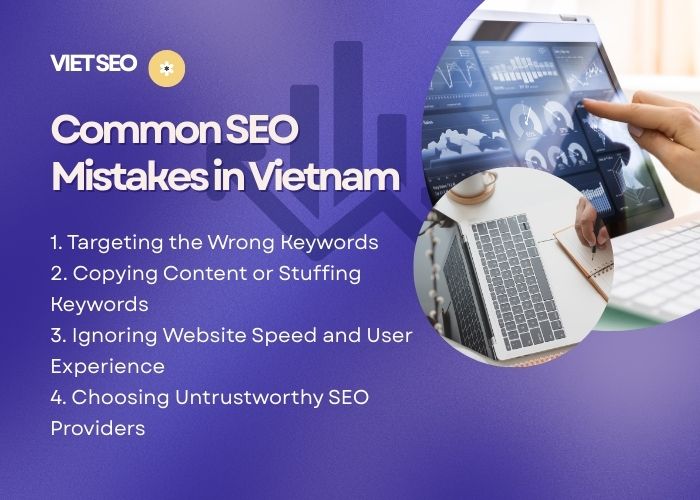
1. Targeting High-Volume but Irrelevant Keywords
A keyword with many searches may provide little value when it does not match the business, target location, or customer intent.
2. Creating One Page for Every Keyword Variation
This can produce thin, overlapping pages that compete with one another.
Related keywords should normally be grouped by topic and intent.
3. Copying Content
Copied content provides limited original value and may make it difficult for search engines to choose which version to show.
4. Keyword Stuffing
Repeating keywords unnaturally reduces readability and may create spam signals.
5. Ignoring Technical SEO
Strong content can underperform when pages are blocked, slow, incorrectly canonicalized, or missing from internal links.
6. Using Low-Quality Link Schemes
Automated links, unrelated forums, paid-link networks, and other manipulative activities may provide little sustainable value and create risk.
7. Focusing Only on Rankings
Rankings should be evaluated together with traffic quality, leads, sales, and business value.
8. Ignoring Conversion Optimization
Traffic has limited value when the landing page contains unclear information, weak calls to action, or difficult forms.
9. Failing to Update the Strategy
Customer demand, competitors, products, website content, and search results change over time.
SEO strategies should be reviewed according to actual data rather than changed only because of industry rumors.
Current Keyword SEO Priorities
Search Intent Over Exact-Match Repetition
Businesses should focus on satisfying the user’s need rather than repeating an exact phrase many times.
Topical Depth
Websites can strengthen their coverage by creating useful pages across the major questions, services, and decision stages within an important topic.
First-Hand Experience
Real projects, original examples, professional experience, research, and practical observations can help content stand out from generic summaries.
Local Relevance
Local businesses should provide genuine information about service areas, locations, projects, customer needs, and local operations.
Page Experience
Fast loading, mobile usability, clear navigation, and stable layouts support customers and can contribute to overall website quality.
They should be improved as part of a complete SEO strategy rather than treated as substitutes for relevant content.
Conversational Queries
Users may search through full questions and natural-language phrases, whether typed or spoken.
Content should answer important questions clearly, but businesses do not need to create a separate page for every possible voice-search variation.
Why Choose Viet SEO for Keyword SEO?
Viet SEO provides keyword research, technical SEO, content optimization, website development support, local SEO, and long-term organic-search strategies.
Business-Focused Keyword Strategy
Keywords are evaluated according to relevance, search intent, competition, and business potential—not only search volume.
Technical and Content Capabilities
Our services can combine website auditing, technical implementation, content planning, on-page optimization, and internal linking.
Understanding of the Vietnamese Market
Strategies can be adapted to Vietnamese search behavior, local competition, language, locations, and customer expectations.
Transparent Scope and Reporting
Deliverables, responsibilities, reporting frequency, measurement methods, and additional development requirements are defined according to the agreed package.
Client Data Control
Clients retain agreed access to their website, Google Search Console, analytics, content, and SEO reports.
Frequently Asked Questions About Keyword SEO
Are Keywords Still Important in SEO?
Yes. Keywords help businesses understand search demand and help clarify page topics. However, SEO now focuses more broadly on search intent, context, content quality, technical accessibility, and authority.
How Many Keywords Should One Page Target?
There is no fixed number. A page should target one clear search intent and may naturally cover multiple related keywords, questions, and phrases.
What Is the Ideal Keyword Density?
There is no universal ideal keyword-density percentage. Content should use relevant terminology naturally and avoid unnecessary repetition.
Should Every Keyword Have a Separate Page?
No. Keywords with the same or closely related intent should normally be grouped on one strong page.
Are Long-Tail Keywords Always Better?
Not always, but they can provide clearer intent and may be more realistic for newer or specialized websites.
Can Keyword Research Guarantee Rankings?
No. Keyword research identifies opportunities, but rankings also depend on content, technical SEO, authority, competition, and implementation quality.
How Long Does Keyword SEO Take?
The timeline depends on the website condition, competition, keyword difficulty, content requirements, authority, and available resources.
No fixed period applies to every project.
Can Viet SEO Optimize an Existing Website?
In many cases, yes. The website should first be audited to identify current rankings, technical limitations, content quality, keyword overlap, and growth opportunities.
Keyword SEO as a Long-Term Business Investment
Keywords remain an important part of SEO because they reveal how customers communicate their needs. However, successful SEO requires more than choosing popular phrases.
A complete keyword SEO strategy combines:
- Customer and market research.
- Search-intent analysis.
- Keyword grouping and mapping.
- Technical SEO.
- Useful content.
- Website architecture.
- Internal linking.
- Authority development.
- Conversion optimization.
- Continuous measurement.
The objective is not to insert more keywords into a website. It is to create the right pages for the right searches and help relevant visitors move toward meaningful business actions.
Keywords identify opportunities. Strategy, content, technology, and customer value turn those opportunities into sustainable SEO results.
Contact Viet SEO for Keyword SEO Services
Viet SEO provides keyword research, SEO audits, content planning, Technical SEO, on-page optimization, local SEO, and long-term search-growth services for businesses in Ho Chi Minh City and throughout Vietnam.
Contact us to request a website assessment and receive a keyword SEO roadmap based on your business, customers, competition, and current website condition.
Hotline: +84 917 212 969



Questions & Comments
You can ask a question about this article. Viet SEO will review and reply after moderation.