Affordable Content Writing Services: Costs, Risks and Provider Guide
What Is a Content Writing Service?
A content writing service helps businesses plan, research, create, edit, and publish written materials for websites, marketing campaigns, sales processes, and customer communication.
The service may be provided by:
- An independent freelance writer
- A specialist content team
- A digital marketing or SEO agency
- An in-house writer or editor
Depending on the project, a provider may handle only the writing or manage a broader workflow that includes keyword research, content planning, interviews, editing, internal linking, CMS publishing, and performance reporting.
Common Types of Content Writing
- SEO articles: Informational content designed around relevant search intent.
- Service pages: Commercial pages explaining services, processes, audiences, and next steps.
- Product and category content: Descriptions, specifications, comparisons, and buying guidance.
- PR and editorial content: Announcements, contributed articles, and media materials.
- Social media content: Captions, short-form posts, campaign messages, and content calendars.
- Email content: Newsletters, onboarding sequences, promotions, and follow-up campaigns.
- Advertising scripts: Copy for video, audio, landing pages, and digital advertisements.
- Long-form resources: Ebooks, reports, case studies, guides, and white papers.
What Is a Cheap Content Writing Service?
A cheap content writing service is usually a service offered at a lower price than other providers in the same market.
However, the term “cheap” does not describe the scope of work. Two articles with the same word count may require very different levels of research, subject expertise, editing, SEO planning, interviews, or approval.
A low price may be possible because:
- The writer is new and building a portfolio.
- The project has a simple topic and clear source material.
- The client supplies a detailed brief and verified information.
- The provider uses templates or a standardized workflow.
- The price excludes research, editing, images, publishing, or revisions.
- The provider is operating in a lower-cost market.
Low-cost content is not automatically poor. Likewise, expensive content is not automatically effective. The important question is whether the agreed scope, quality controls, and final output match the business’s needs.
Cheap Content vs. Cost-Effective Content
Cheap content focuses mainly on the initial price. Cost-effective content considers the value delivered relative to the total cost.
| Area | Cheap content | Cost-effective content |
|---|---|---|
| Primary focus | Lowest possible price | Appropriate quality for the business goal |
| Scope | May be unclear or very limited | Deliverables and exclusions are documented |
| Research | Often minimal | Matched to the topic and risk level |
| Editing | May not be included | Includes defined quality review |
| SEO | May mean only adding keywords | Considers intent, structure, links, metadata, and page purpose |
| Business value | Measured by number of articles | Measured by usefulness, leads, sales, or operational support |
Advantages of Affordable Content Writing Services
1. Lower Entry Cost
Affordable services may help small businesses begin improving important pages without committing to a large project.
2. Suitable for Simple Content
Lower-cost writing may be appropriate for:
- Basic company updates
- Simple product descriptions based on verified data
- Formatting existing material
- Rewriting approved internal documents
- Short social media content
3. Useful for Testing a Provider
A limited paid trial can help evaluate communication, research, writing, editing, and delivery before beginning a larger engagement.
4. Flexible Ordering
Freelancers and smaller teams may offer flexible project sizes without long-term contracts.
Risks of Choosing Content Based on Price Alone
1. Insufficient Research
A low fee may not provide enough time to verify facts, review official sources, or understand the business.
2. Generic Content
Articles may repeat common advice without examples, original information, or a clear relationship to the company’s products and services.
3. Factual Errors
Inaccurate claims can create serious problems in technical, financial, medical, legal, or regulated industries.
4. Hidden Exclusions
The advertised fee may not include:
- Keyword research
- Content briefs
- Interviews
- Editing
- Revisions
- CMS publishing
- Images
- Performance reporting
5. Inconsistent Output
Large low-cost orders may be distributed among several writers without consistent style guidance or editorial control.
6. Excessive Use of Automation
AI-assisted writing can improve efficiency, but unverified generated text may contain invented facts, repetitive explanations, or unsupported claims.
7. Copyright and Originality Risks
A provider may copy, lightly rewrite, or reuse existing content without proper attribution or permission.
8. Weak Commercial Alignment
A page may attract irrelevant traffic or fail to connect readers to an appropriate service, product, or next action.
What Affects Content Writing Cost?
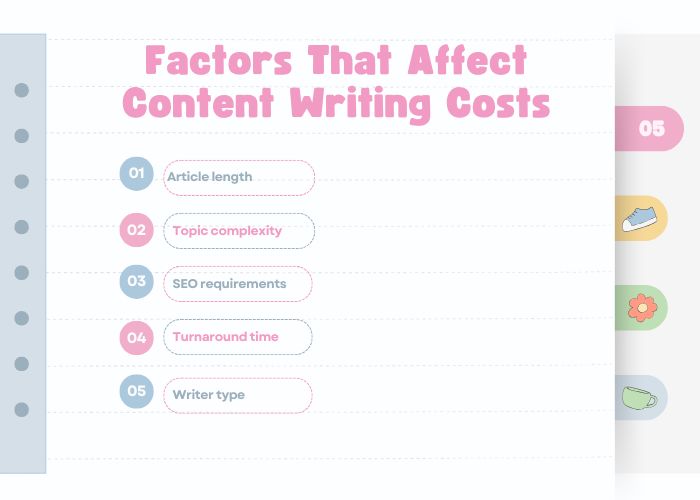
Content-writing prices should reflect the work required rather than only the final word count.
1. Content Type
A short social post, product page, technical guide, landing page, and case study require different skills and workflows.
2. Topic Complexity
Specialist topics may require:
- Industry knowledge
- Technical documentation
- Professional review
- Additional fact-checking
- Legal or regulatory caution
3. Research Requirements
Costs may increase when the writer must:
- Locate and verify external sources
- Review long documents
- Interview employees or customers
- Analyze competitors
- Interpret data
4. Content Length and Depth
Longer content often requires more work, but word count alone does not determine value.
A concise technical page may require more expertise than a long general-interest article.
5. SEO Scope
SEO-related responsibilities may include:
- Search-intent analysis
- Keyword research
- Content mapping
- Title and description writing
- Heading structure
- Internal-link planning
- Content updates based on performance
6. Source Material
A project is usually easier when the client supplies accurate product data, approved company information, subject-matter experts, and existing documents.
7. Revision and Approval Process
Several stakeholders and multiple revision rounds can significantly increase project time.
8. Turnaround Time
Urgent work may require schedule changes or additional staff and may therefore cost more.
9. Publishing and Formatting
CMS uploading, image handling, HTML formatting, internal linking, and mobile quality checks should be included clearly in the scope.
10. Writer Experience and Specialization
Experienced specialist writers may charge more because they require less training, understand industry terminology, and can identify factual or strategic problems earlier.
Common Content Writing Pricing Models
1. Per-Word Pricing
The fee is calculated according to the final word count.
This model is easy to understand, but it may not reflect the full value of research, interviews, editing, SEO planning, or publishing.
2. Per-Article or Per-Page Pricing
A fixed fee is agreed for one defined deliverable.
The scope should specify:
- Content type
- Approximate length or depth
- Research
- SEO responsibilities
- Revisions
- Publishing
3. Hourly or Daily Pricing
This may be appropriate for editing, consulting, workshops, audits, or projects with changing requirements.
4. Project-Based Pricing
A project may include content strategy, briefs, interviews, multiple pages, editing, CMS publishing, and reporting.
5. Monthly Retainer
A retainer may cover an agreed level of ongoing support, such as:
- New pages
- Content updates
- Editorial planning
- Performance analysis
- Meetings and coordination
6. Package Pricing
Packages can reduce administrative work, but the provider should not sacrifice research, review, or quality control merely to deliver a fixed article count.
Why Fixed Market Price Tables Can Be Misleading
Public price ranges can become outdated quickly and may compare services with completely different scopes.
For example, two providers may both advertise a “1,000-word SEO article,” but one price may include only writing while the other includes:
- Keyword and intent research
- Expert interviews
- Editorial review
- Metadata
- Internal links
- Images
- CMS publishing
- Performance monitoring
A business should compare deliverables and responsibilities rather than article prices alone.
How to Calculate a Content Writing Quotation
A provider may estimate:
Research time
+ content planning
+ writing
+ editing
+ fact-checking
+ SEO work
+ publishing
+ revision allowance
+ project management
= project fee
Information Needed Before Quoting
- Content type
- Target audience
- Business objective
- Number of pages
- Topic complexity
- Available source material
- SEO responsibilities
- Required images or media
- CMS publishing requirements
- Deadline
- Approval process
- Number of revisions
- Usage and ownership rights
When an Affordable Service May Be Suitable
A lower-cost provider may be appropriate when:
- The topic is simple and low risk.
- The client provides complete and verified information.
- The content follows an existing template.
- Only light editing or formatting is required.
- The provider has relevant samples and a reliable process.
- The business can perform its own specialist review.
When to Invest in Specialist Content
A more experienced writer, editor, or agency may be appropriate when:
- The topic affects health, finance, law, safety, or compliance.
- The page represents an important product or service.
- The content requires interviews or original research.
- The company needs a consistent brand voice across many channels.
- The project includes strategy, SEO, publishing, and measurement.
- Errors could damage trust or create legal risk.
How to Evaluate a Content Writing Provider
1. Review Relevant Samples
Do not evaluate samples only by grammar.
Check whether the content:
- Serves a clear audience
- Uses reliable information
- Has a logical structure
- Provides original value
- Matches the intended page type
- Includes appropriate calls to action
2. Ask About the Process
Questions may include:
- Who conducts the research?
- Who writes and edits the content?
- How are facts verified?
- How is AI used?
- How many revisions are included?
- Who approves the final version?
3. Request a Paid Trial
A small paid assignment can help both parties determine whether the working relationship is suitable.
Free samples may not reflect the provider’s normal process and can create unfair expectations.
4. Evaluate the Briefing Process
A professional provider should ask about:
- Audience
- Objectives
- Products or services
- Sources
- Brand tone
- Competitors
- Next action
5. Check Revisions and Ownership
The agreement should state:
- How many revision rounds are included
- What counts as a revision
- Who owns the final content
- Whether the writer may use it in a portfolio
- How confidential information is handled
6. Check Delivery Reliability
Review communication, deadline management, file organization, and response to feedback.
Questions to Ask Before Hiring a Content Writing Service
- What exactly is included in the fee?
- Who will write and edit the content?
- Does the provider have experience in our industry?
- How are facts and sources verified?
- Is keyword and search-intent research included?
- Are metadata and internal links included?
- Will the provider upload the content to the CMS?
- How many revisions are included?
- What is the expected delivery schedule?
- How are confidential materials protected?
- Who owns the content after payment?
- How will success be measured?
Warning Signs of a Low-Quality Provider
- Promises guaranteed Google rankings
- Cannot explain the research or editing process
- Offers extremely large volumes with unrealistic deadlines
- Uses copied or lightly rewritten samples
- Refuses to define revisions or ownership
- Publishes content without verifying product or business information
- Focuses only on keyword density and word count
- Recommends filler articles or bulk content solely for backlink building
Why Filler Content Is Not a Good Strategy
Content created only to increase page count or support artificial link building may provide little value to users.
It can also create:
- Overlapping pages
- Weak brand credibility
- Editorial maintenance costs
- Low-quality search traffic
- Indexing and content-selection problems
Even a limited budget should be directed toward useful pages with a clear audience and purpose.
How to Brief a Content Writer
| Brief component | What to provide |
|---|---|
| Audience | Who the content is for |
| Objective | What the page should help users or the business accomplish |
| Page type | Article, service page, product page, email, social post, or another format |
| Main topic | The central subject or search intent |
| Sources | Product data, documents, interviews, and approved references |
| Brand voice | Preferred tone, terminology, and examples |
| Internal links | Relevant pages the content should connect to |
| Call to action | The appropriate next step |
| Review process | Who will approve facts and final wording |
How to Measure the Value of Content Writing
The value of content should not be measured only by word count or the number of articles delivered.
Search Performance
- Organic impressions
- Organic clicks
- Relevant queries
- Priority-page visibility
Engagement and Navigation
- Internal-link clicks
- Downloads
- Form interactions
- Product views
- Return visits where relevant
Business Outcomes
- Qualified enquiries
- Bookings
- Orders
- Revenue
- Lead quality
- Assisted conversions
Operational Value
- Reduced repetitive customer questions
- Faster sales communication
- More consistent product information
- Reusable content across channels
Why Choose Viet SEO?
Viet SEO provides content services designed around business objectives rather than article volume alone.
Depending on the agreed scope, support may include:
- Audience and search-intent research
- Content planning and briefs
- SEO articles and commercial pages
- Editing and quality control
- Metadata and internal links
- CMS formatting
- Coordination with SEO and website-development work
Before beginning a project, the scope, responsibilities, timeline, revisions, and deliverables should be confirmed clearly so that clients can compare cost with actual value.
Content Writing Service Checklist
| Area | Question to review |
|---|---|
| Scope | Are all deliverables and exclusions documented? |
| Audience | Does the provider understand who the content serves? |
| Research | Is the research level appropriate for the subject? |
| Accuracy | Who verifies facts, data, and product claims? |
| SEO | Does the service consider intent, structure, links, and page purpose? |
| Editing | Is professional review included? |
| AI use | How is generated content verified and edited? |
| Revisions | How many rounds are included and what do they cover? |
| Ownership | Who owns the final content and source files? |
| Confidentiality | How is private business information protected? |
| Publishing | Are CMS formatting and quality checks included? |
| Measurement | How will the project’s value be evaluated? |
Frequently Asked Questions
Is cheap content writing always low quality?
No. A lower price may reflect a simple project, a new provider, supplied source material, or a limited scope. Quality should be evaluated through samples, process, accuracy, editing, and reliability.
How much does content writing cost?
Costs vary according to content type, complexity, research, writer expertise, SEO responsibilities, revisions, publishing, and turnaround time. There is no single market price suitable for every project.
Is per-word pricing the best option?
Per-word pricing is simple, but it may not reflect research, interviews, editing, SEO planning, or publishing. Page-based or project-based fees may be more suitable for complex work.
Should I order a trial article?
A small paid trial can help evaluate the provider’s research, communication, writing, editing, and ability to follow the brief before a larger commitment.
Does cheap content harm SEO?
Price alone does not determine SEO performance. Inaccurate, generic, copied, manipulative, or poorly targeted content can create problems regardless of how much it costs.
Should I use cheap content for backlink building?
Content created only as filler for artificial link building is unlikely to provide lasting value and may be associated with manipulative link practices. Prioritize useful content and legitimate promotion.
What should a content writing quotation include?
It should define the content type, scope, research, SEO work, editing, revisions, publishing, delivery schedule, ownership, and any excluded services.
How do I know whether content is worth the cost?
Evaluate whether it supports relevant search visibility, customer understanding, qualified leads, sales, or operational efficiency—not only whether it meets a word count.
Conclusion
A cheap content writing service is not automatically a bad choice, but the lowest price should not be the only decision factor.
Businesses should compare the full scope of work, including research, factual verification, SEO planning, editing, revisions, publishing, ownership, and performance measurement.
Affordable content can be suitable for simple, low-risk assignments with clear source material. More important commercial or specialist pages may require experienced writers, editors, and subject-matter review.
The objective should not be to purchase the greatest number of words or articles. It should be to create accurate and useful content that supports customers and contributes to measurable business goals.
Viet SEO also provides SEO services and website design for businesses that need content integrated with website structure, search visibility, and conversion planning.



Questions & Comments
You can ask a question about this article. Viet SEO will review and reply after moderation.