Rich Content and SEO: Why Quality Content Is Not Enough
A detailed page does not earn a ranking simply by covering more topics than its competitors. It needs a clear purpose, useful information for that purpose, and a website that makes the page accessible and understandable.
This guide takes a page-level approach: define what the reader needs to accomplish, identify missing information, and decide whether to improve an existing page or create something new. It also separates search requirements from the business metrics used to evaluate results.
Choose the Right Content Action
Use this review framework before commissioning more content. It is a planning aid, not Google’s ranking formula.
| Finding | Possible action | Evidence needed |
|---|---|---|
| The page answers the need accurately | Keep it and monitor relevant changes | A review of its purpose, accuracy, and usability |
| The purpose is right but useful information is missing | Update the existing page | Specific unanswered customer questions and reliable source material |
| Several pages serve substantially the same purpose | Investigate overlap before consolidation | Distinct value, current traffic, links, and the role of each URL |
| A different customer task needs its own destination | Consider a separate page | A clear audience, page purpose, and enough distinct information |
| The page is not accessible or indexed as intended | Investigate technical conditions first | URL status, access settings, rendering, and canonical selection |
What Is “Rich Content”?
“Rich content” is a common marketing term rather than an official Google ranking category.
In practice, it usually describes content that provides enough useful information, context, evidence, and structure to satisfy a particular audience or search need.
Rich content does not simply mean:
- A high word count
- Many keywords
- Several images or videos
- A long list of headings
- Repeating information already available elsewhere
A useful page may instead:
- Answer the main question clearly
- Address important follow-up questions
- Explain processes, limitations, and alternatives
- Use relevant examples
- Support important claims
- Help the reader decide what to do next
What Makes Content Useful?
1. A Clear Match with Search Intent
Search intent describes what the user is trying to accomplish.
A search may indicate that the user wants to:
- Learn about a topic
- Compare products or providers
- Find a local business
- Check pricing
- Complete a purchase
- Access a specific website or page
A detailed educational article may be useful for an informational search but unsuitable for a query where users expect a product category, pricing page, or local service provider.
2. Direct and Complete Answers
The page should answer the primary question without forcing the reader through a long introduction.
Additional detail should be included when it helps the reader understand:
- How something works
- Why it matters
- Which options are available
- Which risks or limitations exist
- How to make a decision
3. Accuracy and Support
Keep a record of important claims and their sources. Distinguish product facts, first-hand observations, estimates, and illustrative examples so readers can understand what the evidence supports.
A case study should state its context and limitations. A statistic needs a relevant source and period; adding a number without that context may create a false impression of precision.
4. Relevant Experience and Expertise
Content can become more useful when it includes real knowledge such as:
- Practical steps
- First-hand observations
- Original examples
- Common mistakes
- Implementation considerations
- Clear professional limitations
Professional credentials may be important for health, legal, financial, and other high-risk topics, but an author biography alone does not prove that every statement is accurate.
5. Readable Presentation
Useful presentation may include:
- Descriptive headings
- Short, focused paragraphs
- Lists where appropriate
- Tables for genuine comparisons
- Images that explain or demonstrate something
- Clear next steps
Content should not be divided into excessive headings merely to appear more optimized.
Rich Content Is Important, but It Is Not Enough
Similar length and topic coverage do not establish that two pages have equal quality or serve the same search need. One may help the reader choose a service while the other explains a concept.
Separate three questions: can the page be accessed and considered for indexing, does it fit the intended search, and does it help the business or reader achieve the desired outcome? These are related questions, but the evidence for one does not answer the others.
The sections below are areas for investigation, not independent ranking factors with equal or publicly known weights.
Factors That May Affect Organic Search Performance
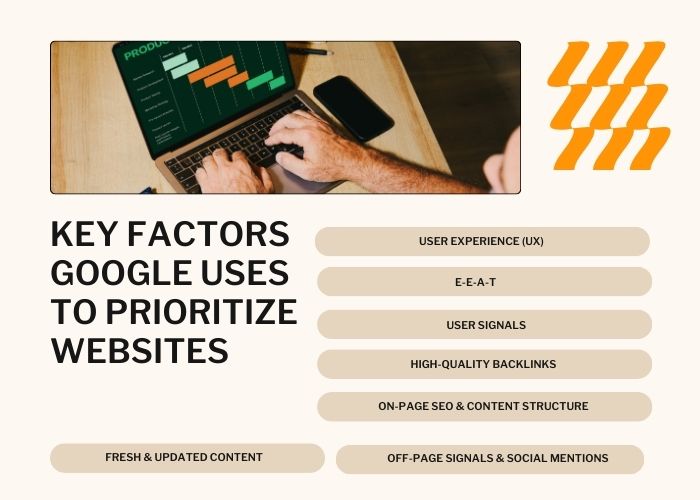
1. Content Relevance and Quality
The page should provide information appropriate to the query, audience, and expected page format.
Quality is not determined by one characteristic such as length, keyword density, or number of images.
2. Crawlability and Indexing
Review the actual URL and its intended role before changing content. Check whether it is accessible, whether indexing is restricted, how its main content renders, and which canonical URL is selected.
A robots.txt restriction, a noindex directive, and a canonical hint have different roles. Do not treat them as interchangeable settings. Fixing an access issue removes an obstacle; it does not guarantee indexing or high rankings.
3. Website Architecture
A clear structure helps users and search systems understand:
- Main products and services
- Topic relationships
- Important categories
- Supporting information
- Page hierarchy
Publishing strong articles without connecting them to relevant service, product, or category pages may limit their business value.
4. Internal Linking
Internal links help users discover related pages and clarify how content fits within the website.
Useful internal links should:
- Point to genuinely relevant pages
- Use descriptive anchor text
- Help users continue their journey
- Reduce orphan pages
- Support important commercial pages where appropriate
Adding large numbers of keyword-rich internal links does not automatically improve performance.
5. Page Experience and Usability
A page should be accessible and usable on common devices and screen sizes.
Important considerations may include:
- Mobile layout
- Readable typography
- Navigation
- Visual stability
- Interaction responsiveness
- Page-loading performance
- Intrusive advertisements or pop-ups
Good usability supports visitors, but it should not be described as a guarantee of higher rankings.
6. Core Web Vitals
Core Web Vitals cover loading, interaction responsiveness, and layout stability through LCP, INP, and CLS. Distinguish real-user field data from a single test performed under simulated conditions.
Google’s page-experience guidance explains that Core Web Vitals are used by its ranking systems, while good results do not guarantee a high position. There is no single page-experience signal that captures every aspect.
Use the measurements to identify concrete visitor problems on important page types. A high overall tool score is not a complete assessment of content or search performance.
7. Mobile Accessibility
A website should provide essential content and functions on mobile devices.
Businesses should avoid relying on a universal percentage of mobile traffic. Actual device usage differs by audience, market, page type, and industry.
8. Authorship and Trust
Trust may be supported by:
- Accurate business information
- Clear contact details
- Transparent authorship
- Relevant professional credentials
- Editorial review
- Secure website operation
- Correction and update policies
How Should Businesses Understand E-E-A-T?
E-E-A-T means Experience, Expertise, Authoritativeness, and Trustworthiness. Google’s helpful-content guidance says that E-E-A-T itself is not a specific ranking factor, and quality raters do not directly control page rankings.
Use it as a self-assessment framework rather than a score to buy or a set of decorative elements to add. The following questions can help reviewers examine the substance behind a page.
Experience
Does the content demonstrate relevant first-hand or practical experience where it matters?
Expertise
Does the author or organization have appropriate knowledge of the subject?
Authoritativeness
Is the author, organization, or website recognized within the relevant area?
Trustworthiness
Is the information accurate, transparent, safe, and appropriate for its purpose?
Trust is particularly important for topics that may affect health, finances, legal rights, personal safety, or major life decisions.
A medical article written by a licensed professional is not automatically guaranteed to rank. However, appropriate expertise and review can improve reliability for readers.
Does Google Use Bounce Rate and Dwell Time?
Businesses should be careful when describing analytics metrics such as bounce rate, time on page, and dwell time as direct ranking signals.
These metrics can also be difficult to interpret.
For example:
- A user may find an answer quickly and leave satisfied.
- A user may keep a page open without reading it.
- Analytics configuration may affect reported engagement.
- Different page types naturally produce different behaviors.
These metrics may help website owners evaluate page experience, but they should not be treated as universal proof of search quality.
Click-Through Rate and Organic Search
Search CTR is clicks divided by impressions for the selected scope. Compare consistent queries, pages, periods, devices, and markets where possible; a change in the mix can alter the average.
Before rewriting a title because CTR is low, examine position and the result format. An impression near the bottom of a results page is not equivalent to one near the top. Record the reason for a change and evaluate it in context.
CTR is useful diagnostic evidence. A higher rate alone does not establish that the page satisfies visitors or that the title caused a ranking change.
External Links, Backlinks, and References
External references can help users and search systems discover and understand websites.
Potentially useful sources may include:
- Industry publications
- Professional associations
- Relevant business partners
- Original research citations
- Digital PR coverage
- Useful directories
Link quality cannot be evaluated through domain type alone.
A link from a university or government domain is not automatically valuable, while a relevant industry website is not automatically weak.
Businesses should evaluate:
- Relevance
- Editorial context
- Transparency
- Audience usefulness
- Placement method
- Potential risk
On-Page SEO and Content Structure
On-Page SEO helps clarify a page’s topic and purpose.
SEO Title
The title should accurately describe the page and give users a reason to consider the result.
Meta Description
A meta description can summarize the page, although search engines may choose to display different text.
Heading Hierarchy
Headings should organize the content logically. They should not be added solely to insert more keywords.
Keyword Use
Relevant terms should appear naturally where they help explain the topic.
Image Optimization
Use images that explain or demonstrate relevant information. Provide appropriate alternative text, suitable dimensions, and efficient files while preserving necessary visual detail.
Apply lazy loading where suitable rather than automatically to every image. Test that key visuals and page content remain available and usable on common devices.
Technical Files and Signals
XML sitemaps and robots.txt can support crawling management, but their presence does not guarantee indexing or rankings.
Does Content Need to Be Updated Regularly?
Content should be reviewed when accuracy, usefulness, products, regulations, prices, technology, or customer needs change.
An article does not need to be updated simply because a fixed period has passed.
Update content when:
- Facts or statistics are outdated.
- The product or service has changed.
- The search intent has shifted.
- The page no longer answers important questions.
- Links or resources are broken.
- Competitors provide substantially more useful information.
Changing the publication date without meaningfully improving the content does not make a page more useful.
Social Media and Off-Page Visibility
Social shares and mentions may help a business:
- Distribute content
- Reach new audiences
- Generate referral traffic
- Attract editorial attention
- Increase brand familiarity
They should not automatically be described as direct ranking factors.
The SEO value may be indirect when wider exposure leads to genuine searches, references, links, or customer engagement.
What Does “Complete Value” Mean?
No page can provide every possible piece of information. Attempting to cover everything may make the page difficult to use.
A better objective is to provide the information required for the specific search and audience.
| Area | Useful Questions |
|---|---|
| Search intent | Does the page match what the user is trying to accomplish? |
| Information | Does it answer the main question and necessary follow-up questions? |
| Accuracy | Are important statements correct and appropriately supported? |
| Usability | Can users read, navigate, and act on the page easily? |
| Technical access | Can search systems access, render, and index the content? |
| Trust | Is the author, business, and purpose presented transparently? |
| Next action | Can the user continue to a relevant product, service, or resource? |
How to Create a Content and SEO Strategy
Step 1: Define the Business Objective
Determine whether the content should support:
- Customer education
- Lead generation
- Product discovery
- Online sales
- Local visibility
- Customer retention
Step 2: Research the Audience
Use sources such as:
- Customer interviews
- Sales questions
- Support requests
- Reviews
- Search Console data
- Website searches
Step 3: Review Search Intent
Record the customer task and the page type likely to serve it. Use observed search results as context, not a template that must be copied.
For example, a customer comparing service options may need scope, conditions, evidence, and a contact route. A longer explanation of terminology would not necessarily address that task. This is an illustrative distinction, not a prediction for every query.
Step 4: Map Topics to Pages
Assign each topic group to an appropriate service page, product page, category page, article, or comparison page.
Step 5: Prioritize Existing Pages
Review the existing page’s purpose, useful information, visitors, and links before deciding to keep, update, consolidate, or replace it. Do not create a new URL merely because a keyword variation is not repeated in the current title.
Overlap in vocabulary does not automatically mean harmful competition. Establish whether the pages serve different tasks before making changes that affect URLs or navigation.
Step 6: Create a Content Brief
Write a brief around the intended reader task, not just a target keyword and word count. Include the main answer, necessary supporting detail, approved source material, and what the page will leave to other resources.
- Identify the intended reader and situation.
- State what the reader should understand or be able to do afterwards.
- List claims requiring evidence or specialist approval.
- Define useful examples, media, and related pages.
- Name the writer, reviewer, and final approver.
- Record the publication checks and reason for future review.
Step 7: Review Technical Requirements
Confirm that the page can be crawled, indexed, displayed correctly, and measured.
Step 8: Publish and Connect the Page
Add relevant internal links from existing pages and make the content accessible through the website structure.
Step 9: Measure Business Performance
Match measures to the page’s purpose. An educational resource may help readers understand a process; a service page may support suitable enquiries. Not every page needs the same conversion action.
Keep search impressions and clicks, website sessions, contact events, qualified opportunities, and sales separate. A phone-link click is not a verified call, and a form is not automatically a qualified lead. State the reporting period, source, and tracking limitations.
Step 10: Improve When Needed
Record a reason for each substantial revision: changed facts, an unanswered question, a usability problem, or a performance pattern requiring investigation. Retain a change log and identify what should be checked after publication.
If performance falls, consider technical changes, demand, comparison periods, and search-result changes before assuming that the answer is more text. Update the information that needs improvement and observe relevant outcomes.
Should You Use Pillar and Cluster Content?
A pillar-and-cluster structure may help organize broad topics into a main page and related supporting pages.
It can be useful when:
- The topic has several distinct subtopics.
- Each supporting page serves a genuine search need.
- The internal links help users navigate.
- The structure reflects the business’s services or expertise.
It is not necessary for every website, and publishing many cluster articles does not automatically establish authority.
How Viet SEO Approaches Content and Technical SEO
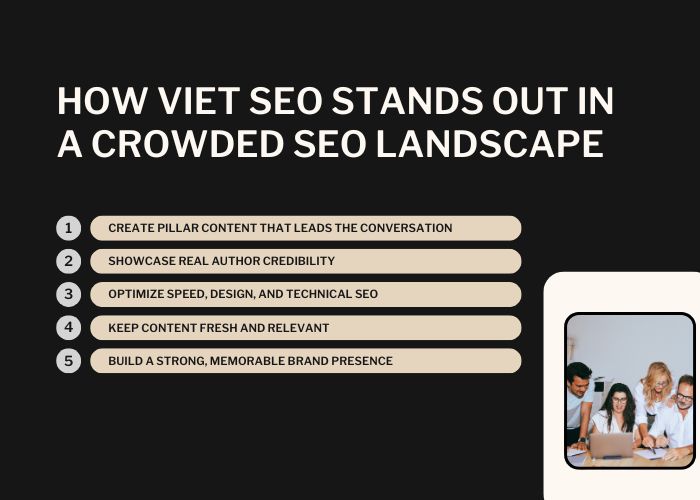
Viet SEO approaches content as one part of a wider website and marketing system.
Depending on the project, the work may include:
- Business and audience research
- SEO Audits
- Search-intent analysis
- Website and content mapping
- Technical implementation
- On-Page SEO
- Content development and editing
- Internal linking
- Authority and reputation development
- Conversion tracking
1. Priority Content Development
Instead of publishing articles only to increase quantity, priority is given to pages connected to:
- Important products and services
- Customer questions
- Search demand
- Business objectives
2. Authorship and Editorial Review
Where relevant, content can include clear authorship, qualifications, sources, and review responsibility.
These elements should reflect real expertise rather than being added as decorative trust signals.
3. Technical and Website Improvements
SEO recommendations may involve:
- Website architecture
- Templates
- Page performance
- Mobile usability
- Indexing controls
- Structured data
- Analytics
4. Content Review Based on Need
Content-review schedules should be based on the topic, business, and rate of change rather than a universal six- or twelve-month rule.
5. Brand Consistency
SEO content should match the company’s real services, expertise, tone, visual identity, and customer experience.
A strong brand can support recognition and demand, but no brand is completely protected from market, reputation, or search changes.
Common Mistakes When Creating “Rich Content”
Common mistakes are decisions made without a clear reader benefit or supporting evidence:
- Adding length without answering another necessary question.
- Creating a new page for every wording variation.
- Copying competitor headings instead of defining the customer task.
- Adding statistics or expert claims that cannot be verified.
- Removing or merging pages before checking their role and existing value.
- Treating a tool score, author box, or media count as proof of quality.
- Using the same lead-generation target for every page regardless of purpose.
Frequently Asked Questions About Rich Content and SEO
Is “rich content” a Google ranking factor?
It is not an official single ranking factor. The term generally describes content that provides useful depth, context, and presentation for a particular audience.
Do longer articles rank better?
Not simply because they are longer. Google states that it has no preferred word count. Include the information needed for the reader’s task, and remove repetition that does not help.
Can good content rank without backlinks?
It may rank for some searches, but performance depends on competition, relevance, website structure, technical condition, authority, and other factors.
Is bounce rate a direct ranking factor?
Businesses should not assume their analytics bounce rate is used directly as a universal ranking signal.
Is dwell time a confirmed ranking factor?
It should not be presented as a simple confirmed metric that website owners can optimize directly for rankings.
Do social shares directly improve rankings?
Social distribution may create traffic, awareness, links, and mentions, but shares should not automatically be described as direct ranking factors.
Must content be updated every six or twelve months?
No. Update it when facts, products, user needs, regulations, links, or search intent change.
Does a website have a measurable E-E-A-T score?
There is no standard Google E-E-A-T score for website owners to optimize. Use the framework to assess real experience, expertise, recognition, and trust rather than treating a third-party score as Google’s measurement.
Do Core Web Vitals guarantee better rankings?
No. They help assess aspects of page experience but do not guarantee a particular organic position.
Build Useful Pages Within a Strong Website
A useful page has a defined purpose, reliable information, and a place within a website people can navigate. Its quality should be reviewed through what it helps readers accomplish, alongside technical access and appropriate performance evidence.
Before adding another article, identify the missing customer task or information. Improve an existing page when that is the better destination, and create a separate page when the need and content are genuinely distinct.
Viet SEO can assess content, website structure, technical conditions, and measurement within an agreed scope. The objective is to choose improvements with a clear rationale and checkable outputs.
Contact Viet SEO
- Website: Viet SEO services and solutions
- Hotline: +84 917 212 969
- Service area: Ho Chi Minh City and clients in other locations


Questions & Comments
You can ask a question about this article. Viet SEO will review and reply after moderation.