10 Advanced SEO Strategies to Improve Website Performance
SEO is not a one-time setup. Search behavior, competitors, websites, and content quality change continuously, so businesses need a process for reviewing and improving their organic search strategy over time.
Many companies focus only on common tasks such as adding keywords, publishing articles, and building backlinks. Those activities can be useful, but they are not enough on their own.
A stronger SEO strategy also considers structured data, information architecture, content maintenance, brand signals, media optimization, internal linking, technical accessibility, and conversion measurement.
This guide presents ten practical SEO strategies that are often overlooked but can improve a website’s visibility, usability, and long-term business value.
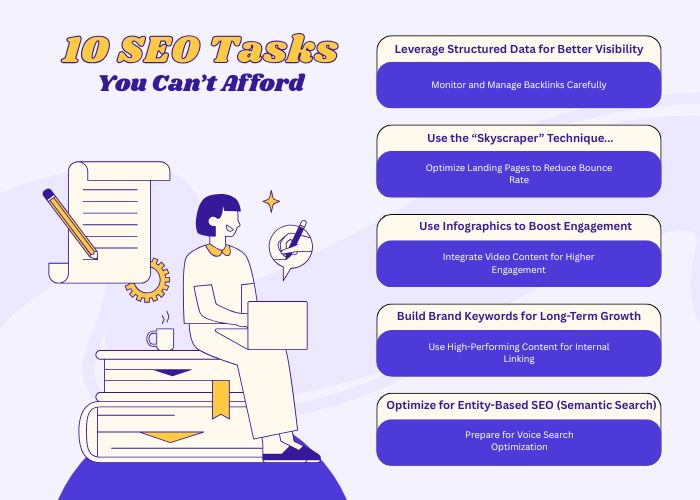
1. Use Structured Data Accurately
Structured data is machine-readable markup that helps search engines understand specific page elements and entities.
Depending on the page, suitable schema types may include:
ArticleProductOrganizationLocalBusinessEventRecipeVideoObjectBreadcrumbList
Structured data may make a page eligible for supported search features, but it does not guarantee rich results, higher rankings, or more clicks.
How to Implement Structured Data
- Choose a schema type that accurately matches the visible content.
- Add the markup using JSON-LD where appropriate.
- Validate the markup with a suitable testing tool.
- Check for syntax and eligibility errors.
- Monitor structured-data reports in Google Search Console when available.
Use Schema.org as a reference for vocabulary and properties.
Structured Data Best Practices
- Mark up only information visible on the page.
- Keep prices, availability, dates, and ratings accurate.
- Do not create fabricated reviews or ratings.
- Keep canonical URLs and structured-data URLs consistent.
- Update markup when page content changes.
2. Review Backlinks Without Overreacting
Backlinks can help search engines discover content and understand website authority. However, not every unusual or low-quality-looking link requires action.
Websites naturally receive links from scrapers, directories, automated pages, and unrelated sources. Search engines may already ignore many of these links.
When to Review a Backlink Profile
A backlink review may be useful when:
- The website has previously purchased links.
- An agency built large volumes of manipulative backlinks.
- The website received a manual action related to unnatural links.
- There is evidence of coordinated link manipulation.
- The business is acquiring another website or domain.
How to Review Backlinks
- Use Google Search Console to review known linking websites and pages.
- Use third-party tools for broader research and historical analysis.
- Evaluate relevance, editorial context, traffic legitimacy, and manipulation risk.
- Document links that were created intentionally.
- Request removal when the business controls or paid for problematic links.
The disavow tool should not be used simply because a third-party tool labels links as “toxic.” It is a specialized action that should be considered carefully when there is a meaningful risk from unnatural links.
3. Create Content That Provides Original Value
The traditional “Skyscraper Technique” recommends finding successful content and producing a more complete version. That approach can still provide research ideas, but simply making an article longer does not make it better.
A stronger content process should focus on information gain and genuine audience value.
How to Create Better Content
- Identify the real user need: Determine what the searcher wants to understand or accomplish.
- Review existing results: Identify what is already explained well and what remains unclear.
- Add original value: Include experience, data, examples, tools, or expert analysis.
- Improve usability: Use clear headings, visuals, tables, and actionable steps.
- Promote appropriately: Share the resource with audiences and organizations that may genuinely benefit from it.
Examples of Original Value
- Original research or survey results
- Real project data
- Case studies
- Industry-specific examples
- Downloadable templates
- Calculators or interactive tools
- Expert commentary
- Before-and-after comparisons
Outreach should not pressure websites to replace existing links. A page earns references when it provides a useful reason to be cited.
4. Optimize Landing Pages for Search Intent and Conversions
A landing page should match the user’s search intent and make the next step clear.
Bounce rate should not be treated as a simple direct ranking factor. A user may leave after receiving a complete answer, while another visitor may remain because the page is confusing.
Instead of trying to reduce bounce rate at all costs, evaluate whether users can complete the intended task.
Landing-Page Optimization Checklist
- The title and search snippet accurately describe the page.
- The main heading confirms the page topic.
- The introduction addresses the user’s need quickly.
- Important information is easy to find.
- The page works properly on mobile devices.
- Forms, buttons, and checkout steps function correctly.
- Trust information is visible.
- The call to action matches the customer journey.
Measure Task Completion
Depending on the page, useful actions may include:
- Submitting a form
- Calling the business
- Purchasing a product
- Booking an appointment
- Downloading a document
- Reading a related resource
Landing-page optimization should be evaluated through qualified conversions and user outcomes, not only traffic or engagement metrics.
5. Use Infographics When They Improve Understanding
Infographics can make complex processes, comparisons, statistics, and timelines easier to understand.
They are most useful when the visual format communicates information more effectively than plain text.
Effective Infographic Topics
- Processes and workflows
- Data comparisons
- Timelines
- Decision frameworks
- Step-by-step instructions
- Industry statistics
Infographic SEO Best Practices
- Include a clear HTML explanation near the image.
- Use accurate and readable text.
- Add suitable ALT text.
- Compress the image appropriately.
- Provide source citations for data.
- Create a mobile-friendly version when necessary.
Do not place all important information only inside an image. HTML text improves accessibility, mobile usability, translation, and content maintenance.
An infographic may attract links or social shares when it is genuinely useful, but visual content does not automatically generate backlinks.
6. Integrate Video Where It Adds Value
Video can support product education, demonstrations, tutorials, interviews, and explanations that are difficult to communicate through text alone.
Useful Video Formats
- Product demonstrations
- Step-by-step tutorials
- Customer interviews
- Case-study explanations
- Webinars
- Technical walkthroughs
Video Optimization Best Practices
- Use an accurate and descriptive title.
- Write a useful description.
- Provide captions and transcripts.
- Use a clear thumbnail.
- Place the video near relevant text.
- Avoid unnecessary autoplay.
- Add valid
VideoObjectstructured data when appropriate.
Embedding video does not automatically improve rankings. It should help the user understand the subject or complete a task.
Monitor video starts, completion rates, conversions, and page performance to determine whether it provides value.
7. Build Brand Demand and Consistent Entity Signals
Branded searches occur when users search for a company, product, service, or person by name.
Businesses should not create awkward keyword combinations simply to manufacture branded terms. Brand demand usually develops through customer experience, marketing, public relations, useful content, and word of mouth.
How to Strengthen Brand Visibility
- Use a consistent business name.
- Maintain accurate contact and organization information.
- Create clear About, Contact, and service pages.
- Publish real case studies and expert content.
- Earn legitimate media and industry mentions.
- Maintain relevant social and business profiles.
- Encourage genuine customer reviews.
Keep Entity Information Consistent
Important information should remain consistent across the website and major business profiles:
- Company name
- Logo
- Address
- Phone number
- Website URL
- Founding information
- Products and services
Structured data may reinforce this information, but it cannot replace real-world reputation and consistent business signals.
8. Use Strong Pages to Improve Internal Linking
Pages that receive traffic, backlinks, or consistent impressions can provide useful internal-link opportunities.
Internal linking helps users and search engines understand relationships between pages.
How to Find Internal-Link Opportunities
- Review high-traffic pages in analytics.
- Review pages with strong impressions in Search Console.
- Identify pages with external backlinks.
- Search the website for relevant topics and terms.
- Identify important orphan or weakly linked pages.
Internal-Linking Best Practices
- Link only when the destination is contextually useful.
- Use descriptive and natural anchor text.
- Link to the most suitable canonical URL.
- Avoid adding excessive repeated links.
- Update older pages when useful new resources are published.
Internal links do not simply “transfer authority” in a predictable amount. Their main value is helping with discovery, hierarchy, context, navigation, and page importance.
9. Optimize Topics, Entities, and Context
Search systems evaluate more than exact keyword matches. They also consider topics, context, relationships, and entities such as organizations, products, people, and locations.
Entity-focused SEO does not require repeating names or adding schema everywhere. It requires clear, consistent, and well-supported information.
How to Improve Topic and Entity Clarity
- Give each page one clear primary purpose.
- Use accurate terminology.
- Explain relevant relationships between concepts.
- Link to supporting internal resources.
- Identify authors, organizations, products, and locations clearly.
- Use structured data only when it matches visible content.
- Cite reliable sources for important claims.
Build Topical Coverage Without Creating Duplicate Pages
A strong content structure may include:
- A main service or topic page
- Supporting educational guides
- Case studies
- Frequently asked questions
- Comparisons
- Implementation resources
Avoid creating separate pages for every minor keyword variation when the search intent is substantially the same.
10. Optimize for Conversational and Local Search
Users increasingly search using longer, natural-language questions through keyboards, mobile devices, and conversational interfaces.
Instead of treating voice search as a separate SEO discipline, businesses should make their content clear, direct, and useful for conversational queries.
How to Support Conversational Search
- Answer common questions clearly.
- Use natural language.
- Provide concise answers followed by useful detail.
- Use descriptive headings.
- Include definitions, steps, prices, locations, and requirements when relevant.
Support Local and Action-Oriented Queries
Many spoken searches have local or immediate intent, such as:
- “Where is the nearest repair service?”
- “Which restaurants are open now?”
- “How much does website design cost?”
Local businesses should maintain:
- An accurate Google Business Profile
- Correct opening hours
- Clear service areas
- Updated phone and address information
- Useful location pages
- Genuine customer reviews
No format guarantees selection as a spoken answer. Clear and accurate content simply makes information easier to understand and use.
Additional Strategy: Conduct Content Pruning
Publishing more content is not always the best solution. Some websites contain outdated, duplicated, thin, or poorly targeted pages that weaken website structure and maintenance quality.
Content Audit Actions
A content audit may classify pages as:
- Keep: The page remains useful and accurate.
- Improve: The page needs stronger information or organization.
- Combine: Several overlapping pages should become one resource.
- Redirect: The page has a better replacement.
- Remove: The page has no continuing user or business value.
Before removing a page, review:
- Organic traffic
- Conversions
- Backlinks
- Internal links
- Business purpose
- Legal or support requirements
Additional Strategy: Analyze Server Logs
Server-log analysis can show how search-engine crawlers interact with a website.
It may help identify:
- Important pages crawled infrequently
- Large volumes of parameter URLs
- Redirect chains
- Repeated server errors
- Wasted crawling on low-value URLs
- Differences between known URLs and actual crawler activity
Log analysis is especially useful for large e-commerce, publishing, marketplace, and international websites.
Additional Strategy: Distribute Content
Publishing a high-quality resource does not guarantee that the intended audience will discover it.
Content distribution may include:
- Email newsletters
- Professional communities
- Industry partnerships
- Social platforms
- Digital public relations
- Sales-team outreach
- Relevant paid promotion
Distribution should focus on audiences that may genuinely benefit from the content rather than mass outreach.
How to Prioritize These SEO Strategies
Not every website needs to implement every tactic immediately.
Priority 1: Fix Critical Technical Problems
- Server errors
- Accidental indexing blocks
- Incorrect canonicals
- Broken redirects
- Unavailable priority pages
Priority 2: Improve Priority Pages
- Product pages
- Service pages
- Category pages
- Local landing pages
- High-conversion content
Priority 3: Strengthen Website Structure
- Navigation
- Internal links
- Topic relationships
- Content consolidation
Priority 4: Develop Authority and Distribution
- Original research
- Useful media
- Digital PR
- Industry outreach
- Legitimate backlinks and mentions
How to Measure the Results
Search Visibility
- Organic impressions
- Organic clicks
- Relevant query coverage
- Indexed priority pages
- Branded and non-branded searches
Technical Performance
- Crawl errors
- Indexing issues
- Structured-data errors
- Core Web Vitals
- Server reliability
Content Performance
- Qualified landing-page traffic
- Internal-link usage
- Video engagement
- Downloads
- Relevant backlinks and mentions
Business Performance
- Qualified enquiries
- Purchases
- Bookings
- Phone calls
- Organic revenue
- Conversion rate
- Assisted conversions
Traffic, rankings, and engagement provide context, but the business should also measure whether SEO contributes to meaningful outcomes.
Common Mistakes to Avoid
- Adding structured data that does not match visible content
- Disavowing backlinks based only on automated scores
- Making content longer without adding value
- Treating bounce rate as a direct ranking score
- Publishing infographics without accessible HTML explanations
- Embedding heavy video without monitoring performance
- Forcing branded keyword phrases unnaturally
- Adding internal links solely to repeat exact-match keywords
- Creating duplicate pages for minor keyword variations
- Treating voice search as a guaranteed source of traffic
- Measuring results only through rankings
SEO Strategy Checklist
Structured Data
- The markup matches visible content.
- Required properties are present.
- URLs and values are accurate.
- Errors are monitored.
Links
- Backlink reviews focus on real risk.
- Internal links are useful and descriptive.
- Important pages are not orphaned.
- Manipulative link practices are avoided.
Content and Media
- Content provides original value.
- Infographics include accessible explanations.
- Videos include captions or transcripts.
- Outdated and duplicated pages are reviewed.
Brand and Entities
- Business information is consistent.
- Authors and organizations are identified clearly.
- Important claims are supported.
- Brand mentions are developed legitimately.
Measurement
- Search Console is configured.
- Analytics is installed correctly.
- Primary conversions are tracked.
- Business results are reviewed.
Frequently Asked Questions About Advanced SEO Strategies
Does Structured Data Improve Rankings?
Structured data helps search engines understand specific information and may support eligible search features. It does not guarantee ranking improvements.
Should Every Suspicious Backlink Be Disavowed?
No. Many low-quality links may already be ignored. Disavow should be considered carefully when there is a meaningful risk from links created to manipulate rankings.
Does Longer Content Rank Better?
Not automatically. Content should be long enough to satisfy the user’s need without filler or repetition.
Is Bounce Rate a Direct Ranking Factor?
Analytics bounce rate should not be treated as a simple direct ranking factor. Its meaning depends on the page and user task.
Do Infographics Automatically Generate Backlinks?
No. They may earn references when they are original, useful, accurate, and promoted to a relevant audience.
Does Video Improve SEO?
Video can improve understanding and support eligible video visibility, but embedding a video alone does not guarantee better rankings.
What Is Entity SEO?
Entity SEO focuses on making organizations, people, products, places, and their relationships clear and consistent through content, links, structured data, and real-world signals.
Is Voice Search Optimization Still Important?
Businesses should focus on clear, conversational, and useful content rather than treating voice search as a separate guaranteed traffic channel.
Conclusion
Advanced SEO is not about applying isolated tricks. It is about building a website that is technically accessible, useful to customers, clearly structured, trustworthy, and measurable.
The ten core strategies are:
- Use structured data accurately.
- Review backlinks without overreacting.
- Create content with original value.
- Optimize landing pages for intent and conversions.
- Use infographics when they improve understanding.
- Integrate video where it adds value.
- Build brand demand and consistent entity signals.
- Improve internal linking from strong pages.
- Clarify topics, entities, and context.
- Support conversational and local searches.
Businesses should also review outdated content, analyze technical crawl behavior, distribute useful resources, and connect SEO performance with qualified leads, sales, and revenue.
These strategies do not guarantee a particular ranking or timeline. Their purpose is to improve the website’s quality, discoverability, usability, and long-term competitiveness.
Viet SEO helps businesses audit websites, prioritize SEO opportunities, improve content, resolve technical issues, strengthen authority, and measure organic performance.
With a clear roadmap and consistent implementation, SEO can become a sustainable digital channel that attracts the right audience and contributes to measurable business growth.


Questions & Comments
You can ask a question about this article. Viet SEO will review and reply after moderation.