Landing Page Design for Google Ads and AEO/GEO: A Practical QA Guide
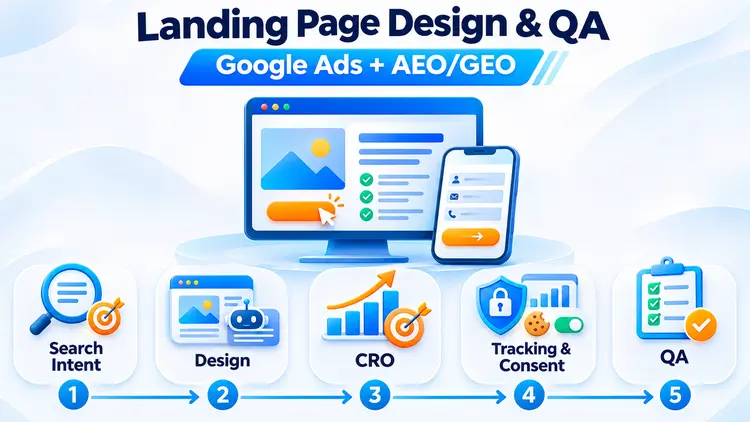
A successful landing page does more than repeat an advertising headline. It connects the visitor's search intent with a clear offer, trustworthy evidence, a simple conversion path and dependable measurement. When the same page is also intended to support Answer Engine Optimization (AEO) and Generative Engine Optimization (GEO), its information must be easy for both people and search systems to understand.
This guide outlines a practical workflow for planning, building, testing and accepting landing pages for Google Ads campaigns. It covers intent mapping, messaging, technical SEO, conversion rate optimization (CRO), privacy-aware tracking and the first 72 hours after launch. AEO/GEO readiness can improve clarity and discoverability, but it does not guarantee inclusion or citation in AI-generated answers.
1. Define campaign goals and acceptance criteria
Start by identifying one primary business outcome for the landing page: a purchase, qualified inquiry, booked consultation, free trial or other meaningful action. Avoid treating every page interaction as an equally important conversion.
- Primary conversion: a completed action that directly supports the campaign objective, such as a confirmed order or accepted lead.
- Secondary actions: phone clicks, form starts, brochure downloads or engagement events that help diagnose user behavior.
- Quality criteria: lead validity, sales qualification, booking attendance or revenue, rather than form volume alone.
- Core KPIs: conversion rate, cost per acquisition (CPA), qualified lead rate and return on ad spend (ROAS), where applicable.
Agree on ownership and measurement definitions before development. For example, determine whether a lead counts when a form is submitted, when the CRM accepts it, or only after the sales team qualifies it.
2. Map search intent to the right landing page
Align keywords, ad groups, audiences and landing page templates. Not every visitor needs the same content or call to action.
| Search intent | Visitor's question | Recommended page elements |
|---|---|---|
| Transactional | Can I buy or book now? | Specific offer, price or terms, primary CTA, short purchase or inquiry flow. |
| Commercial investigation | Why choose this solution? | Comparisons, use cases, genuine testimonials, service details and supporting proof. |
| Informational | How does it work? | Direct answer, explanation, relevant FAQs and a contextual next step. |
Prefer stable, descriptive URLs such as /en/google-ads-landing-page/. Where testing or advertising parameters create duplicate URLs, review canonicalization and indexing rules carefully. A canonical tag is a search indexing signal, not a mechanism that preserves ad attribution. Measure attribution through reliable click identifiers and approved analytics configuration.
3. Keep ads and landing page messaging consistent
Visitors should immediately recognize the promise they clicked. Match the offer, audience, location, pricing conditions and expected next action across the advertisement and destination.
- Use a specific headline that closely reflects the relevant ad message without forcing identical wording.
- Explain the main benefit and qualification conditions near the top of the page.
- Make the primary CTA visible and unambiguous, especially on mobile.
- Show credible proof: real customer feedback with permission, demonstrable results or clear service policies.
- Remove conflicting promotions, misleading urgency and distractions that interrupt conversion.
For example, an ad promising a website audit should lead to a page describing the audit scope and request process—not a generic page advertising every digital marketing service.
4. Structure content for users, AEO and GEO
AEO-oriented content answers relevant questions clearly, while GEO practices emphasize useful context, consistent entities and verifiable claims that may be referenced by AI-driven discovery experiences. Neither approach replaces standard SEO or guarantees visibility in AI interfaces.
Place a concise answer near the top
Include a short, natural-language explanation of what the offer is, who it is for and what happens next. Add details, limitations and evidence immediately afterward. A rigid word count is unnecessary; prioritize accuracy and usefulness.
Make important claims verifiable
- Explain the process, deliverables, conditions and relevant costs where possible.
- Attribute case-study results to a verifiable project and time period; avoid invented percentages or guarantees.
- Keep organization details and service descriptions consistent across the website.
- Use meaningful section headings, tables and FAQs when these genuinely help readers.
AI-generated answers may summarize information without generating a visit. Content structure may help interpretation, but a page should still provide reasons to visit, compare options and contact the business.
5. Meet technical SEO and structured data requirements
Mobile usability and page performance
- Check real mobile layouts, legible text, touch targets, form usability and sticky elements that might obscure content.
- Compress images appropriately, reserve image dimensions and load below-the-fold media efficiently.
- Measure Core Web Vitals and loading behavior using representative field data when available, alongside lab tests.
- Limit unnecessary third-party scripts and investigate slow server responses.
- Ensure important page content remains accessible and is not entirely dependent on fragile client-side rendering.
Select schema based on actual page content
Use relevant structured data, such as Organization, LocalBusiness, Product or other supported types only when the page meets the applicable requirements. JSON-LD must accurately reflect visible content; do not invent ratings, reviews or offers. Google generally limits FAQ rich results to qualifying authoritative government and health websites, so FAQPage markup should not be treated as a guaranteed search enhancement.
Validate applicable markup with Google's Rich Results Test and Schema Markup Validator, then check production pages after deployment. Valid markup does not guarantee rich results or AI citations.
6. Improve conversions through UX, forms and trust
Conversion rate optimization is a process of removing uncertainty and unnecessary effort, not simply adding more buttons.
- CTA: describe the next action precisely, such as “Request a website audit” or “Book a consultation.”
- Form: request only the information needed at the first stage; provide clear field labels and useful error messages.
- Mobile: use appropriate keyboard types and verify that forms work on narrow screens.
- Trust: show real business identity, contact methods, privacy information and policies relevant to the offer.
- Accessibility: ensure keyboard operation, readable contrast and descriptive text for controls.
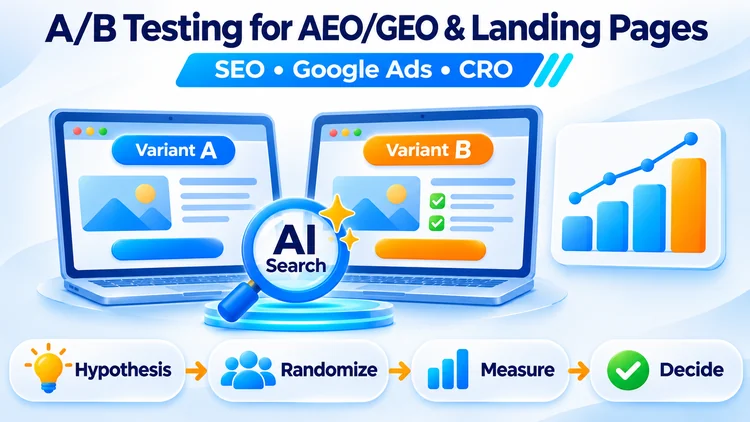
Test one meaningful hypothesis at a time. A change that increases low-quality submissions may be worse for the business even if the reported form conversion rate rises.
7. Design reliable, privacy-aware conversion measurement
Plan measurement before launching ads. Document which events represent a conversion, which platform receives them and how duplicates will be prevented.
| Event | Purpose | Validation |
|---|---|---|
page_view |
Measure visits and page context. | Confirm page path and campaign information where permitted. |
form_start |
Identify form engagement. | Ensure it fires only on genuine interaction. |
generate_lead |
Record accepted inquiry submission. | Compare successful submissions with CRM or backend records. |
purchase |
Measure completed orders when applicable. | Verify order ID, value, currency and deduplication. |
UTM parameters and advertising click identifiers
Adopt consistent campaign naming and use UTM parameters when useful for analytics. Where applicable, configure Google Ads auto-tagging and preserve authorized click identifiers through redirects and form journeys. UTMs can support source reporting, but they cannot fully replace Google Ads attribution or identify every visitor.
Server-side tagging and consent
Server-side tagging can improve control over event processing, routing and data quality, but it does not bypass consent requirements, browser restrictions or privacy law. Configure a suitable consent-management process and implement Google Consent Mode where relevant. Data collection and transmission must respect user choices and applicable policies.
For enhanced conversions, use approved first-party data collection and Google's supported implementation methods, including the required permissions and consent. Avoid storing unnecessary personal information in URLs, analytics events or logs.
Plan for incomplete attribution
If a user declines measurement consent or tracking is otherwise unavailable, do not secretly reconstruct their identity. Use permissible aggregate reports, CRM outcomes, consented campaign data and documented measurement limitations. Backend records may capture lawful lead-source information for business operations, but they should not be presented as complete attribution.
8. Assess AI search visibility without overstating attribution
When AI tools mention a business or summarize its content without a click, direct attribution may be unavailable. Review observable signals rather than claiming that every brand search or conversion was caused by an AI citation.
- Track branded and non-branded query trends in available search reporting.
- Review referral traffic from AI services where a referrer is provided.
- Document manually verified brand mentions or citations with dates and example queries.
- Compare inquiry quality and broader conversion trends while accounting for advertising, seasonality and other channels.
AI visibility monitoring provides directional context. It should not be conflated with the measured return on paid advertising.
9. Pre-launch landing page acceptance checklist
- Campaign fit: goal, audience, intent, ad claim and destination are aligned.
- Content: the offer, eligibility, pricing conditions, evidence and CTA are accurate.
- Responsive UX: page, navigation, CTA and form work on representative phones and desktops.
- Technical SEO: metadata, canonical URL, indexing policy, links and any applicable JSON-LD are reviewed.
- Form functionality: validation, success handling, spam controls and CSRF protections are tested.
- Measurement: events fire as intended, consent choices are respected, and duplicate conversions are prevented.
- Operations: hosting, HTTPS, page speed, error logging and backup or rollback steps are checked.
- Stakeholder sign-off: the campaign owner confirms an agreed test record before spending begins.
Use test submissions and, where appropriate, a low-risk pilot to verify the real journey from ad click to confirmed business outcome. Do not mistake a successful tag preview for proof that the CRM and ad-platform reporting are correct end to end.
10. Monitor the first 72 hours after launch
| Window | Priority checks | Possible actions |
|---|---|---|
| 0–24 hours | Page availability, mobile form completion, consent handling, event firing and unexpected errors. | Fix critical faults, incorrect redirects or missing submissions immediately. |
| 24–48 hours | Campaign delivery, search terms, lead validity, conversion duplication and source consistency. | Adjust obvious targeting mismatches and correct measurement issues. |
| 48–72 hours | Early conversion trends, device differences, landing page drop-offs and sales feedback. | Prioritize improvement hypotheses without overreacting to small samples. |
Seventy-two hours is an operational observation window, not a guarantee of enough data to judge campaign performance. Wait for sufficient volume and account for conversion delays before drawing strong conclusions about CPA or ROAS.
Frequently asked questions
Can one landing page support both Google Ads and AEO/GEO?
Yes. A page can combine a focused conversion journey with clear explanations, relevant evidence and accessible structured content. However, paid campaign targeting and organic or AI visibility have different measurement methods and cannot be treated as interchangeable.
Does structured data guarantee AI citations?
No. Structured data helps systems interpret eligible information, but it does not guarantee search enhancements, rankings or inclusion in AI-generated answers.
Does server-side tracking remove the need for consent?
No. Server-side implementation must still follow applicable privacy requirements, user choices and platform policies. It is a technical architecture, not an exemption from data-protection obligations.
When is a landing page ready for campaign launch?
When its content and offer are approved, the complete conversion path works, privacy and measurement controls pass testing, the page is usable on mobile, and the business owner has signed off on defined acceptance criteria.
Conclusion
An effective Google Ads landing page balances message match, intent, conversion experience, evidence and accountable measurement. AEO/GEO-friendly content adds clarity and structure, while technical validation and privacy-aware tracking reduce operational risks. Use a documented acceptance checklist and post-launch monitoring to improve the page based on observed behavior—not assumptions or unsupported AI-visibility claims.

Questions & Comments
You can ask a question about this article. Viet SEO will review and reply after moderation.