AI Content Governance SOP: Safety Policy for SEO, AEO & GEO
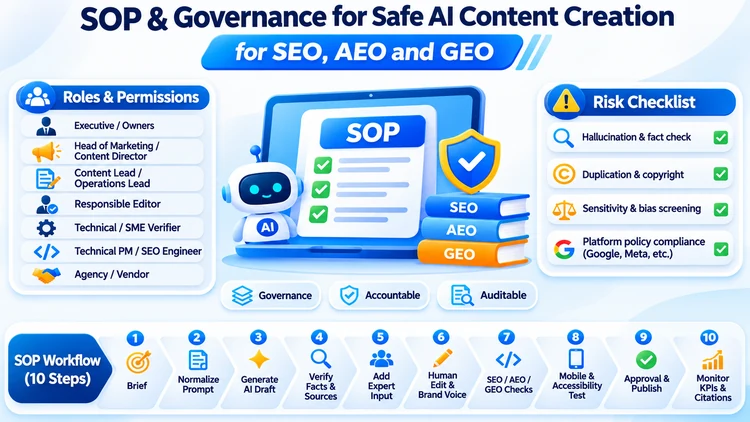
AI-assisted content governance is a documented process for planning, generating, checking, approving, publishing and maintaining content created with the help of artificial intelligence. For businesses and agencies working on SEO, Answer Engine Optimization (AEO) and Generative Engine Optimization (GEO), a clear standard operating procedure (SOP) helps prevent inaccurate claims, copyright problems, data exposure and inconsistent publishing decisions.
This guide provides a practical SOP that teams can adapt to their existing content management systems. It focuses on human accountability, verifiable evidence, proportionate risk controls and continuous improvement—not on producing large volumes of content simply because AI makes drafting faster.
What is an AI content SOP, and why does it matter?
An AI content SOP is a repeatable set of rules defining who may use AI, which materials may be supplied to a model, how generated information is checked, when expert review is required and what evidence must be retained before publication.
AI can help with research organization, outlines, language editing and draft production. However, generated text can contain fabricated facts, invented references, unsupported statistics or outdated instructions. Publishing without human review transfers those risks to the organization and its customers.
- For readers: the aim is useful, accurate and transparent information.
- For editors: responsibilities and approval criteria become explicit.
- For clients: decisions, revisions and evidence can be traced.
- For SEO: content quality, originality and technical consistency take priority over automated output volume.
1. Establish the principles of responsible AI content production
A workable policy should use the following principles as mandatory review criteria.
- Human accountability: a named person remains responsible for every published article.
- Evidence before publication: check claims against reliable, current primary sources whenever possible.
- Purpose and originality: add relevant experience, practical explanation, useful comparisons or original analysis rather than lightly rewriting generic material.
- Privacy by design: do not paste client secrets, personal data, credentials or unpublished commercial information into AI tools without authorization and appropriate safeguards.
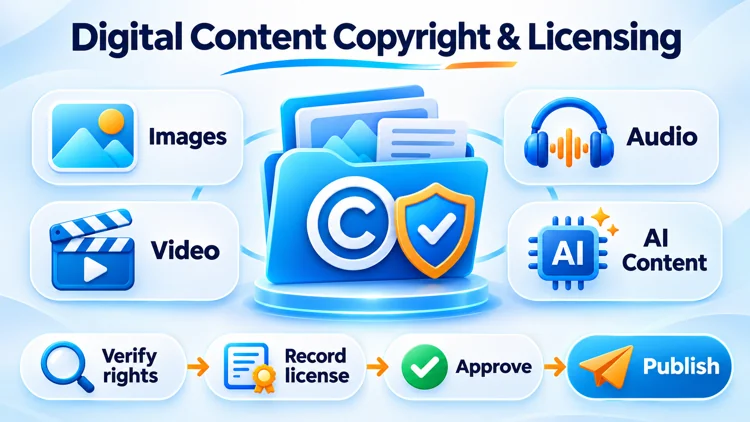
- Rights and permissions: verify the right to use text, images, customer testimonials, trademarks and other assets.
- Traceability: keep an editorial record of the author, reviewer, approval date, material sources and significant changes.
- Proportionate review: apply stricter checks to higher-risk topics and claims.
2. Define roles, permissions and approval responsibilities
One person may hold multiple roles on a small team, but the approval responsibility must remain clear. High-risk content should receive independent expert review where feasible.
| Role | Primary responsibility | Approval or record |
|---|---|---|
| Business owner / management | Approve policy, resources and risk tolerance. | Policy version and escalation authority. |
| Content or marketing lead | Assign topics, audiences, brand guidelines and publication priorities. | Brief and editorial assignment. |
| Writer / AI operator | Prepare draft, document supplied sources and flag uncertain output. | Draft version and source list. |
| Responsible editor | Improve clarity, check claims, copyright and suitability for readers. | Editorial review and final recommendation. |
| Subject-matter expert (SME) | Validate technical, legal, medical, financial or specialist claims when relevant. | Expert sign-off for high-risk claims. |
| Technical SEO / developer | Check metadata, links, indexability, structured data and mobile usability. | Technical QA result. |
| Publisher / account manager | Confirm authorization and publish the approved version. | Publication log and URL. |
Recommended control: a draft should not move to “Ready to publish” merely because an AI model or automated SEO score reports that it is complete. A person must make the final approval decision.
3. Classify content risk before drafting
Not every article requires the same review effort. Define risk at the brief stage, then reclassify if sensitive claims appear during editing.
| Risk level | Typical examples | Required review |
|---|---|---|
| Low | General explainers, non-sensitive product descriptions and basic tutorials. | Editorial fact-check and standard SEO QA. |
| Medium | Product comparisons, pricing claims, case studies, policies and technical instructions. | Source verification plus relevant business or technical review. |
| High | Medical, legal, financial, safety-critical advice; personal data; regulated advertising; major public allegations. | Qualified SME review, management authorization and documented evidence; do not publish if unresolved. |
For example, an article explaining how a CMS stores blog categories may be low risk, while an article making claims about treatment outcomes or legal obligations calls for a different level of scrutiny.
4. A ten-step SOP for AI-assisted SEO, AEO and GEO content
Step 1: Create a complete content brief
Record the target audience, search intent, reader problem, content objective, planned language, key questions, required references, relevant service or product information, risk rating, deadline and approver. Identify what the article must not claim.
Step 2: Prepare safe instructions and inputs
Use approved source documents and clear requirements. Remove passwords, unpublished client data and unnecessary personally identifiable information before submission. Specify that uncertain claims should be marked for verification rather than presented as facts.
Step 3: Generate and label the working draft
Store the initial output as an internal draft, not a published article. Record the AI tool or model where required by team policy, the operator and the version date. A prompt log can be a concise summary instead of a verbatim copy when confidential information or retention rules make full storage inappropriate.
Step 4: Check facts, quotations and sources
Verify names, figures, product specifications, dates, links, quotations and statements about third-party policies. Open original sources rather than trusting fabricated or misquoted citations. Remove unverified claims if they cannot be supported.
Step 5: Add genuine expertise and practical value
Ask what the team knows from direct work: a tested procedure, common failure modes, a documented example, decision criteria or an original checklist. Never invent case studies, customer feedback, screenshots or performance outcomes.
Step 6: Edit for humans and brand voice
Replace vague claims and repeated AI-style phrasing with clear explanations. Use appropriate terminology, define acronyms and remove unnecessary keyword repetition. Check that the article answers the intended question without overwhelming the reader.
Step 7: Complete SEO and AI-search readiness checks
- Use one clear page title and a logical H2/H3 structure; avoid inserting a second H1 when the CMS generates one.
- Write a descriptive SEO title and meta description; use natural internal links and meaningful image alt text.
- Check canonical URLs, redirects, language alternates where applicable, indexing permissions and page accessibility.
- Use structured data only where it accurately represents visible content and meets the relevant guidelines. Valid markup is not a guarantee of enhanced search appearance.
- For AEO/GEO, favor clear explanations, verifiable sources, unique expertise and accessible pages. There is no special markup or wording that guarantees citation by AI services.
Step 8: Test mobile rendering and accessibility
Check heading order, link labels, table readability, contrast, image dimensions and keyboard access. Test the production page, not just the editor preview. For bilingual articles, verify both versions independently instead of assuming an automated translation is accurate.
Step 9: Approve and publish
The responsible editor confirms the checklist and refers any high-risk material to the designated expert. Preserve the approved version, review date and source references. Publish only after human authorization, and verify the live URL and public-facing metadata.
Step 10: Monitor, update and improve
Track errors reported by readers, search performance, outdated references, broken links, conversions where relevant and the effectiveness of the article in helping its audience. AI-search visibility can be reviewed through available platform reports or carefully documented sampling, but citation counts should not be treated as a guaranteed or complete metric.
5. Transparency, disclosure and record retention
Disclosing substantial AI assistance can help readers understand how content was made, particularly when the production method would reasonably matter to them. An AI label is not a universal Google Search requirement for every AI-assisted article. Internal records, however, should distinguish AI-assisted drafts from manually approved publications.
- Minimum record: page URL or article ID, brief, owner, draft/version number, review date, approver and key evidence links.
- When appropriate: model/tool identity, relevant prompt summary, editorial change log and disclosure statement.
- Retention: choose a period based on contractual, security and legal requirements; do not impose an arbitrary universal retention period.
- Access control: limit who can read confidential prompts, client data and unpublished drafts.
6. Pre-publication risk checklist
- Are factual assertions backed by reliable sources, with dates checked where necessary?
- Have direct quotations, customer testimonials and figures been verified?
- Does the text add original value rather than repeat existing pages at scale?
- Have privacy, copyright, bias, misleading advertising and sector-specific risks been reviewed?
- Do visible content, metadata, images and structured data agree?
- Have English and Vietnamese versions been checked for meaning, terminology and URL consistency?
- Are the editor, expert reviewer where required, and final approver identified?
- Does the live page render correctly and meet basic technical SEO checks?
If any critical item is unresolved, keep the content in draft or pending review instead of publishing it.
7. Incident response: what to do when published AI content is wrong
- Assess severity: determine whether the issue involves a minor typo, misinformation, privacy exposure, copyright risk or unsafe advice.
- Contain the problem: promptly correct, temporarily unpublish or restrict the affected content according to severity. Preserve evidence securely.
- Notify responsible people: inform the content owner, relevant SME, management and client where appropriate.
- Investigate and correct: identify how the error passed review; verify the replacement information and document changes.
- Restore and monitor: republish only after sign-off. Update related pages or language versions if the same issue appears elsewhere.
- Prevent recurrence: improve sources, training, prompts, access controls or approval rules based on findings.
For significant issues, a visible correction notice may be more appropriate than silently replacing the text. Legal or contractual notification duties must be evaluated for each case.
8. Practical templates for teams and agencies
Content brief template
- Project / website / language:
- Topic, audience, primary intent and target questions:
- Required source material and factual claims to verify:
- Risk level, responsible editor and SME:
- Internal links, CTA and desired publication date:
Editorial approval log
- Article ID / URL and version:
- AI tool used (where applicable) and operator:
- Sources checked and corrections made:
- SEO / accessibility QA result:
- Reviewer, approver, approval date and final status:
Incident report
- Date, affected URL and severity:
- Problem description and source of report:
- Immediate action, accountable owner and affected versions:
- Corrective action, approval and follow-up review:
9. Applying the SOP in a bilingual CMS
For a CMS that stores Vietnamese and English versions together, maintain a distinct editorial status for each language. Approving one translation should not silently approve the other. A simple workflow is: Draft → Needs review → Approved for manual publishing → Published. If staff publish articles manually, the internal tool should record the handoff rather than claim it has published the page.
Before enabling a new page, verify its category, title, slug, SEO fields, visible article HTML, links, image alt text and language-specific canonical/hreflang relationships where relevant. Preserve trailing slashes consistently if this is the site's URL convention. Keep the initial publication disabled until checks are complete.
10. Frequently asked questions
Does Google prohibit AI-written content?
No. Google evaluates content against its quality and spam policies. Mass-producing pages without adding user value can breach scaled-content abuse policies, regardless of whether humans or AI produced them.
Must every AI-assisted article display an AI label?
Not universally. An appropriate explanation of AI involvement may be useful for transparency, depending on audience expectations, company policy, applicable rules and how the content was created.
Can structured data guarantee AI citations?
No. Structured data can help describe eligible page content, but it does not guarantee ranking, AI citations or search enhancements. Clear, original and accurate content remains essential.
Who should approve a high-risk article?
It should receive editorial approval plus review from a suitably qualified subject-matter expert, and management or compliance authorization if required by the organization's policy.
Is a plagiarism checker sufficient for copyright review?
No. Similarity checks cannot determine every licensing, attribution or infringement issue. Review source rights, quotations, images and permissions separately.
Conclusion: make AI assistance accountable
A practical AI content governance policy is not designed to slow every article down. It makes routine work more consistent while reserving deeper scrutiny for material that carries greater risk. The best outcome is an editorial process where AI supports research and drafting, people verify the claims, experts assess specialized information, and publication remains a deliberate, traceable decision.
Further reading: Google Search guidance on generative AI content; Creating helpful, people-first content; Google guidance for generative AI features.

Questions & Comments
You can ask a question about this article. Viet SEO will review and reply after moderation.