A/B Testing for AEO/GEO Content and Landing Pages: SEO & Ads
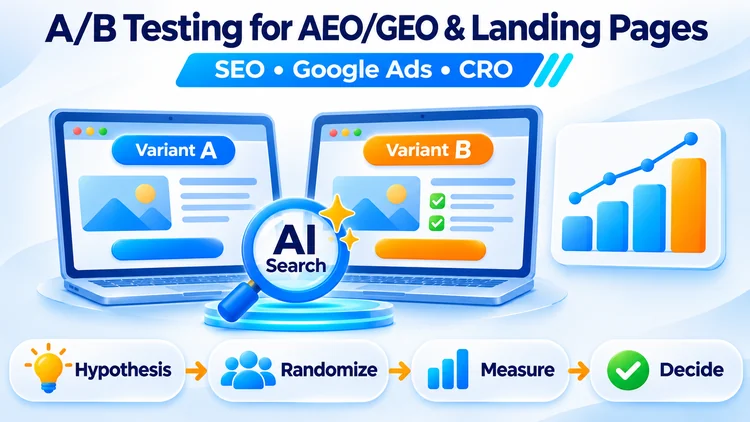
Can an A/B test improve both landing-page conversions and visibility in AI-powered search? It can help teams test content and user-experience hypotheses, but these outcomes need different experimental designs. Paid landing-page variants can be randomized by visitor; organic rankings and AI citations generally cannot be attributed to the same randomized visitor-level test. This guide explains how to measure each outcome without confusing correlation with causation.
Use the framework to coordinate SEO, AEO (Answer Engine Optimization), GEO (Generative Engine Optimization), CRO and Google Ads teams. The goal is a repeatable process with verifiable evidence, clear decision rules and minimal search-indexing risk.
1. What A/B testing can—and cannot—measure
A/B testing randomly assigns eligible visitors to a control experience (A) or a changed experience (B), then compares preselected outcomes such as completed leads or sales. Randomization helps isolate the effect of the change when assignment, tracking and exposure are implemented correctly.
- CRO and paid landing pages: random assignment can support causal conclusions about conversions for the tested audience.
- Organic SEO: search engines rank URLs and content over time; randomized visitor variants do not necessarily create separately measurable organic search outcomes. Consider a controlled page-group or SEO split test instead.
- AI visibility and citations: AI-generated answers may vary with platform, location, query and time. Repeatable prompt sampling and Search Console reports can establish trends, but not automatically prove that a specific page change caused them.
Do not call an increase in AI citations an experimentally proven uplift unless the comparison design credibly isolates the change from other factors.
2. Define a testable hypothesis and a primary KPI
Write the hypothesis before launching. Example: “Adding a concise evidence-backed answer section will improve qualified-lead conversion rate among paid visitors without increasing cost per qualified lead.” Treat AI visibility as a secondary observational measure, unless the experiment specifically uses a defensible page-level SEO design.
| Experiment | Primary outcome | Supporting / guardrail outcomes |
|---|---|---|
| Google Ads landing page | Qualified leads / eligible sessions | CPA, lead quality, tracking completeness, page speed |
| E-commerce landing page | Purchases / eligible sessions | Revenue per session, refund signals, cart abandonment |
| SEO content cohort | Organic clicks or impressions at page-group level | Rank distribution, query mix, indexed URLs, seasonality |
| AI search visibility monitoring | Predefined eligible AI impressions or observed citation frequency | Page coverage, prompt mix, platform and date variability |
Pick one primary metric per experiment. Secondary metrics can explain trade-offs but should not become a way to claim a win after the fact.
3. Choose meaningful content and UX variants
Content experiments worth testing
- Answer-first copy: lead with a direct, useful explanation versus a conventional promotional introduction.
- Evidence presentation: verified sources, specifications or case-study data in a readable comparison table versus paragraphs.
- CTA placement: one prominent CTA near the value proposition versus a CTA lower on the page.
- Form design: fewer required fields versus additional qualification fields; monitor both completion and lead quality.
- Trust elements: verifiable customer evidence, refund/return information or transparent service terms.
Avoid testing an arbitrary “AI-ready JSON-LD” block. Structured data must match visible content and a valid schema type. Google’s QAPage markup is not suitable for an ordinary editorial article or FAQ without user-submitted answers; adding markup does not guarantee AI citations.
4. Select the right design for each channel
Google Ads and CRO: visitor-level randomization
- Decide whether the test belongs in a Google Ads experiment or a landing-page testing platform. Keep campaign settings, eligibility and audiences comparable.
- Assign eligible users consistently to A or B, ideally using a persistent experiment ID so returning visitors do not switch versions.
- Use the same conversion definition and consent-aware measurement for both versions. Retain
experiment_idandvariant_idin analytics. - Document any differences in ad creative, bidding, device mix or landing-page load speed that could influence results.
Organic SEO: controlled page-group tests
For SEO, compare similar URL cohorts where one cohort receives a content change and the other remains unchanged, with a suitable baseline and time-series controls. This design is usually quasi-experimental rather than a clean visitor-level A/B test. Match pages on prior trends and intent, and account for algorithm updates, seasonality and changes in indexing.
When testing alternate URLs, Google recommends rel="canonical" pointing to the preferred original URL, temporary 302 redirects when a redirect is needed, and no cloaking. Do not serve deceptive bot-only content. End tests when sufficient evidence is available and remove unnecessary variants.
5. Build a consistent measurement plan
Define the population, event names, exclusions and attribution rules before the test. Recommended tracking fields include:
| Field / metric | Purpose | Caution |
|---|---|---|
experiment_id, variant_id |
Identify the tested experience | Do not infer a variant from URL alone when content is served dynamically |
session_start, form_start, generate_lead, purchase |
Measure funnel behavior | Validate actual completion, not only button clicks |
| UTM parameters and Google Ads click identifiers | Understand campaign acquisition | Respect privacy requirements and avoid changing attribution unintentionally |
| Qualified-lead status from CRM | Check downstream business value | Account for delayed qualification and incomplete data |
| Generative AI impressions in Search Console | Observe eligible Google AI feature visibility | Not a per-visitor experiment assignment or a cross-platform citation rate |
Test events in GA4 DebugView and reconcile conversions with your backend or CRM. Server-side tagging does not bypass consent, privacy requirements or data-quality limitations.
6. Measure AI visibility without overclaiming
As of August 31, 2026, Google Search Console’s Generative AI performance report has been rolled out worldwide. It reports impressions and dimensions such as pages, dates, countries and devices for supported Google AI features including AI Overviews and AI Mode. If the report is unavailable for a site, insufficient eligible impressions may be the reason.
Use that report for Google-specific visibility analysis. For other answer engines, maintain a separate, carefully sampled AI citation observation log rather than treating manual snapshots as complete platform analytics.
- Create a fixed and representative query set by intent, market and language.
- Record the platform, query, date/time, locale and account settings when known.
- Record whether the target domain or exact URL appears as a cited source, and save evidence when permitted.
- Keep sampling frequency and query composition consistent between comparison periods.
- Report observed citations as “citations in sampled responses / valid sampled responses,” with sample counts and methodology.
Important: a citation in a sampled answer is not equivalent to a Search Console AI impression, a referral visit or a conversion. Do not combine these into one KPI.
7. Sample size, duration and statistical interpretation
For randomized conversion tests, estimate the required sample size from the baseline conversion rate, minimum detectable effect, significance level and desired statistical power. Teams often plan around a two-sided 5% significance level and 80% power, but these are design choices, not guarantees.
- Agree on the stopping rule before launch; do not end a test merely because a dashboard temporarily shows a favorable result.
- Run long enough to cover relevant business cycles and collect the planned sample. “Two to four weeks” is not a universal minimum.
- Use suitable tests for rates (for example, two-proportion methods) and methods consistent with your randomization unit. Consider confidence intervals, absolute change and commercial impact—not only a p-value.
- For observational SEO and AI trends, explain the limitations of causal inference. A difference between two dates is not automatically an A/B test result.
If traffic is limited, consider prioritizing larger, clearer UX changes or reporting directional evidence without a claim of statistical significance.
8. Pre-launch QA checklist
- Confirm hypothesis, primary KPI, minimum detectable effect and decision rule.
- Check random assignment and persistence across sessions where applicable.
- Verify that A and B render correctly on desktop and mobile, including forms and CTAs.
- Validate event data, CRM matching, UTM parameters and consent handling.
- Check URL indexing rules, canonical tags, redirects and consistent treatment of crawlers.
- Confirm that claims, testimonials, sources and structured data match visible content.
- Log the start date, versions, deployment owner and rollback procedure.
- Keep AI query sampling plans and Search Console reporting separate from visitor-level experiment metrics.
9. Reporting, decisions and rollback
Build one report with distinct sections for randomized CRO outcomes, paid campaign performance, organic search trends and AI visibility observations. Include sample sizes, date ranges, traffic allocation, data exclusions, estimated effects and uncertainty.
Declare a winner only against the predefined primary metric and guardrails. A variant with more clicks but worse qualified leads may not be a business improvement. If a critical bug, misleading claim or meaningful conversion loss appears, pause the affected variant and document the reason; emergency safeguards can override the ordinary stopping rule.
10. Common mistakes to avoid
- Claiming AI citation uplift from a handful of manually repeated prompts.
- Comparing organic CTR of dynamically served variants as though Search Console identifies which version each searcher saw.
- Changing headline, form, pricing and CTA simultaneously and then assigning the effect to a single element.
- Assuming schema markup creates an AI ranking advantage or using
QAPageon a normal blog post. - Using different consent behavior or broken tracking for one variant.
- Reporting a Google Ads Quality Score change as proof of a specific page's conversion uplift; Quality Score is a diagnostic and can reflect other factors.
11. Frequently asked questions
Can I A/B test AI citations directly?
You can compare observed citation frequency over controlled query samples or test cohorts of pages, but you usually cannot randomize individual AI answers in the same way as website visitors. Describe such results as observational unless the research design supports a causal claim.
Does Search Console report visibility in Google AI search?
Yes. Its Generative AI performance report provides visibility data for supported AI features such as AI Overviews and AI Mode. The metrics and dimensions available should be checked in the live report; they are not a universal measure of citations across all AI providers.
Should I create separate URLs for every variation?
Not necessarily. Visitor-level tests can run at a shared URL. For alternate URLs, apply suitable canonical signals and temporary redirects in line with Google Search testing guidance, and avoid cloaking.
Will FAQ or QAPage schema improve AI citations?
No guarantee exists. Use relevant, valid structured data that reflects the visible page. Do not use QAPage for ordinary editorial FAQs without a community answer-submission format.
Conclusion
A credible A/B testing program for SEO, Google Ads and AEO/GEO begins by separating what can be randomized from what can only be observed. Use controlled visitor experiments for landing-page conversions, appropriate page-group analysis for organic SEO, and transparent visibility reporting for AI search. Clear hypotheses, verified tracking, predefined decision rules and honest limitations make the results actionable.
Further reading: Google Search Central: Website testing best practices; Search Console: Generative AI performance report; QAPage structured data guidelines.


Questions & Comments
You can ask a question about this article. Viet SEO will review and reply after moderation.