AI Citation Crisis Response: Correcting False Website Information
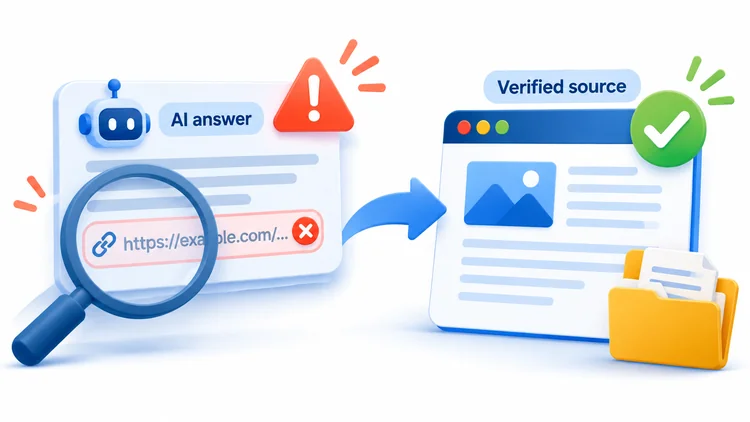
When an AI assistant presents an incorrect statement about your business and links to your website, the first priority is to establish what is wrong, where the claim originated and whether anyone is at risk. Respond with evidence, correct any inaccurate source material you control, and use the platform's available feedback channels. Updating a web page does not guarantee that an AI system will immediately change its answer.
What counts as an AI citation incident?
An AI citation incident occurs when a generative answer misquotes, misinterprets or falsely attributes information to your website. Examples include an incorrect price, product specification, safety statement, business address, warranty term or regulatory claim. A missing citation and a citation to the wrong page are different problems; record the distinction before taking action.
- Source error: the website itself contains outdated, ambiguous or incorrect information.
- Interpretation error: the source is accurate, but the AI answer draws the wrong conclusion.
- Attribution error: the AI links to a page that does not support the claim, or omits the relevant source.
- Third-party error: an external directory, social post or cached document contains conflicting information.
1. Assign roles and decision owners
| Role | Responsibility |
|---|---|
| Incident owner | Prioritize the case, coordinate teams and approve closure. |
| Content / subject expert | Verify the claim against authoritative documentation and revise published information where necessary. |
| SEO / AEO / GEO | Identify cited URLs, inspect discoverability and monitor a fixed query set. |
| Engineering | Preserve technical evidence, confirm deployed changes and check redirects, rendering and access. |
| Customer support / PR | Prepare consistent responses for affected customers and public channels. |
| Legal / compliance | Assess high-risk claims and approve any formal notices or escalation. |
For a small business, one person may hold several roles. What matters is having a named incident owner and a clear approval path.
2. Immediate response: capture, verify and triage
- Preserve the AI answer: save its exact wording, screenshot, date and time, platform, search query, language, country or region when known, and any conversation or shared link you are permitted to retain.
- Save the cited evidence: record each linked URL, the claimed passage, the actual content and an archived copy of the source as it appeared during the incident.
- Reproduce cautiously: repeat the query with the same conditions when possible, but do not mistake one unsuccessful reproduction for proof that the issue is gone.
- Check factual accuracy: ask the business or subject-matter owner to provide an authoritative correction.
- Assess severity: distinguish a minor wording issue from claims involving safety, payments, legal compliance or significant customer harm.
- Assign an owner and next review: set an internal service target based on severity; a fixed one-hour resolution promise is usually unrealistic.
Suggested severity levels
| Level | Example | Response |
|---|---|---|
| Low | Minor description or outdated non-critical detail | Document, correct where needed and monitor. |
| Medium | Wrong service terms, pricing or business contact details | Verify promptly, coordinate support and file platform feedback. |
| High | Safety, legal, privacy or financially harmful misinformation | Escalate to leadership and relevant specialists; assess urgent customer communication. |
3. Build an evidence packet
Use a standardized incident record rather than relying only on screenshots. Capture:
- Incident ID, owner, date, severity and current status.
- AI provider and product, prompt or search term, language and region where available.
- Exact inaccurate statement, cited URLs and screenshots or saved text.
- Authoritative correction with the source owner and supporting document.
- Live URL, archived page version, publication date and correction timestamp.
- Customer reports, support cases and measured business impacts, if verified.
- Feedback submission records, communications and follow-up observations.
Protect customer data: avoid attaching sensitive personal information to vendor feedback unless necessary, authorized and permitted by applicable rules.
4. Correct the authoritative source without damaging SEO
- Determine whether your page is actually wrong. If it is accurate, do not rewrite it solely to mirror the AI's incorrect assertion.
- Clarify ambiguous statements. Put the correct fact near the relevant product, policy or FAQ passage; include dates, units and qualifying conditions.
- Update related pages consistently. Check translations, PDFs, service pages, product feeds and internal links for contradictions.
- Validate technical delivery. Ensure the updated content renders correctly, returns the expected HTTP status and is not accidentally blocked by robots directives.
- Review structured data only if relevant. Structured data should accurately represent visible content and conform to Google guidelines; it does not force an AI system to quote the page correctly.
- Record the change. Keep before/after copies and identify who approved the correction.
Do not automatically remove a useful page, apply noindex or redirect it simply because an AI answer was wrong. These changes can harm ordinary search visibility and may not fix the AI response.
5. Report the issue through appropriate platform channels
Where the platform offers feedback or reporting, submit the incorrect answer, supporting citation, verified correction and a concise explanation of why the output is misleading. Report options differ by provider and may change.
- Google AI Overviews: use the feedback controls attached to the overview and describe the inaccurate claim and supporting evidence.
- ChatGPT: use applicable in-product feedback or content reporting options; choose the appropriate route for factual quality concerns versus safety or legal issues.
- Other AI services: consult the provider's current official help or reporting interface.
Useful official references: Google AI Overviews feedback, OpenAI content reporting guidance and Google structured data guidelines.
Important: submitting feedback, making a legal request or correcting a website does not guarantee prompt removal, a changed AI answer or a particular response time.
6. Communicate with customers and stakeholders
Publish a correction notice only when its reach and severity justify public communication. Otherwise, make sure support, sales and account teams can consistently explain the verified facts. Avoid repeating an unverified claim in promotional materials.
We identified an inaccurate AI-generated statement concerning [topic] on [date]. Our verified information is: [short factual correction]. The authoritative reference is [official URL]. We are reviewing the issue and have submitted feedback to the relevant platform where available. For assistance, contact [verified support channel].
Have legal or compliance staff review statements involving regulated products, allegations, medical claims or significant reputational harm.
7. Monitor corrections and define closure
- Use a fixed set of priority questions and document the platform, location, language and test date consistently.
- Track the share of sampled answers that reproduce the error and the share that cite the correct source; label these as sample-based measures rather than global platform rates.
- Review Google Search Console and analytics separately for search and referral trends; never infer that an individual AI citation caused a conversion without supporting evidence.
- Confirm that the original website issue has been corrected across relevant pages and languages.
- Keep an incident open or monitored if the high-risk false claim persists; close only according to documented internal criteria.
8. Simple incident log template
| Field | Example entry |
|---|---|
| Incident ID | AI-INC-2026-001 |
| Platform / query | [Provider] / [Exact question] |
| Severity | Medium |
| Incorrect claim | [Exact text] |
| Verified correction | [Correct fact + evidence] |
| Owned source URL | [URL ending in /] |
| Action / owner | [Fix, report, communicate] / [Name] |
| Retest / status | [Date + outcome] / Monitoring |
The example identifier is illustrative. Establish a retention policy based on organizational requirements and applicable privacy obligations.
9. Prevent recurring AI citation errors
- Keep high-value facts such as prices, opening hours, specifications and policies consistent across the main site, PDFs and third-party listings.
- Identify an owner for each important claim and define review dates.
- Use clear headings, concise explanations and cited primary sources where appropriate.
- Audit multilingual pages to avoid contradictory English and Vietnamese content.
- Maintain a small, repeatable AI answer monitoring set and review unexpected changes manually.
- Train support and content teams to preserve evidence before editing or responding publicly.
10. Frequently asked questions
Can a website owner force an AI platform to correct an answer?
Not through an ordinary website update or schema tag. You can improve your authoritative information and submit relevant feedback, but changes to AI-generated responses depend on the platform and its processes.
Should we noindex or delete the cited page?
Usually not as a first response. Investigate the underlying error and assess search visibility and business risks before applying removal or indexing controls.
Does structured data guarantee accurate AI citations?
No. Appropriate structured data can describe supported facts to search systems, but it does not guarantee rich results or correct AI-generated answers.
How often should the team retest?
Set a cadence according to severity and available resources. Use consistent test conditions, retain snapshots and distinguish observable changes from confirmed causes.
Conclusion: A reliable AI misinformation response process starts with verified facts and evidence, followed by proportionate source corrections, platform feedback, customer communications and disciplined monitoring. The objective is to reduce harm and improve information quality—not to promise control over an external AI system.



Questions & Comments
You can ask a question about this article. Viet SEO will review and reply after moderation.