Designing Open APIs and Open Data for AEO/GEO: A Practical Guide
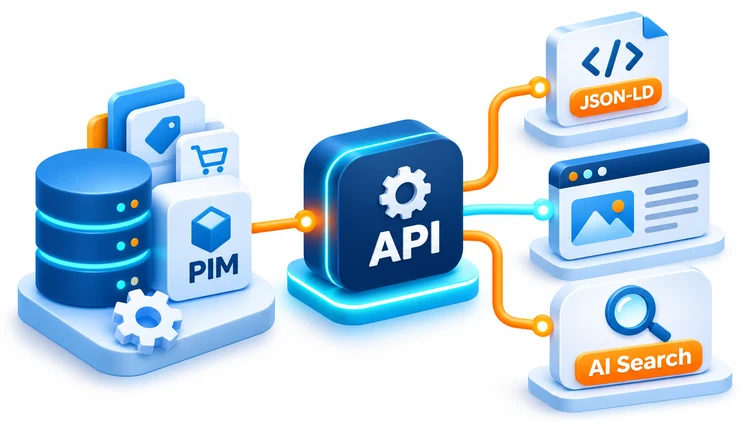
Open APIs and open data can help businesses distribute reliable, up-to-date information to websites, partners and approved applications. They can also support a broader SEO, AEO (Answer Engine Optimization) and GEO (Generative Engine Optimization) strategy by keeping public information accurate and consistent. However, publishing an API does not mean that Google, ChatGPT or another AI system will automatically discover, call or cite it.
This guide explains when to publish a REST API, when to provide a downloadable data feed, how to use JSON-LD on public web pages, and how to manage access, security, versioning and operational quality.
1. What open APIs and open data actually do
An API lets authorized software request structured information from a defined endpoint. Open data refers to datasets published for reuse under clearly stated terms. A data feed is usually a downloadable file or regularly updated export. JSON-LD is a structured-data format often embedded in HTML to describe the page's visible content.
These components solve different problems. An API makes system-to-system integration easier; a feed supports bulk synchronization; and public, crawlable HTML pages remain an important entry point for search engines and AI search experiences.
| Publishing method | Best suited to | Key limitation |
|---|---|---|
| Public website pages | People, search engines and accessible citations | Content must stay current and crawlable |
| REST API | Partner applications and dynamic queries | AI search providers may not call the API |
| JSON or CSV feed | Catalog exports and bulk imports | Consumers must fetch and process updates |
| JSON-LD on HTML | Machine-readable page descriptions | Does not guarantee rich results or AI citations |
2. Choosing an API, data feed or hybrid approach
- Choose an API when partners need filtering, pagination, frequent updates or product-level queries, such as stock availability and compatible product variants.
- Choose a feed when consumers need a complete catalog, price list, specification archive or daily snapshot.
- Choose a hybrid design when real-time attributes are served through an API while less volatile information is exported as a scheduled feed.
- Maintain public landing pages for products, company policies and FAQs. These pages should be readable without calling private APIs or requiring a login.
Practical example: an e-commerce business might keep product identity and descriptions in a PIM, stock levels in an ERP, and publish canonical product pages on its website. The API exposes approved fields to authorized partners, while an export feeds selected marketplaces.
3. Define an authoritative data model and owners
Start by identifying the system of record for each field. PIM may own product descriptions, but inventory and final selling price may come from different services. A central API should resolve these responsibilities instead of creating a second, conflicting source of truth.
| Data group | Recommended fields | Ownership example |
|---|---|---|
| Product identity | id, sku, brand, name, category, canonical_url | PIM |
| Product content | description, attributes, image URLs, updated_at | PIM/content team |
| Commercial terms | price, currency, stock, valid_from, valid_until | ERP or commerce platform |
| Policies | title, body, effective_date, locale, version | Operations/legal |
| Provenance | source_url, reviewed_at, data_owner, revision | Editorial governance |
Use stable identifiers, ISO 8601 timestamps, explicit currencies and supported language tags such as vi and en. Do not fabricate identifiers such as GTINs. Keep a separate internal audit log for each content change.
4. Design practical REST API endpoints
The following paths are illustrative only. Adapt them to your existing architecture rather than implementing them verbatim.
GET /api/v1/products/{id}
GET /api/v1/products?updated_since=2026-11-01T00%3A00%3A00Z&page=1
GET /api/v1/policies?locale=en
GET /data/catalog-en.json
GET /api/v1/health
Return standard HTTP status codes and consistent JSON errors. Add pagination for collections, validate query parameters, cap result sizes and document missing or restricted attributes. Prefer ISO timestamps over ambiguous date strings.
Example product response
{
  "id": "sample-123",
  "sku": "SKU-123",
  "name": "Example product",
  "description": "A factual, reviewed product description.",
  "currency": "USD",
  "price": "29.90",
  "availability": "in_stock",
  "canonical_url": "https://example.com/products/sample-123/",
  "locale": "en",
  "updated_at": "2026-11-01T08:00:00Z"
}
All details above are sample data. In production, validate displayed prices, availability and product claims against the responsible source system.
5. OpenAPI, JSON:API and JSON-LD: different purposes
- OpenAPI describes API operations, request parameters, schemas, security requirements and possible responses. Publish a maintained specification for developers.
- JSON:API is an optional convention for structuring REST responses. Ordinary JSON can also be suitable; do not adopt a new standard without an integration need.
- JSON-LD expresses linked structured data, including Schema.org terms. On web pages, mark up facts that are actually visible to visitors.
For example, a public product detail page may contain Product structured data with a matching name, description, URL and offer information when applicable. A machine-readable API response does not replace a public HTML page or automatically become eligible for Google rich results.
Example JSON-LD for a public product page
{
  "@context": "https://schema.org",
  "@type": "Product",
  "name": "Example product",
  "sku": "SKU-123",
  "description": "A factual, reviewed product description.",
  "url": "https://example.com/products/sample-123/",
  "offers": {
    "@type": "Offer",
    "price": "29.90",
    "priceCurrency": "USD",
    "availability": "https://schema.org/InStock"
  }
}
Validate syntax and eligibility with Google's tools, then check that the markup accurately reflects the rendered page. Do not add unsupported review ratings or other claims.
6. Security, privacy and access control
- Separate public information from private customer records, supplier contracts and internal pricing.
- Use TLS, input validation, allowlisted fields, sensible CORS settings and appropriate access logging.
- Use API keys or OAuth 2.0 client credentials for authenticated partners when appropriate. Never expose credentials in client-side source or public documentation.
- Apply rate limits and quotas according to consumer type and infrastructure capacity. Return
429 Too Many Requestswith clear retry guidance when limits apply. - Review personal-data protection obligations and third-party licensing before publication. Public access does not mean unrestricted reuse.
Where a sensitive attribute is unnecessary for the public use case, exclude it instead of exposing it behind a weak or undocumented filter.
7. Versioning, caching and data freshness
Use a documented versioning policy for breaking changes. A path such as /api/v1/ can be useful, while individual content updates should not require a new endpoint version.
- Cache-Control: select a cache lifetime according to how quickly each value changes.
- ETag / If-None-Match: support conditional requests to avoid unnecessary downloads.
- Last-Modified: expose a reliable resource modification time when available.
- Changelog: document removed fields, new fields, deprecation dates and migration steps.
- Consistency: compare feed exports, API responses and the public website on a schedule.
A dynamic stock level may need a short cache period, whereas a policy document may be cached longer with appropriate invalidation after review.
8. Website crawlability and AI discovery
For Google Search and its AI features, prioritize technical SEO fundamentals: indexable HTML pages, useful content, discoverable internal links, accurate canonical URLs and structured data that matches visible text. Google does not require a separate AI-specific file or special schema to appear in its AI features.
Different providers use different crawlers and access rules. For ChatGPT search, review the official guidance for OAI-SearchBot and your site's robots.txt, CDN and firewall configuration. Allowing a crawler to access a site does not guarantee that any specific URL or API endpoint will be cited.
When testing, use ordinary HTTP requests and your own logs; changing a User-Agent string alone does not authenticate a request as a genuine search crawler. Do not present a bot simulation as proof of indexing.
9. Measure outcomes without overstating attribution
- API quality: availability, error rate, p95 response time, freshness and consumer adoption.
- Website quality: indexed pages, clicks and impressions where provided by Search Console, plus relevant GA4 engagement and conversions.
- AI visibility: use supported search reporting and controlled answer snapshots, with platform, prompt, date and location context recorded.
- Data consistency: track mismatches between canonical pages, feeds, structured data and API payloads.
Do not add tracking redirects or synthetic UTM parameters to canonical URLs solely in hopes that an AI system will reuse them. AI citations may not contain a click, and API server logs alone cannot prove that a later AI answer used a particular response.
10. Deployment and operations checklist
- Identify data owners and approved public fields.
- Choose API, feed or hybrid delivery based on real consumer requirements.
- Publish an OpenAPI document and example responses when running an API.
- Validate authorization, data exposure, rate limiting and error responses.
- Test pagination, dates, currencies, language variants and change detection.
- Verify JSON-LD against public page content where structured data is used.
- Check robots.txt, canonical URLs, HTML rendering and relevant crawler access.
- Monitor uptime, latency, freshness, sync failures and unexpected changes.
- Prepare incident ownership, rollback procedures and a deprecation policy.
- Review business outcomes regularly without assuming direct AI-citation causality.
11. Frequently asked questions
Does publishing a public API make AI systems cite my business?
No. An API may help authorized applications consume reliable data, but AI platforms decide independently which sources and mechanisms to use. Crawlable public pages and trustworthy information remain important.
Is JSON-LD the same as an API?
No. JSON-LD is a format for linked structured data. An API is an interface through which software requests data or services. A system may provide both.
Should I make all product fields publicly available?
No. Publish only fields that are accurate, permitted, relevant to users and safe to share. Keep sensitive commercial and personal information restricted.
Can API logs accurately measure AI citations?
Not by themselves. A request log records access to the endpoint; it does not establish that the response was quoted in an AI answer. Use platform reporting or documented observation methods where available.
12. Final recommendations
Build authoritative data infrastructure to improve accuracy, interoperability and maintainability first. Then connect that infrastructure to strong public web pages and a practical SEO/AEO/GEO measurement plan. The most valuable outcome is a consistent and verifiable source of business information—not a promise of automatic AI citations.
Further reading: Google Search Central: AI features and your website; Google structured data guidelines; OpenAI crawler documentation.
Editorial note: Sample endpoints and records in this article are illustrative. Validate architecture, security, legal terms and field ownership before implementing them in production.

Questions & Comments
You can ask a question about this article. Viet SEO will review and reply after moderation.